{"ajaxurl":"https:\/\/models118.co.uk\/wp-admin\/admin-ajax.php?lang=en_GB","nonce":"8688bd9d48","homeUrl":"https:\/\/models118.co.uk\/","shopUrl":"https:\/\/models118.co.uk\/shop\/","cartUrl":"https:\/\/models118.co.uk\/cart-en-gb\/","checkoutUrl":"https:\/\/models118.co.uk\/checkout\/","skipCart":true,"collectionLimit":12,"i18n":{"addedToCart":"Added to basket","addToWishlist":"Add to wishlist","addedToWishlist":"Added to wishlist","removeFromWishlist":"Remove from wishlist","removedFromWishlist":"Removed from wishlist","undo":"Undo","error":"Something went wrong","loading":"Loading...","outOfStock":"Out of stock","viewCart":"View basket","proceedToCheckout":"Proceed to checkout","addedToCollection":"Added to your collection","reserved":"Added to your collection","soldOut":"Sold out","invalidEmail":"Please enter a valid email address","connectionError":"Connection error. Please try again.","tocToggle":"On this page","close":"Close","inCartTooltip":"Already in your basket \u2013 open your basket to check out","loginToSave":"Sign in to save this model","waitlistNotify":"Notify me","waitlistOnList":"On the waiting list \u2713","waitlistJoined":"You're on the waiting list. We'll email you the moment this model is available again.","waitlistRemoved":"Done \u2014 you're off the waiting list for this model.","waitlistRateLimit":"Too many attempts \u2014 please try again shortly","waitlistTurnstile":"We couldn't complete the check \u2014 please try again","waitlistError":"Sorry, something went wrong. Please try again in a moment."},"wishlist":{"loggedIn":false,"loginUrl":"https:\/\/models118.co.uk\/my-account\/","addAction":"models118_wishlist_add","removeAction":"models118_wishlist_remove"},"waitlist":{"loggedIn":false,"subscribeAction":"models118_waitlist_subscribe","toggleAction":"models118_waitlist_toggle","stateAction":"models118_waitlist_state"},"stats":{"models":2418,"brands":213,"manufacturers":128,"collectors":10000},"product":{"id":1659307,"sku":"AM59553G","condition":"used","availability":"in_stock","name":"Panasonic Toyota Racing TF106 #12 R. Schumacher Presentation 2006 Minichamps 1:18","brand":"Toyota","manufacturer":"Minichamps","scale":"1:18","material":"Diecast","price":89,"regularPrice":89,"isOnSale":false,"savingsAmount":0,"stockQty":1,"stockStatus":"very_low","isDiscontinued":false,"image":"https:\/\/models118.co.uk\/wp-content\/uploads\/2026\/08\/panasonic-toyota-racing-tf106-12-r-schumacher-presentation-2006-minichamps-1-18-am59553g-1-1-300x200.jpg","permalink":"https:\/\/models118.co.uk\/panasonic-toyota-racing-tf106-12-r-schumacher-presentation-2006-minichamps-1-18-am59553g\/"}}
Cookies on Models118
We use cookies to remember your preferences, understand how the shop is used and show you models and offers that suit your interests. What you allow is up to you, and you can change it at any time.
Always active
The technical storage or access is strictly necessary for the legitimate purpose of enabling the use of a specific service explicitly requested by the subscriber or user, or for the sole purpose of carrying out the transmission of a communication over an electronic communications network.
The technical storage or access is necessary for the legitimate purpose of storing preferences that are not requested by the subscriber or user.
The technical storage or access that is used exclusively for statistical purposes.
The technical storage or access is required to create user profiles to send advertising, or to track the user on a website or across several websites for similar marketing purposes.
Panasonic Toyota Racing TF106 #12 R. Schumacher Presentation 2006 Minichamps 1:18
1/6
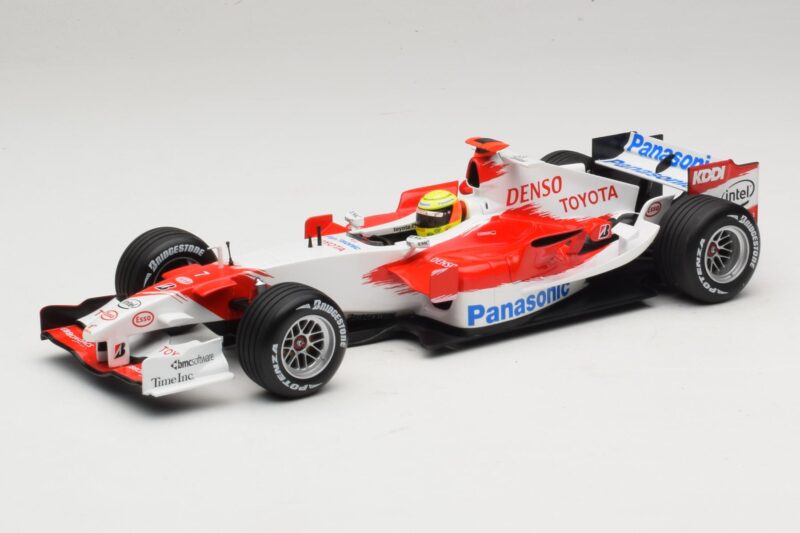
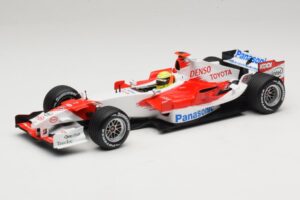
Minichamps' 1:18 diecast Toyota TF106 reproduces the presentation-liveried version of Ralf Schumacher's 2006 #12 entry for Panasonic Toyota Racing. Presentation cars carry a team's launch-event livery rather than a full race-weekend sponsor scheme, and Minichamps captures that distinction in a sealed, one-piece body built for display precision. Toyota's Cologne-based works team ran the TF106 across the 2006 season, and this piece marks the car's public unveiling rather than its grand prix outings.
1 / 6
[{"index":0,"id":"1659556","thumb":"https:\/\/models118.co.uk\/wp-content\/uploads\/2026\/08\/panasonic-toyota-racing-tf106-12-r-schumacher-presentation-2006-minichamps-1-18-am59553g-1-1-300x200.jpg","medium":"https:\/\/models118.co.uk\/wp-content\/uploads\/2026\/08\/panasonic-toyota-racing-tf106-12-r-schumacher-presentation-2006-minichamps-1-18-am59553g-1-1-800x533.jpg","full":"https:\/\/models118.co.uk\/wp-content\/uploads\/2026\/08\/panasonic-toyota-racing-tf106-12-r-schumacher-presentation-2006-minichamps-1-18-am59553g-1-1.jpg","srcset":"https:\/\/models118.co.uk\/wp-content\/uploads\/2026\/08\/panasonic-toyota-racing-tf106-12-r-schumacher-presentation-2006-minichamps-1-18-am59553g-1-1-800x533.jpg 800w, https:\/\/models118.co.uk\/wp-content\/uploads\/2026\/08\/panasonic-toyota-racing-tf106-12-r-schumacher-presentation-2006-minichamps-1-18-am59553g-1-1-300x200.jpg 300w, https:\/\/models118.co.uk\/wp-content\/uploads\/2026\/08\/panasonic-toyota-racing-tf106-12-r-schumacher-presentation-2006-minichamps-1-18-am59553g-1-1-64x43.jpg 64w, https:\/\/models118.co.uk\/wp-content\/uploads\/2026\/08\/panasonic-toyota-racing-tf106-12-r-schumacher-presentation-2006-minichamps-1-18-am59553g-1-1.jpg 1800w","sizes":"(max-width: 1023px) 400px, 640px","srcsetAvif":"https:\/\/models118.co.uk\/wp-content\/uploads\/2026\/08\/panasonic-toyota-racing-tf106-12-r-schumacher-presentation-2006-minichamps-1-18-am59553g-1-1-800x533.jpg.avif 800w, https:\/\/models118.co.uk\/wp-content\/uploads\/2026\/08\/panasonic-toyota-racing-tf106-12-r-schumacher-presentation-2006-minichamps-1-18-am59553g-1-1-300x200.jpg.avif 300w, https:\/\/models118.co.uk\/wp-content\/uploads\/2026\/08\/panasonic-toyota-racing-tf106-12-r-schumacher-presentation-2006-minichamps-1-18-am59553g-1-1-64x43.jpg.avif 64w, https:\/\/models118.co.uk\/wp-content\/uploads\/2026\/08\/panasonic-toyota-racing-tf106-12-r-schumacher-presentation-2006-minichamps-1-18-am59553g-1-1.jpg.avif 1800w","srcsetWebp":"https:\/\/models118.co.uk\/wp-content\/uploads\/2026\/08\/panasonic-toyota-racing-tf106-12-r-schumacher-presentation-2006-minichamps-1-18-am59553g-1-1-800x533.jpg.webp 800w, https:\/\/models118.co.uk\/wp-content\/uploads\/2026\/08\/panasonic-toyota-racing-tf106-12-r-schumacher-presentation-2006-minichamps-1-18-am59553g-1-1-300x200.jpg.webp 300w, https:\/\/models118.co.uk\/wp-content\/uploads\/2026\/08\/panasonic-toyota-racing-tf106-12-r-schumacher-presentation-2006-minichamps-1-18-am59553g-1-1-64x43.jpg.webp 64w, https:\/\/models118.co.uk\/wp-content\/uploads\/2026\/08\/panasonic-toyota-racing-tf106-12-r-schumacher-presentation-2006-minichamps-1-18-am59553g-1-1.jpg.webp 1800w","alt":"Panasonic Toyota Racing TF106 #12 R. Schumacher Presentation 2006 Minichamps 1:18 AM59553G Diecast"},{"index":1,"id":1659558,"thumb":"https:\/\/models118.co.uk\/wp-content\/uploads\/2026\/08\/panasonic-toyota-racing-tf106-12-r-schumacher-presentation-2006-minichamps-1-18-am59553g-1-300x200.jpg","medium":"https:\/\/models118.co.uk\/wp-content\/uploads\/2026\/08\/panasonic-toyota-racing-tf106-12-r-schumacher-presentation-2006-minichamps-1-18-am59553g-1-800x533.jpg","full":"https:\/\/models118.co.uk\/wp-content\/uploads\/2026\/08\/panasonic-toyota-racing-tf106-12-r-schumacher-presentation-2006-minichamps-1-18-am59553g-1.jpg","srcset":"https:\/\/models118.co.uk\/wp-content\/uploads\/2026\/08\/panasonic-toyota-racing-tf106-12-r-schumacher-presentation-2006-minichamps-1-18-am59553g-1-800x533.jpg 800w, https:\/\/models118.co.uk\/wp-content\/uploads\/2026\/08\/panasonic-toyota-racing-tf106-12-r-schumacher-presentation-2006-minichamps-1-18-am59553g-1-300x200.jpg 300w, https:\/\/models118.co.uk\/wp-content\/uploads\/2026\/08\/panasonic-toyota-racing-tf106-12-r-schumacher-presentation-2006-minichamps-1-18-am59553g-1-64x43.jpg 64w, https:\/\/models118.co.uk\/wp-content\/uploads\/2026\/08\/panasonic-toyota-racing-tf106-12-r-schumacher-presentation-2006-minichamps-1-18-am59553g-1.jpg 1800w","sizes":"(max-width: 1023px) 400px, 640px","srcsetAvif":"https:\/\/models118.co.uk\/wp-content\/uploads\/2026\/08\/panasonic-toyota-racing-tf106-12-r-schumacher-presentation-2006-minichamps-1-18-am59553g-1-800x533.jpg.avif 800w, https:\/\/models118.co.uk\/wp-content\/uploads\/2026\/08\/panasonic-toyota-racing-tf106-12-r-schumacher-presentation-2006-minichamps-1-18-am59553g-1-300x200.jpg.avif 300w, https:\/\/models118.co.uk\/wp-content\/uploads\/2026\/08\/panasonic-toyota-racing-tf106-12-r-schumacher-presentation-2006-minichamps-1-18-am59553g-1-64x43.jpg.avif 64w, https:\/\/models118.co.uk\/wp-content\/uploads\/2026\/08\/panasonic-toyota-racing-tf106-12-r-schumacher-presentation-2006-minichamps-1-18-am59553g-1.jpg.avif 1800w","srcsetWebp":"https:\/\/models118.co.uk\/wp-content\/uploads\/2026\/08\/panasonic-toyota-racing-tf106-12-r-schumacher-presentation-2006-minichamps-1-18-am59553g-1-800x533.jpg.webp 800w, https:\/\/models118.co.uk\/wp-content\/uploads\/2026\/08\/panasonic-toyota-racing-tf106-12-r-schumacher-presentation-2006-minichamps-1-18-am59553g-1-300x200.jpg.webp 300w, https:\/\/models118.co.uk\/wp-content\/uploads\/2026\/08\/panasonic-toyota-racing-tf106-12-r-schumacher-presentation-2006-minichamps-1-18-am59553g-1-64x43.jpg.webp 64w, https:\/\/models118.co.uk\/wp-content\/uploads\/2026\/08\/panasonic-toyota-racing-tf106-12-r-schumacher-presentation-2006-minichamps-1-18-am59553g-1.jpg.webp 1800w","alt":"Panasonic Toyota Racing TF106 #12 R. Schumacher Presentation 2006 Minichamps 1:18 AM59553G Diecast \u2014 photo 2 of 6"},{"index":2,"id":1659560,"thumb":"https:\/\/models118.co.uk\/wp-content\/uploads\/2026\/08\/panasonic-toyota-racing-tf106-12-r-schumacher-presentation-2006-minichamps-1-18-am59553g-2-300x200.jpg","medium":"https:\/\/models118.co.uk\/wp-content\/uploads\/2026\/08\/panasonic-toyota-racing-tf106-12-r-schumacher-presentation-2006-minichamps-1-18-am59553g-2-800x533.jpg","full":"https:\/\/models118.co.uk\/wp-content\/uploads\/2026\/08\/panasonic-toyota-racing-tf106-12-r-schumacher-presentation-2006-minichamps-1-18-am59553g-2.jpg","srcset":"https:\/\/models118.co.uk\/wp-content\/uploads\/2026\/08\/panasonic-toyota-racing-tf106-12-r-schumacher-presentation-2006-minichamps-1-18-am59553g-2-800x533.jpg 800w, https:\/\/models118.co.uk\/wp-content\/uploads\/2026\/08\/panasonic-toyota-racing-tf106-12-r-schumacher-presentation-2006-minichamps-1-18-am59553g-2-300x200.jpg 300w, https:\/\/models118.co.uk\/wp-content\/uploads\/2026\/08\/panasonic-toyota-racing-tf106-12-r-schumacher-presentation-2006-minichamps-1-18-am59553g-2-64x43.jpg 64w, https:\/\/models118.co.uk\/wp-content\/uploads\/2026\/08\/panasonic-toyota-racing-tf106-12-r-schumacher-presentation-2006-minichamps-1-18-am59553g-2.jpg 1800w","sizes":"(max-width: 1023px) 400px, 640px","srcsetAvif":"https:\/\/models118.co.uk\/wp-content\/uploads\/2026\/08\/panasonic-toyota-racing-tf106-12-r-schumacher-presentation-2006-minichamps-1-18-am59553g-2-800x533.jpg.avif 800w, https:\/\/models118.co.uk\/wp-content\/uploads\/2026\/08\/panasonic-toyota-racing-tf106-12-r-schumacher-presentation-2006-minichamps-1-18-am59553g-2-300x200.jpg.avif 300w, https:\/\/models118.co.uk\/wp-content\/uploads\/2026\/08\/panasonic-toyota-racing-tf106-12-r-schumacher-presentation-2006-minichamps-1-18-am59553g-2-64x43.jpg.avif 64w, https:\/\/models118.co.uk\/wp-content\/uploads\/2026\/08\/panasonic-toyota-racing-tf106-12-r-schumacher-presentation-2006-minichamps-1-18-am59553g-2.jpg.avif 1800w","srcsetWebp":"https:\/\/models118.co.uk\/wp-content\/uploads\/2026\/08\/panasonic-toyota-racing-tf106-12-r-schumacher-presentation-2006-minichamps-1-18-am59553g-2-800x533.jpg.webp 800w, https:\/\/models118.co.uk\/wp-content\/uploads\/2026\/08\/panasonic-toyota-racing-tf106-12-r-schumacher-presentation-2006-minichamps-1-18-am59553g-2-300x200.jpg.webp 300w, https:\/\/models118.co.uk\/wp-content\/uploads\/2026\/08\/panasonic-toyota-racing-tf106-12-r-schumacher-presentation-2006-minichamps-1-18-am59553g-2-64x43.jpg.webp 64w, https:\/\/models118.co.uk\/wp-content\/uploads\/2026\/08\/panasonic-toyota-racing-tf106-12-r-schumacher-presentation-2006-minichamps-1-18-am59553g-2.jpg.webp 1800w","alt":"Panasonic Toyota Racing TF106 #12 R. Schumacher Presentation 2006 Minichamps 1:18 AM59553G Diecast \u2014 photo 3 of 6"},{"index":3,"id":1659562,"thumb":"https:\/\/models118.co.uk\/wp-content\/uploads\/2026\/08\/panasonic-toyota-racing-tf106-12-r-schumacher-presentation-2006-minichamps-1-18-am59553g-3-300x200.jpg","medium":"https:\/\/models118.co.uk\/wp-content\/uploads\/2026\/08\/panasonic-toyota-racing-tf106-12-r-schumacher-presentation-2006-minichamps-1-18-am59553g-3-800x533.jpg","full":"https:\/\/models118.co.uk\/wp-content\/uploads\/2026\/08\/panasonic-toyota-racing-tf106-12-r-schumacher-presentation-2006-minichamps-1-18-am59553g-3.jpg","srcset":"https:\/\/models118.co.uk\/wp-content\/uploads\/2026\/08\/panasonic-toyota-racing-tf106-12-r-schumacher-presentation-2006-minichamps-1-18-am59553g-3-800x533.jpg 800w, https:\/\/models118.co.uk\/wp-content\/uploads\/2026\/08\/panasonic-toyota-racing-tf106-12-r-schumacher-presentation-2006-minichamps-1-18-am59553g-3-300x200.jpg 300w, https:\/\/models118.co.uk\/wp-content\/uploads\/2026\/08\/panasonic-toyota-racing-tf106-12-r-schumacher-presentation-2006-minichamps-1-18-am59553g-3-64x43.jpg 64w, https:\/\/models118.co.uk\/wp-content\/uploads\/2026\/08\/panasonic-toyota-racing-tf106-12-r-schumacher-presentation-2006-minichamps-1-18-am59553g-3.jpg 1800w","sizes":"(max-width: 1023px) 400px, 640px","srcsetAvif":"https:\/\/models118.co.uk\/wp-content\/uploads\/2026\/08\/panasonic-toyota-racing-tf106-12-r-schumacher-presentation-2006-minichamps-1-18-am59553g-3-800x533.jpg.avif 800w, https:\/\/models118.co.uk\/wp-content\/uploads\/2026\/08\/panasonic-toyota-racing-tf106-12-r-schumacher-presentation-2006-minichamps-1-18-am59553g-3-300x200.jpg.avif 300w, https:\/\/models118.co.uk\/wp-content\/uploads\/2026\/08\/panasonic-toyota-racing-tf106-12-r-schumacher-presentation-2006-minichamps-1-18-am59553g-3-64x43.jpg.avif 64w, https:\/\/models118.co.uk\/wp-content\/uploads\/2026\/08\/panasonic-toyota-racing-tf106-12-r-schumacher-presentation-2006-minichamps-1-18-am59553g-3.jpg.avif 1800w","srcsetWebp":"https:\/\/models118.co.uk\/wp-content\/uploads\/2026\/08\/panasonic-toyota-racing-tf106-12-r-schumacher-presentation-2006-minichamps-1-18-am59553g-3-800x533.jpg.webp 800w, https:\/\/models118.co.uk\/wp-content\/uploads\/2026\/08\/panasonic-toyota-racing-tf106-12-r-schumacher-presentation-2006-minichamps-1-18-am59553g-3-300x200.jpg.webp 300w, https:\/\/models118.co.uk\/wp-content\/uploads\/2026\/08\/panasonic-toyota-racing-tf106-12-r-schumacher-presentation-2006-minichamps-1-18-am59553g-3-64x43.jpg.webp 64w, https:\/\/models118.co.uk\/wp-content\/uploads\/2026\/08\/panasonic-toyota-racing-tf106-12-r-schumacher-presentation-2006-minichamps-1-18-am59553g-3.jpg.webp 1800w","alt":"Panasonic Toyota Racing TF106 #12 R. Schumacher Presentation 2006 Minichamps 1:18 AM59553G Diecast \u2014 photo 4 of 6"},{"index":4,"id":1659564,"thumb":"https:\/\/models118.co.uk\/wp-content\/uploads\/2026\/08\/panasonic-toyota-racing-tf106-12-r-schumacher-presentation-2006-minichamps-1-18-am59553g-4-300x200.jpg","medium":"https:\/\/models118.co.uk\/wp-content\/uploads\/2026\/08\/panasonic-toyota-racing-tf106-12-r-schumacher-presentation-2006-minichamps-1-18-am59553g-4-800x533.jpg","full":"https:\/\/models118.co.uk\/wp-content\/uploads\/2026\/08\/panasonic-toyota-racing-tf106-12-r-schumacher-presentation-2006-minichamps-1-18-am59553g-4.jpg","srcset":"https:\/\/models118.co.uk\/wp-content\/uploads\/2026\/08\/panasonic-toyota-racing-tf106-12-r-schumacher-presentation-2006-minichamps-1-18-am59553g-4-800x533.jpg 800w, https:\/\/models118.co.uk\/wp-content\/uploads\/2026\/08\/panasonic-toyota-racing-tf106-12-r-schumacher-presentation-2006-minichamps-1-18-am59553g-4-300x200.jpg 300w, https:\/\/models118.co.uk\/wp-content\/uploads\/2026\/08\/panasonic-toyota-racing-tf106-12-r-schumacher-presentation-2006-minichamps-1-18-am59553g-4-64x43.jpg 64w, https:\/\/models118.co.uk\/wp-content\/uploads\/2026\/08\/panasonic-toyota-racing-tf106-12-r-schumacher-presentation-2006-minichamps-1-18-am59553g-4.jpg 1800w","sizes":"(max-width: 1023px) 400px, 640px","srcsetAvif":"https:\/\/models118.co.uk\/wp-content\/uploads\/2026\/08\/panasonic-toyota-racing-tf106-12-r-schumacher-presentation-2006-minichamps-1-18-am59553g-4-800x533.jpg.avif 800w, https:\/\/models118.co.uk\/wp-content\/uploads\/2026\/08\/panasonic-toyota-racing-tf106-12-r-schumacher-presentation-2006-minichamps-1-18-am59553g-4-300x200.jpg.avif 300w, https:\/\/models118.co.uk\/wp-content\/uploads\/2026\/08\/panasonic-toyota-racing-tf106-12-r-schumacher-presentation-2006-minichamps-1-18-am59553g-4-64x43.jpg.avif 64w, https:\/\/models118.co.uk\/wp-content\/uploads\/2026\/08\/panasonic-toyota-racing-tf106-12-r-schumacher-presentation-2006-minichamps-1-18-am59553g-4.jpg.avif 1800w","srcsetWebp":"https:\/\/models118.co.uk\/wp-content\/uploads\/2026\/08\/panasonic-toyota-racing-tf106-12-r-schumacher-presentation-2006-minichamps-1-18-am59553g-4-800x533.jpg.webp 800w, https:\/\/models118.co.uk\/wp-content\/uploads\/2026\/08\/panasonic-toyota-racing-tf106-12-r-schumacher-presentation-2006-minichamps-1-18-am59553g-4-300x200.jpg.webp 300w, https:\/\/models118.co.uk\/wp-content\/uploads\/2026\/08\/panasonic-toyota-racing-tf106-12-r-schumacher-presentation-2006-minichamps-1-18-am59553g-4-64x43.jpg.webp 64w, https:\/\/models118.co.uk\/wp-content\/uploads\/2026\/08\/panasonic-toyota-racing-tf106-12-r-schumacher-presentation-2006-minichamps-1-18-am59553g-4.jpg.webp 1800w","alt":"Panasonic Toyota Racing TF106 #12 R. Schumacher Presentation 2006 Minichamps 1:18 AM59553G Diecast \u2014 photo 5 of 6"},{"index":5,"id":1659566,"thumb":"https:\/\/models118.co.uk\/wp-content\/uploads\/2026\/08\/panasonic-toyota-racing-tf106-12-r-schumacher-presentation-2006-minichamps-1-18-am59553g-5-300x200.jpg","medium":"https:\/\/models118.co.uk\/wp-content\/uploads\/2026\/08\/panasonic-toyota-racing-tf106-12-r-schumacher-presentation-2006-minichamps-1-18-am59553g-5-800x533.jpg","full":"https:\/\/models118.co.uk\/wp-content\/uploads\/2026\/08\/panasonic-toyota-racing-tf106-12-r-schumacher-presentation-2006-minichamps-1-18-am59553g-5.jpg","srcset":"https:\/\/models118.co.uk\/wp-content\/uploads\/2026\/08\/panasonic-toyota-racing-tf106-12-r-schumacher-presentation-2006-minichamps-1-18-am59553g-5-800x533.jpg 800w, https:\/\/models118.co.uk\/wp-content\/uploads\/2026\/08\/panasonic-toyota-racing-tf106-12-r-schumacher-presentation-2006-minichamps-1-18-am59553g-5-300x200.jpg 300w, https:\/\/models118.co.uk\/wp-content\/uploads\/2026\/08\/panasonic-toyota-racing-tf106-12-r-schumacher-presentation-2006-minichamps-1-18-am59553g-5-64x43.jpg 64w, https:\/\/models118.co.uk\/wp-content\/uploads\/2026\/08\/panasonic-toyota-racing-tf106-12-r-schumacher-presentation-2006-minichamps-1-18-am59553g-5.jpg 1800w","sizes":"(max-width: 1023px) 400px, 640px","srcsetAvif":"https:\/\/models118.co.uk\/wp-content\/uploads\/2026\/08\/panasonic-toyota-racing-tf106-12-r-schumacher-presentation-2006-minichamps-1-18-am59553g-5-800x533.jpg.avif 800w, https:\/\/models118.co.uk\/wp-content\/uploads\/2026\/08\/panasonic-toyota-racing-tf106-12-r-schumacher-presentation-2006-minichamps-1-18-am59553g-5-300x200.jpg.avif 300w, https:\/\/models118.co.uk\/wp-content\/uploads\/2026\/08\/panasonic-toyota-racing-tf106-12-r-schumacher-presentation-2006-minichamps-1-18-am59553g-5-64x43.jpg.avif 64w, https:\/\/models118.co.uk\/wp-content\/uploads\/2026\/08\/panasonic-toyota-racing-tf106-12-r-schumacher-presentation-2006-minichamps-1-18-am59553g-5.jpg.avif 1800w","srcsetWebp":"https:\/\/models118.co.uk\/wp-content\/uploads\/2026\/08\/panasonic-toyota-racing-tf106-12-r-schumacher-presentation-2006-minichamps-1-18-am59553g-5-800x533.jpg.webp 800w, https:\/\/models118.co.uk\/wp-content\/uploads\/2026\/08\/panasonic-toyota-racing-tf106-12-r-schumacher-presentation-2006-minichamps-1-18-am59553g-5-300x200.jpg.webp 300w, https:\/\/models118.co.uk\/wp-content\/uploads\/2026\/08\/panasonic-toyota-racing-tf106-12-r-schumacher-presentation-2006-minichamps-1-18-am59553g-5-64x43.jpg.webp 64w, https:\/\/models118.co.uk\/wp-content\/uploads\/2026\/08\/panasonic-toyota-racing-tf106-12-r-schumacher-presentation-2006-minichamps-1-18-am59553g-5.jpg.webp 1800w","alt":"Panasonic Toyota Racing TF106 #12 R. Schumacher Presentation 2006 Minichamps 1:18 AM59553G Diecast \u2014 photo 6 of 6"}]
Panasonic Toyota Racing TF106 #12 R. Schumacher Presentation 2006 Minichamps 1:18
About the Panasonic Toyota Racing TF106 #12 R. Schumacher Presentation 2006 Minichamps 1:18
TL;DR: Minichamps' 1:18 diecast Toyota TF106 reproduces the presentation-liveried version of Ralf Schumacher's 2006 #12 entry for Panasonic Toyota Racing. Presentation cars wear a team's launch-event scheme rather than a full race-weekend livery, and this sealed one-piece body captures that distinction with sharp decal registration rather than opening panels.
Formula 1 teams stage a public launch for each new chassis, and the livery worn that day often differs from what appears on the grid weeks later. Minichamps preserves that specific moment with this TF106, showing Ralf Schumacher's #12 car exactly as Panasonic Toyota Racing presented it, before race-specific sponsor decals and circuit-day changes were added ahead of the season.
What Makes a Presentation Car Different
Launch Livery vs Race-Weekend Sponsorship
A presentation car exists to introduce a new season's chassis to the press and sponsors before a wheel turns in anger, and teams often use the occasion to reveal a simplified or slightly earlier livery than the one that eventually races. Some sponsor logos arrive late in negotiations, others get repositioned once the aerodynamics department finalises the bodywork, so the launch scheme captured on presentation day can differ meaningfully from what a car wears three months into the season. Minichamps distinguishes this TF106 from its raced counterparts specifically because that difference is real and collectible in its own right, not a manufacturing shortcut.
Ralf Schumacher's #12 at the Unveiling
Schumacher had joined Toyota for the 2005 season after his time at Williams, and by 2006 he was established as the team's senior driver alongside Jarno Trulli. Car number 12 followed him through that TF106 campaign, and this presentation-spec model shows the livery as it appeared when Panasonic Toyota Racing unveiled the new chassis, a moment that matters to anyone tracking the visual evolution of a Formula 1 season from launch through to the final grand prix. Schumacher's move from Williams to Toyota was one of the bigger driver market stories heading into 2005, bringing a proven grand prix winner into a team still establishing itself as a genuine works effort rather than the newcomer it had been at its 2002 debut.
Toyota's Cologne Works Team and the TF106 Season
Toyota entered Formula 1 as a full works team in 2002, running its operation from a purpose-built factory in Cologne rather than the traditional British motorsport belt where most rivals were based. That German operational base gave the team a distinct identity on the grid, and by 2006 the TF106 represented the fourth generation of Toyota's own chassis design, developed alongside an engine programme the team built in-house rather than sourcing from an outside supplier. Panasonic's backing gave the cars their white, red and black colour scheme, a livery that stayed broadly consistent across Toyota's F1 seasons and became one of the more recognisable liveries on the mid-2000s grid even to viewers with only a passing interest in the sport. The team fielded Ralf Schumacher and Jarno Trulli as its driver pairing through the TF106 campaign, giving Toyota a lineup with genuine grand prix winning experience between them, even though neither had claimed a title before joining the Japanese manufacturer's works effort. That combination of deep manufacturer resources and experienced drivers made Toyota one of the more closely watched entries of the mid-2000s, with expectations running well ahead of what a genuinely young works programme could reasonably deliver against establishment teams with decades of grand prix history behind them.
Minichamps' Diecast Approach to the TF106 Launch Livery
Sealed-Body Precision for a Formula Subject
Minichamps builds this TF106 as a fixed, one-piece diecast body, which suits an open-cockpit single-seater particularly well since there is no bonnet, boot or door to omit from the construction. The zinc alloy build gives the model real heft in the hand, and without hinge tolerances to plan around, the aerodynamic surfaces, front wing, bargeboards and sculpted sidepods, all cast with consistent, tight lines rather than the seam gaps a moving panel would introduce nearby. That sealed construction also means the model tolerates handling at fairs and swapmeets without risking a loose hinge or a panel that no longer sits flush.
Decal Registration on a Simplified Scheme
Presentation liveries tend to carry fewer sponsor logos than a full race scheme, which sounds like it should make the decal work easier, but a simplified livery leaves less clutter to hide a misaligned logo behind. Minichamps holds the Panasonic branding and Toyota's corporate identity in precise registration across the nose and sidepods, and the cleaner layout of a launch-day scheme actually shows off that registration accuracy more clearly than a race livery crowded with a season's worth of accumulated sponsor deals would. That contrast is worth keeping in mind when comparing this piece against a raced #12 TF106 from the same season, since the two capture genuinely different stages of the livery's life.
A Launch-Livery Companion to the Race Car
This presentation TF106 works best as a companion piece rather than a standalone purchase, ideally sitting beside a raced #12 Schumacher car from the same season so the two together trace the livery's evolution from launch day to grand prix Sunday. At roughly 20 centimetres nose to rear wing in 1:18, the single-seater's low, wide stance photographs cleanly from above, where the sponsor decal work and cockpit sculpting read most clearly. For collectors assembling a Panasonic Toyota Racing shelf, or simply tracking the TF106 across its full season, this presentation-spec piece fills a gap that a raced-only collection would otherwise leave open, and it holds its own as a distinct chapter in the car's public life. Buyers hunting the raced counterpart should look for it as a separate purchase, since Minichamps typically issues launch and race liveries as distinct catalogue items rather than variations of one production run.
Create a free account and claim 10% off your first order — from hundreds of collectible 1:18, 1:43 and 1:12 models by Porsche, Mercedes-Benz, BMW and more.
{"id":1659307,"name":"Panasonic Toyota Racing TF106 #12 R. Schumacher Presentation 2006 Minichamps 1:18","price":"£<\/span>89.00<\/bdi><\/span>","image":"https:\/\/models118.co.uk\/wp-content\/uploads\/2026\/08\/panasonic-toyota-racing-tf106-12-r-schumacher-presentation-2006-minichamps-1-18-am59553g-1-1-400x400.jpg","permalink":"https:\/\/models118.co.uk\/panasonic-toyota-racing-tf106-12-r-schumacher-presentation-2006-minichamps-1-18-am59553g\/","brand":"Toyota"}