{"ajaxurl":"https:\/\/models118.co.uk\/wp-admin\/admin-ajax.php?lang=en_GB","nonce":"a127dcec31","homeUrl":"https:\/\/models118.co.uk\/","shopUrl":"https:\/\/models118.co.uk\/shop\/","cartUrl":"https:\/\/models118.co.uk\/cart-en-gb\/","checkoutUrl":"https:\/\/models118.co.uk\/checkout\/","skipCart":true,"collectionLimit":12,"i18n":{"addedToCart":"Added to basket","addToWishlist":"Add to wishlist","addedToWishlist":"Added to wishlist","removeFromWishlist":"Remove from wishlist","removedFromWishlist":"Removed from wishlist","undo":"Undo","error":"Something went wrong","loading":"Loading...","outOfStock":"Out of stock","viewCart":"View basket","proceedToCheckout":"Proceed to checkout","addedToCollection":"Added to your collection","reserved":"Added to your collection","soldOut":"Sold out","invalidEmail":"Please enter a valid email address","connectionError":"Connection error. Please try again.","tocToggle":"On this page","close":"Close","inCartTooltip":"Already in your basket \u2013 open your basket to check out","loginToSave":"Sign in to save this model","waitlistNotify":"Notify me","waitlistOnList":"On the waiting list \u2713","waitlistJoined":"You're on the waiting list. We'll email you the moment this model is available again.","waitlistRemoved":"Done \u2014 you're off the waiting list for this model.","waitlistRateLimit":"Too many attempts \u2014 please try again shortly","waitlistTurnstile":"We couldn't complete the check \u2014 please try again","waitlistError":"Sorry, something went wrong. Please try again in a moment."},"wishlist":{"loggedIn":false,"loginUrl":"https:\/\/models118.co.uk\/my-account\/","addAction":"models118_wishlist_add","removeAction":"models118_wishlist_remove"},"waitlist":{"loggedIn":false,"subscribeAction":"models118_waitlist_subscribe","toggleAction":"models118_waitlist_toggle","stateAction":"models118_waitlist_state"},"stats":{"models":2484,"brands":216,"manufacturers":130,"collectors":10000},"product":{"id":1713640,"metaRid":"1713526","sku":"MCG181011","condition":"new","availability":"in_stock","name":"Opel Kadett C2 Light Blue MCG 1:18","brand":"Opel","manufacturer":"MCG","scale":"1:18","material":"Diecast","price":57,"regularPrice":57,"isOnSale":false,"savingsAmount":0,"stockQty":6,"stockStatus":"in_stock","isDiscontinued":false,"image":"https:\/\/models118.co.uk\/wp-content\/uploads\/2026\/11\/opel-kadett-c2-light-blue-mcg-1-18-mcg181011-1-1-300x200.jpg","permalink":"https:\/\/models118.co.uk\/opel-kadett-c2-light-blue-mcg-1-18-mcg181011\/"}}
Cookies on Models118
We use cookies to remember your preferences, understand how the shop is used and show you models and offers that suit your interests. What you allow is up to you, and you can change it at any time.
Always active
The technical storage or access is strictly necessary for the legitimate purpose of enabling the use of a specific service explicitly requested by the subscriber or user, or for the sole purpose of carrying out the transmission of a communication over an electronic communications network.
The technical storage or access is necessary for the legitimate purpose of storing preferences that are not requested by the subscriber or user.
The technical storage or access that is used exclusively for statistical purposes.
The technical storage or access is required to create user profiles to send advertising, or to track the user on a website or across several websites for similar marketing purposes.
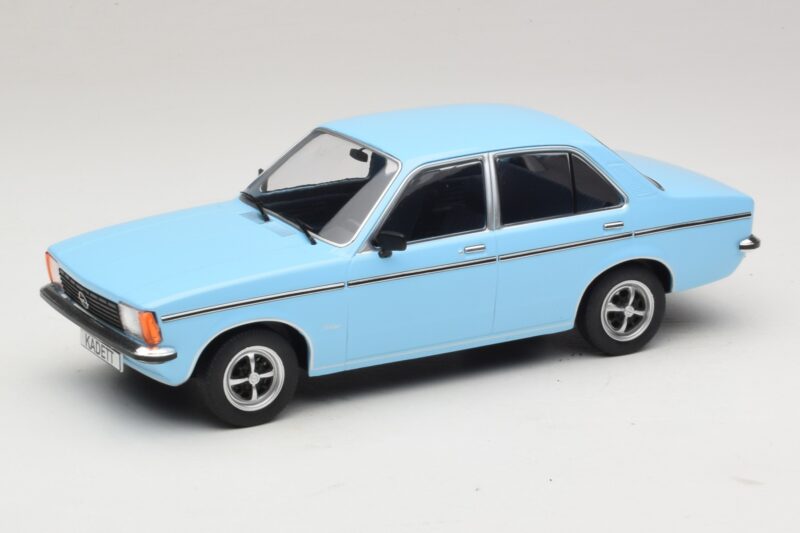
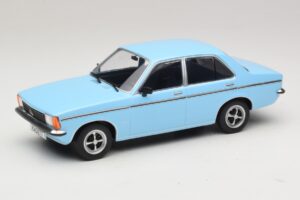
MCG's 1:18 diecast Opel Kadett C2 in Light Blue recreates the 1977 rear-wheel-drive saloon as a one-piece casting, so the whole story sits on the outside: stance, shut lines and paint depth. A tidy pick for retro city car shelves and 1970s German lineups, and a familiar shape to British eyes through its Vauxhall Chevette cousin.
TL;DR: The MCG Opel Kadett C2 1:18 is a Light Blue diecast replica of the 1977 rear-wheel-drive Opel saloon. The body is a one-piece casting with no opening panels, so shut lines, stance and paint carry the detail. It suits collectors building 1970s German or retro city car displays.
Plenty of collectors know the Kadett C through its British sibling, the Vauxhall Chevette, which shared the underpinnings. The Opel version is the original, and MCG gives it a small, honest 1:18 treatment. Light Blue suits the shape. Here is what the casting offers and where it sits on a shelf.
MCG Opel Kadett C2 1:18 in One-Piece Diecast
A Sealed Shell Judged on the Outside
Nothing on this casting opens, so the quality test moves to the exterior. Draw a thumbnail down a door cut and it follows one continuous groove, because a sealed shell has no hinge tolerances to widen it. Next, look at stance. The Kadett's upright proportions, short overhangs and flat-sided glasshouse make ride height and wheel-to-arch gap the first details to check against period photographs. Glazing should sit flush in its apertures, and trim should read as a distinct line rather than a blur. A sealed body is a construction choice, and on a small saloon with simple surfaces it keeps attention where the car's character actually lives: its proportions.
Zinc Alloy Weight and Light Blue Paint
Diecast means zinc alloy, and the mass is the first thing felt when the model leaves its foam tray: dense, cool and planted. A metal shell holds its dimensions over decades on a shelf and tolerates careful handling better than finer resin. Paint sits on a hard surface, so Light Blue reads even and glossy under a display lamp, though a pale colour shows dust and fingermarks sooner than a dark metallic. The trade-off is slightly wider casting tolerances than resin allows: edges are a touch softer and trim a little thicker than a hand-finished resin piece would manage. At 1:18, that is a fair exchange for durability.
A 1970s Saloon from the Opel and Vauxhall Family
From Kadett C to the C2 Update
Opel introduced the Kadett C in 1973 as the small rear-driven model in General Motors' T-car family, a platform shared across several brands, including Vauxhall in Britain, where it became the Chevette. The C2 label covers the later cars, the period this 1977 model belongs to. Production continued until the front-wheel-drive Kadett D took over at the end of the decade, which makes the C the last rear-drive Kadett. That layout is part of the car's period character, and it explains the upright, traditional proportions the model reproduces.
What an Everyday Saloon Adds to a Display
Cabinets tend to fill with coupes and competition cars. A family saloon tells another part of the decade's story: what actually filled the street. The simple, boxy body also suits diecast, since broad flat surfaces show paint depth plainly and clean shut lines read at a glance. A Vauxhall-themed shelf can treat this Opel as the continental counterpart to a Chevette, while anyone building a retro city car run gets a compact, characterful subject with no pretension. A well-cast everyday saloon can be the piece visitors ask about.
Placing the Kadett in a 1:18 Cabinet
At 1:18 a compact saloon takes up noticeably less shelf width than a long grand tourer, so the Kadett slots into a cabinet without crowding its neighbours. Give it a spot at eye level with a lamp angled from above and the paint depth shows without glare. Pale finishes collect dust visibly, so a glazed display case earns its keep. Natural partners are other 1970s road cars in the same scale: a coupe for contrast, a later small hatchback to show how the class changed. British collectors tend to value original packaging, so keep the box. For anyone assembling a retro city car run, this Light Blue Kadett is a durable entry that rewards a close look at its proportions rather than a long list of features.
Create a free account and claim 5% off your first order — from hundreds of collectible 1:18, 1:43 and 1:12 models by Porsche, Mercedes-Benz, BMW and more.
{"id":1713640,"name":"Opel Kadett C2 Light Blue MCG 1:18","price":"£<\/span>57.00<\/bdi><\/span>","image":"https:\/\/models118.co.uk\/wp-content\/uploads\/2026\/11\/opel-kadett-c2-light-blue-mcg-1-18-mcg181011-1-1-400x400.jpg","permalink":"https:\/\/models118.co.uk\/opel-kadett-c2-light-blue-mcg-1-18-mcg181011\/","brand":"Opel"}