{"ajaxurl":"https:\/\/models118.co.uk\/wp-admin\/admin-ajax.php?lang=en_GB","nonce":"1bbaa8ccd4","homeUrl":"https:\/\/models118.co.uk\/","shopUrl":"https:\/\/models118.co.uk\/shop\/","cartUrl":"https:\/\/models118.co.uk\/cart-en-gb\/","checkoutUrl":"https:\/\/models118.co.uk\/checkout\/","skipCart":true,"collectionLimit":12,"i18n":{"addedToCart":"Added to basket","addToWishlist":"Add to wishlist","addedToWishlist":"Added to wishlist","removeFromWishlist":"Remove from wishlist","removedFromWishlist":"Removed from wishlist","undo":"Undo","error":"Something went wrong","loading":"Loading...","outOfStock":"Out of stock","viewCart":"View basket","proceedToCheckout":"Proceed to checkout","addedToCollection":"Added to your collection","reserved":"Added to your collection","soldOut":"Sold out","invalidEmail":"Please enter a valid email address","connectionError":"Connection error. Please try again.","tocToggle":"On this page","close":"Close","inCartTooltip":"Already in your basket \u2013 open your basket to check out","loginToSave":"Sign in to save this model","waitlistNotify":"Notify me","waitlistOnList":"On the waiting list \u2713","waitlistJoined":"You're on the waiting list. We'll email you the moment this model is available again.","waitlistRemoved":"Done \u2014 you're off the waiting list for this model.","waitlistRateLimit":"Too many attempts \u2014 please try again shortly","waitlistTurnstile":"We couldn't complete the check \u2014 please try again","waitlistError":"Sorry, something went wrong. Please try again in a moment."},"wishlist":{"loggedIn":false,"loginUrl":"https:\/\/models118.co.uk\/my-account\/","addAction":"models118_wishlist_add","removeAction":"models118_wishlist_remove"},"waitlist":{"loggedIn":false,"subscribeAction":"models118_waitlist_subscribe","toggleAction":"models118_waitlist_toggle","stateAction":"models118_waitlist_state"},"stats":{"models":2712,"brands":215,"manufacturers":129,"collectors":10000},"product":{"id":1704023,"sku":"940131031","condition":"new","availability":"in_stock","name":"MG MGB Mk1 Green Maxichamps 1:43","brand":"MG","manufacturer":"Maxichamps","scale":"1:43","material":"Diecast","price":67,"regularPrice":67,"isOnSale":false,"savingsAmount":0,"stockQty":2,"stockStatus":"very_low","isDiscontinued":false,"image":"https:\/\/models118.co.uk\/wp-content\/uploads\/2026\/10\/mg-mgb-mk1-green-maxichamps-1-43-940131031-1-1-300x200.jpg","permalink":"https:\/\/models118.co.uk\/mg-mgb-mk1-green-maxichamps-1-43-940131031\/"}}
Cookies on Models118
We use cookies to remember your preferences, understand how the shop is used and show you models and offers that suit your interests. What you allow is up to you, and you can change it at any time.
Always active
The technical storage or access is strictly necessary for the legitimate purpose of enabling the use of a specific service explicitly requested by the subscriber or user, or for the sole purpose of carrying out the transmission of a communication over an electronic communications network.
The technical storage or access is necessary for the legitimate purpose of storing preferences that are not requested by the subscriber or user.
The technical storage or access that is used exclusively for statistical purposes.
The technical storage or access is required to create user profiles to send advertising, or to track the user on a website or across several websites for similar marketing purposes.
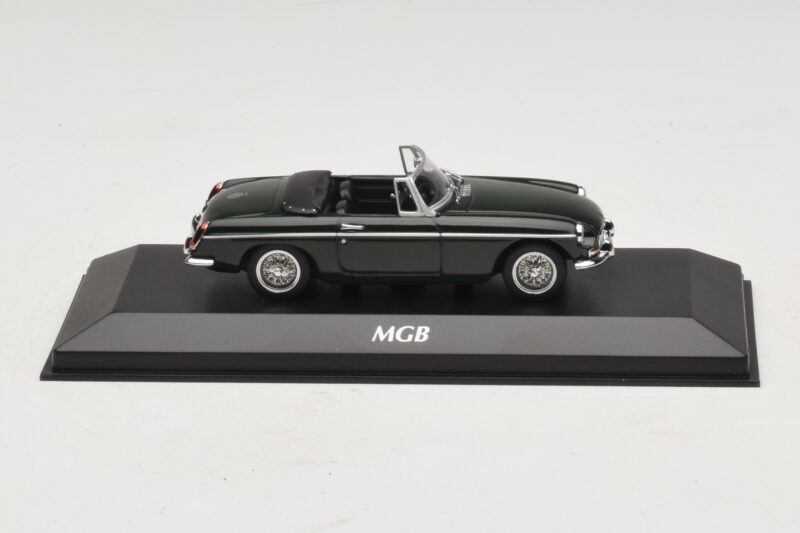
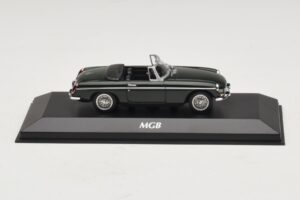
Maxichamps' 1:43 diecast MG MGB Mk1 in Green brings the 1962 Abingdon roadster to the shelf at roughly nine centimetres long. The body is a fixed one-piece casting, so the judging happens on the outside: the stance, the shut lines, the paint and the open cockpit. A natural companion for a run of 1960s British sports cars.
TL;DR: The Maxichamps MG MGB Mk1 1:43 is a diecast roadster in Green, modelled on the 1962 original from Abingdon. The body is a sealed one-piece casting with no opening parts, so its appeal sits in the stance, paintwork and open cockpit. At roughly nine centimetres long, it suits a compact shelf of 1960s British sports cars.
Few roadsters sit as comfortably in a British collector's head as the MGB. It was the everyday open-top sports car of its decade, and Maxichamps has cast the early Mk1 shape at 1:43, the scale that lets a whole garage of 1960s classics share one shelf.
Maxichamps MG MGB Mk1 1:43 in Green Diecast
A Sealed Body Judged from the Outside
Nothing on this model opens. The bonnet, doors and boot lid are cast into one diecast shell, and that single casting is what Maxichamps asks a buyer to judge. Lift it from its tray and the metal gives a settled, cool weight that lighter materials cannot imitate. Run a fingernail along the door line and it tracks one clean groove with no hinge play to accommodate. The Green paint sits on a hard metal body, so the gloss reads even under a display lamp instead of thin at the edges. As an open-top body, the cockpit is where the eye drops first, so the seat shapes and dashboard moulding deserve a close look.
Mk1 Details Worth Checking
Early MGBs wore chrome bumpers and a slim, upright grille, a look that later rubber-bumpered cars lost. Compare those against photographs of the real car: bumper thickness, grille bars and the profile of the windscreen frame show how faithfully a casting reads. Badge crispness is the next test. At 1:43 the badges are small enough that tampo printing, rather than separate parts, usually carries them, so look for clean edges and no smudging. Wheels matter more than their size suggests. Check that each wheel sits centred in its arch and that the tyre sidewall has a believable profile. These checks take a minute with a magnifier and tell you more than any catalogue blurb.
The Abingdon Roadster Behind the Model
What the 1962 Car Offered
MG launched the MGB in 1962 with a monocoque body, a step on from the separate-chassis MGA it replaced, and a 1.8 litre four-cylinder engine. It was built at Abingdon, and the Mk1 label covers the early cars until the Mk2 followed in 1967. That span matters to collectors because it defines the look this casting follows: the chrome-bumpered shape, before the later changes. The MGB's reputation is for being accessible rather than exotic, an honest two-seat sports car that ordinary owners drove, repaired and kept. That gives the model a particular charm on a British shelf.
Why 1:43 Suits a Small Roadster
At 1:43 the MGB comes out at around nine centimetres, so a dozen cars occupy the width of a single 1:18 model. That is the scale's real argument: breadth over bulk. The trade-off is what the scale can physically carry. Wipers, door handles and badges shrink to printed or very fine cast detail, and a collector should expect sensible simplification rather than separately fitted parts. Diecast handles that well, holding its shape and its paint over years on a shelf, which matters on a small open-top body with a thin windscreen surround. A sealed body is a normal choice at this size and price.
Placing the MGB Among British Sports Cars
A Green MGB fits naturally beside other 1960s British open-tops, and the 1:43 scale keeps the row tidy: matching footprints, matching eye lines, and no single car crowding the glass. Pair it with a coupe or a saloon from the same decade and the contrast shows how varied British motoring had become. Keep it out of direct sun, which fades interiors and dulls paint over the years, and use a soft brush for dust, because a small casting collects it quickly. British collectors tend to value the original box, so keep the packaging with the model. The limits are plain: no opening parts, and fine detail at a scale where fine detail is always a compromise. Within those limits, it is a well-judged piece to buy for a shelf of period roadsters.
Create a free account and claim 5% off your first order — from hundreds of collectible 1:18, 1:43 and 1:12 models by Porsche, Mercedes-Benz, BMW and more.