Last one
Used
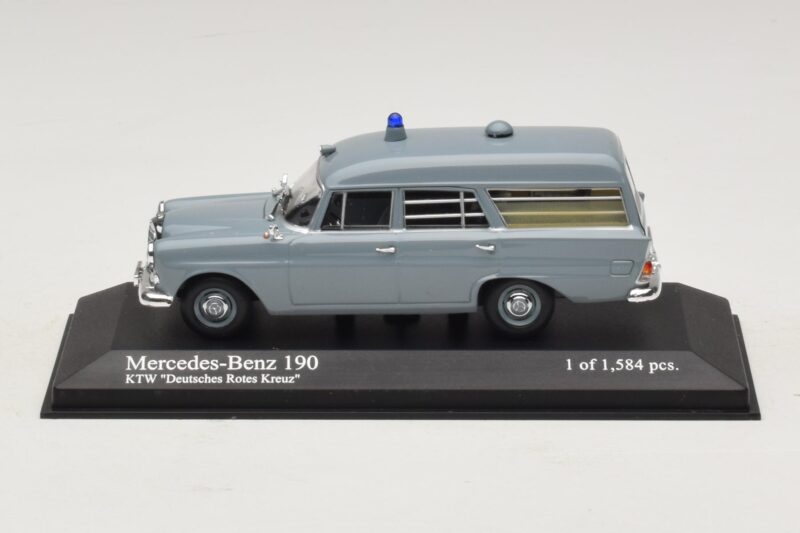
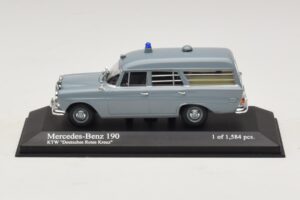
TL;DR: Minichamps' 1:43 Mercedes 190 W110 DRK ambulance reproduces a 1961 German Red Cross conversion of the tailfin-era "Heckflosse" saloon, finished in period livery with a sealed one-piece diecast body. A niche subject built for emergency-vehicle and specialist estate collectors rather than mainstream Mercedes saloon buyers.
Ambulance conversions rarely make it into scale model catalogues, which makes this Mercedes 190 W110 an unusual find for anyone building a themed emergency-vehicle display. Minichamps' 1:43 rendition carries the Deutsches Rotes Kreuz livery over the tailfin-era saloon's estate conversion, a genuinely specialist subject rather than a mainstream family car.
The Deutsches Rotes Kreuz livery relies on a clean white base carrying the organisation's red cross emblem and lettering along the flanks, and getting that combination right depends entirely on precise print registration since there is no busy sponsor graphic to distract from any misalignment. Minichamps applies the markings cleanly onto the sealed body, with the cross emblem holding its shape and the lettering staying legible under close inspection. Because the body carries no opening doors or tailgate, the exterior livery and the roof-mounted equipment detail have to do all the storytelling, and here they manage it convincingly for a subject with this little precedent in scale model form.
The conversion to ambulance specification meant a raised roofline over the rear compartment and, on the real vehicle, equipment mounted for stretcher access, details Minichamps references through the roof profile and cast-in surface detail rather than functional opening panels. At 1:43, capturing that raised-roof silhouette accurately is what separates a credible emergency-vehicle model from a saloon with a livery simply painted over it, and the proportions here read as a genuine period conversion rather than a standard saloon wearing borrowed markings.
The W110 belonged to Mercedes-Benz's "Heckflosse", or tailfin, generation of the late 1950s and early 1960s, a design era defined by modest rear fins that echoed American styling trends of the period without ever approaching their scale. The W110 sat at the smaller, four-cylinder end of that generation's saloon range, positioned below the larger six-cylinder Heckflosse models, which made it a common and relatively affordable base for commercial and service conversions across West Germany during the 1960s.
Coachbuilders regularly adapted the W110 platform for ambulance, hearse and other service roles throughout its production run, work carried out by specialist conversion firms rather than Mercedes-Benz itself, since the factory built the standard saloon and left specialist bodywork to established coachbuilding partners. The Deutsches Rotes Kreuz, Germany's Red Cross organisation, operated fleets of these converted saloons well into the following decade, making this a documented, practical piece of period service history rather than a speculative or invented livery.
This is not a model for a collector chasing mainstream Mercedes saloon history, and it should be positioned honestly as a niche pick for anyone building a dedicated emergency-vehicle, service-fleet or Red Cross-themed shelf. Its appeal lies specifically in that rarity: few manufacturers bother reproducing 1960s ambulance conversions at all, which makes a well-executed example like this one genuinely hard to replace once found. At 1:43, it sits comfortably alongside other period service vehicles from the same design era, building a display that tells a different story from the usual saloon-and-sports-car lineup.







Save £14.00