{"ajaxurl":"https:\/\/models118.co.uk\/wp-admin\/admin-ajax.php?lang=en_GB","nonce":"1bbaa8ccd4","homeUrl":"https:\/\/models118.co.uk\/","shopUrl":"https:\/\/models118.co.uk\/shop\/","cartUrl":"https:\/\/models118.co.uk\/cart-en-gb\/","checkoutUrl":"https:\/\/models118.co.uk\/checkout\/","skipCart":true,"collectionLimit":12,"i18n":{"addedToCart":"Added to basket","addToWishlist":"Add to wishlist","addedToWishlist":"Added to wishlist","removeFromWishlist":"Remove from wishlist","removedFromWishlist":"Removed from wishlist","undo":"Undo","error":"Something went wrong","loading":"Loading...","outOfStock":"Out of stock","viewCart":"View basket","proceedToCheckout":"Proceed to checkout","addedToCollection":"Added to your collection","reserved":"Added to your collection","soldOut":"Sold out","invalidEmail":"Please enter a valid email address","connectionError":"Connection error. Please try again.","tocToggle":"On this page","close":"Close","inCartTooltip":"Already in your basket \u2013 open your basket to check out","loginToSave":"Sign in to save this model","waitlistNotify":"Notify me","waitlistOnList":"On the waiting list \u2713","waitlistJoined":"You're on the waiting list. We'll email you the moment this model is available again.","waitlistRemoved":"Done \u2014 you're off the waiting list for this model.","waitlistRateLimit":"Too many attempts \u2014 please try again shortly","waitlistTurnstile":"We couldn't complete the check \u2014 please try again","waitlistError":"Sorry, something went wrong. Please try again in a moment."},"wishlist":{"loggedIn":false,"loginUrl":"https:\/\/models118.co.uk\/my-account\/","addAction":"models118_wishlist_add","removeAction":"models118_wishlist_remove"},"waitlist":{"loggedIn":false,"subscribeAction":"models118_waitlist_subscribe","toggleAction":"models118_waitlist_toggle","stateAction":"models118_waitlist_state"},"stats":{"models":2712,"brands":215,"manufacturers":129,"collectors":10000},"product":{"id":1701273,"sku":"940033101","condition":"new","availability":"in_stock","name":"Mercedes 180 W120 Red Maxichamps 1:43","brand":"Mercedes","manufacturer":"Maxichamps","scale":"1:43","material":"Diecast","price":42,"regularPrice":42,"isOnSale":false,"savingsAmount":0,"stockQty":2,"stockStatus":"very_low","isDiscontinued":false,"image":"https:\/\/models118.co.uk\/wp-content\/uploads\/2026\/10\/mercedes-180-w120-red-maxichamps-1-43-940033101-1-1-300x200.jpg","permalink":"https:\/\/models118.co.uk\/mercedes-180-w120-red-maxichamps-1-43-940033101\/"}}
Cookies on Models118
We use cookies to remember your preferences, understand how the shop is used and show you models and offers that suit your interests. What you allow is up to you, and you can change it at any time.
Always active
The technical storage or access is strictly necessary for the legitimate purpose of enabling the use of a specific service explicitly requested by the subscriber or user, or for the sole purpose of carrying out the transmission of a communication over an electronic communications network.
The technical storage or access is necessary for the legitimate purpose of storing preferences that are not requested by the subscriber or user.
The technical storage or access that is used exclusively for statistical purposes.
The technical storage or access is required to create user profiles to send advertising, or to track the user on a website or across several websites for similar marketing purposes.
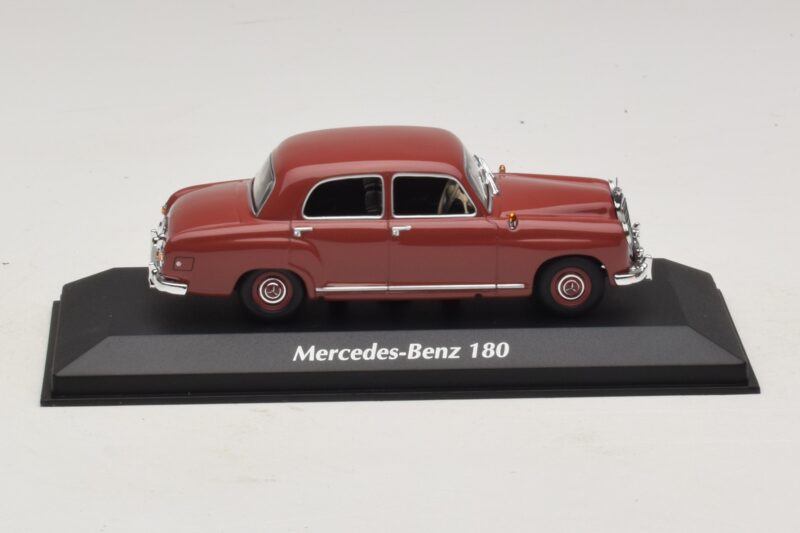
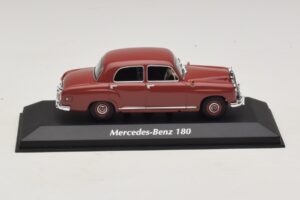
Maxichamps' 1:43 diecast Mercedes 180 W120 brings the 1955 four-cylinder Ponton saloon to the shelf in Red. The body is cast as a single sealed piece, so rounded proportions, gloss depth and a compact footprint carry the display. A sensible first step into post-war Mercedes collecting, with the weight of zinc alloy behind it.
TL;DR: The Maxichamps Mercedes 180 W120 1:43 is a diecast replica of the 1955 Ponton saloon in Red, the four-cylinder car that gave Mercedes its first self-supporting passenger-car body. It is a sealed one-piece casting, so its merit lies in rounded proportions, gloss depth and a compact footprint suited to a post-war Mercedes run.
Not every Ponton wears a six-cylinder badge. The 180 was the entry point, a four-cylinder saloon, and it brought unitary body construction to the Mercedes passenger-car range. That modest standing is exactly why it makes a good first piece in a post-war collection, and why Red lifts it out of the usual sober shades.
Maxichamps 180 W120 and the Start of the Ponton Line
Why Red Suits a Sealed Casting
Red is the least forgiving colour on a model. Orange peel, uneven coverage and polishing marks all show, and a poor red looks flat and plasticky. A good one reads deep, with a clean reflection running unbroken down the bonnet and along the flank. Because this body is cast as one piece, no hinge lines break that reflection, and the cut-lines stay shallow and consistent. Hold the model under a lamp and tilt it slowly; a smooth, even highlight is the first sign of careful finishing. Red also photographs well, which matters if you share your shelf online.
Proportions to Check at About 10cm
At roughly 10cm, the 180 is a small object, so a few proportions decide whether it looks right. Check the roofline: it should arc gently over the glasshouse, with no flat spot. Look at the glazing, which should sit flush with the frame, and then at the bumpers, whose height and thickness set the character of the front and rear. Finally compare the wheels with period photographs. Hubcaps and sidewall height change the stance more than people expect, and a tall, narrow tyre profile is right for the 1950s. Small errors are easy to spot once you know where to look.
Starting a Post-War Mercedes Collection at 1:43
The 180 as an Entry Point
The 180 was the approachable end of the Ponton range, which makes it a natural first purchase. From here a collection can move up through six-cylinder saloons of the same decade, and the family resemblance carries through every step: the same rounded wings, the same upright stance, a little more length each time. Starting with the smallest means you learn what to look for in finish and proportion before spending on larger pieces. It also gives the later cars something to be compared against, which is half the fun of building a themed shelf.
Diecast Trade-Offs for a Sealed Model
A sealed zinc-alloy casting trades interior and engine-bay access for crisp exterior surfaces and a sturdy build. Expect detail on the grille, bumpers and window surrounds to be simplified to what 1:43 can carry, and expect no visible mechanicals at all. In return the shell holds its shape over the years and survives the occasional nudge. For a car whose appeal is its shape rather than its machinery, that is a fair trade, and stating it plainly avoids disappointment later.
Building a Plan Around One Red Saloon
A single red Ponton can anchor a shelf by itself, but it gains from company. Silver and black cars of the same decade make it stand out, while other reds compete with it. Leave a little space around it, because its rounded shape reads best with room to show the profile. Keep it away from direct sun, dust it with a soft brush, and hold it by the roof rather than the trim. Its small footprint also means a whole decade of Stuttgart saloons can share one shelf. For anyone starting a post-war Mercedes run at an accessible scale, this is a logical first step, and it can be ordered as a stand-alone piece.
Create a free account and claim 5% off your first order — from hundreds of collectible 1:18, 1:43 and 1:12 models by Porsche, Mercedes-Benz, BMW and more.