{"ajaxurl":"https:\/\/models118.co.uk\/wp-admin\/admin-ajax.php?lang=en_GB","nonce":"1bbaa8ccd4","homeUrl":"https:\/\/models118.co.uk\/","shopUrl":"https:\/\/models118.co.uk\/shop\/","cartUrl":"https:\/\/models118.co.uk\/cart-en-gb\/","checkoutUrl":"https:\/\/models118.co.uk\/checkout\/","skipCart":true,"collectionLimit":12,"i18n":{"addedToCart":"Added to basket","addToWishlist":"Add to wishlist","addedToWishlist":"Added to wishlist","removeFromWishlist":"Remove from wishlist","removedFromWishlist":"Removed from wishlist","undo":"Undo","error":"Something went wrong","loading":"Loading...","outOfStock":"Out of stock","viewCart":"View basket","proceedToCheckout":"Proceed to checkout","addedToCollection":"Added to your collection","reserved":"Added to your collection","soldOut":"Sold out","invalidEmail":"Please enter a valid email address","connectionError":"Connection error. Please try again.","tocToggle":"On this page","close":"Close","inCartTooltip":"Already in your basket \u2013 open your basket to check out","loginToSave":"Sign in to save this model","waitlistNotify":"Notify me","waitlistOnList":"On the waiting list \u2713","waitlistJoined":"You're on the waiting list. We'll email you the moment this model is available again.","waitlistRemoved":"Done \u2014 you're off the waiting list for this model.","waitlistRateLimit":"Too many attempts \u2014 please try again shortly","waitlistTurnstile":"We couldn't complete the check \u2014 please try again","waitlistError":"Sorry, something went wrong. Please try again in a moment."},"wishlist":{"loggedIn":false,"loginUrl":"https:\/\/models118.co.uk\/my-account\/","addAction":"models118_wishlist_add","removeAction":"models118_wishlist_remove"},"waitlist":{"loggedIn":false,"subscribeAction":"models118_waitlist_subscribe","toggleAction":"models118_waitlist_toggle","stateAction":"models118_waitlist_state"},"stats":{"models":2712,"brands":215,"manufacturers":129,"collectors":10000},"product":{"id":1704020,"sku":"940033100","condition":"new","availability":"in_stock","name":"Mercedes 180 W120 Grey Maxichamps 1:43","brand":"Mercedes","manufacturer":"Maxichamps","scale":"1:43","material":"Diecast","price":58,"regularPrice":58,"isOnSale":false,"savingsAmount":0,"stockQty":2,"stockStatus":"very_low","isDiscontinued":false,"image":"https:\/\/models118.co.uk\/wp-content\/uploads\/2026\/10\/mercedes-180-w120-grey-maxichamps-1-43-940033100-1-1-300x200.jpg","permalink":"https:\/\/models118.co.uk\/mercedes-180-w120-grey-maxichamps-1-43-940033100\/"}}
Cookies on Models118
We use cookies to remember your preferences, understand how the shop is used and show you models and offers that suit your interests. What you allow is up to you, and you can change it at any time.
Always active
The technical storage or access is strictly necessary for the legitimate purpose of enabling the use of a specific service explicitly requested by the subscriber or user, or for the sole purpose of carrying out the transmission of a communication over an electronic communications network.
The technical storage or access is necessary for the legitimate purpose of storing preferences that are not requested by the subscriber or user.
The technical storage or access that is used exclusively for statistical purposes.
The technical storage or access is required to create user profiles to send advertising, or to track the user on a website or across several websites for similar marketing purposes.
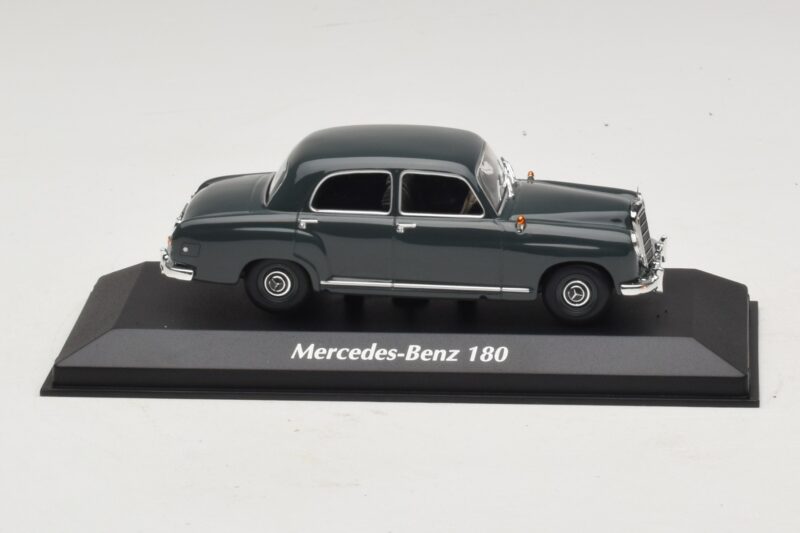
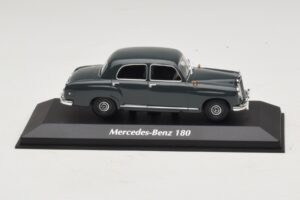
Maxichamps' 1:43 diecast Mercedes 180 W120 in Grey models the 1955 Ponton saloon as a sealed one-piece body with no opening parts. With little ornament to lean on, the model is judged on outline, paint and proportion, which suits collectors who prefer the everyday classic. A sound starting point for a Ponton family line-up.
TL;DR: The Maxichamps Mercedes 180 W120 1:43 is a diecast replica of the 1955 Ponton saloon in Grey. The body is a sealed one-piece casting, so the whole model is judged on its outline, paint, glazing and wheels. It is the simplest car in the Ponton family, which makes it a useful baseline for a postwar Mercedes shelf.
Grey is an honest colour for a car that never tried to impress. The 180 introduced the Ponton body in 1953 and set the pattern for a generation of Mercedes saloons, and its modest trim and four-cylinder engine make it the foundation of the family. A 1:43 model of it rewards attention to outline and proportion over ornament.
Maxichamps Mercedes 180 W120 in Grey
Reading a Plain Saloon
With less chrome than the six-cylinder cars, the 180 depends on its basic shape, and a model has nowhere to hide. The body is a one-piece casting with no opening parts, so the roofline, the sweep of the wings into the doors and the line of the bootlid are each cast as continuous surfaces. Check that the shoulder line runs straight from front to rear and that the windows sit evenly in their frames. A casting this simple lives or dies on the accuracy of those long, gentle curves, and they are easy to judge side-on.
Grey Paint and Diecast Heft
Grey takes light differently from white or red. A good one shows a soft, even sheen with no mottling, and under a lamp it should look slightly cool rather than flat. Because grey was a common colour on real cars of the period, it also makes the model look believable rather than showy. The diecast body gives a firm, cool-to-the-touch weight, and the metal keeps its shape over time. Wheels and hubcaps are worth a close look: they should be neatly round, with slim bright rims and a tidy centre.
The Ponton That Started the Line
A Self-Supporting Body for a New Era
The 180 was Mercedes' first passenger car with a self-supporting body, meaning the shell and structure were one, rather than a body mounted on a separate chassis. It was powered by a four-cylinder petrol engine and arrived in 1953, setting the shape that the six-cylinder 220 and later cars would build on. For a collector that makes it the starting point of a clear lineage, not just another 1950s saloon, and the 1955 date on this model sits well inside the car's production life.
The Everyday Classic
It was a durable everyday saloon rather than a flagship, and that sturdy character is part of why the Ponton name is remembered fondly. A model of one rewards the collector who prefers the workaday classic to the glamorous one. Beside a six-cylinder sibling, the 180 shows how little separated the range visually and how much that restraint defined the shape. Put the two side by side and the differences in brightwork become obvious.
Grey on the Postwar Shelf
At roughly 10 cm, the 180 fits comfortably on a standard cabinet shelf and spaces well with other 1950s saloons. Grey calls for a lighter backdrop so the outline reads, and a lamp angled from the side shows off the body curves. Keep it away from direct sun and damp, handle it by the base, and dust it with a soft brush. If you collect by provenance, the original box is worth keeping. As a plain, accurate saloon it is a calm counterweight to brighter cars on the same shelf.
Create a free account and claim 5% off your first order — from hundreds of collectible 1:18, 1:43 and 1:12 models by Porsche, Mercedes-Benz, BMW and more.