Used
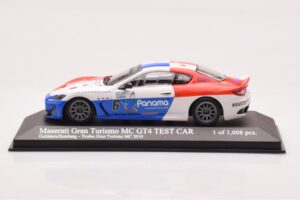
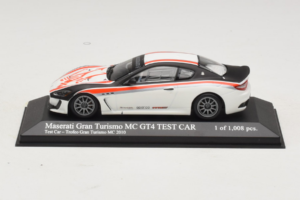
Maserati GranTurismo MC GT4 #6 Goldstein / Sumberg Trofeo GranTurismo 2010 Minichamps 1:43
Only 2 left
Price:
£32.00
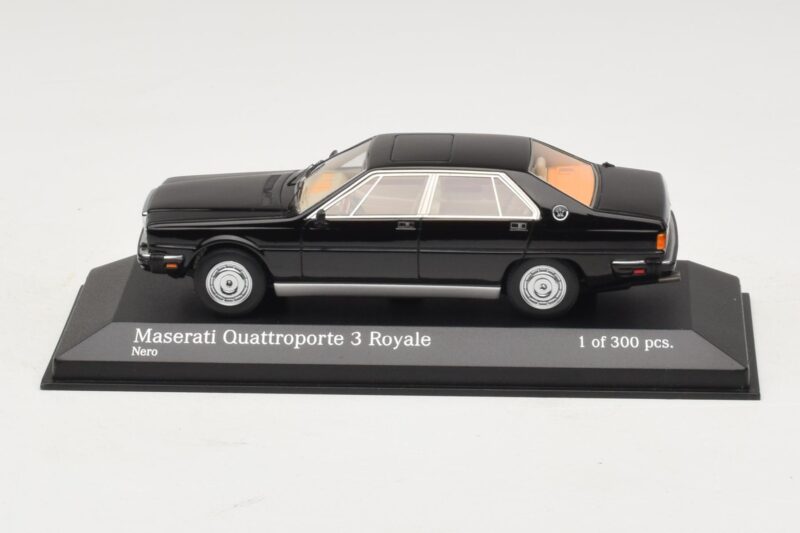
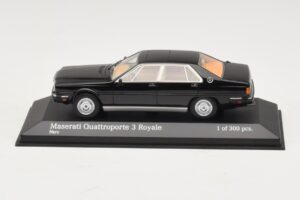
TL;DR: Minichamps' 1:43 diecast Maserati Quattroporte III reproduces the range-topping Royale specification from the saloon's final production years, finished in black over a sealed one-piece diecast shell. Giorgetto Giugiaro's Italdesign shape reads cleanly on this scale, making it a compact anchor for an Ultra-Luxury Sedans display.
Giorgetto Giugiaro's Italdesign penned the Quattroporte III in 1979, and by the time production wound down a decade later Maserati had pushed the range to its most opulent point with the Royale specification. This 1:43 diecast from Minichamps takes that late, most luxurious version and casts it in black, the colour suited to a saloon built to look understated from the kerb.
The Quattroporte III arrived at a moment when Maserati needed a saloon that could compete with Mercedes and Jaguar's flagship offerings while still looking unmistakably Italian. Giugiaro's answer was a crisp, folded-panel design, all straight creases and a low waistline, a sharp contrast to the rounder saloons German rivals were building at the time. Production ran through the 1980s, evolving gradually rather than through dramatic redesign.
As the model matured, Maserati introduced the Royale trim for its final years, adding a longer specification list, richer leather and wood trim, and detail changes that marked it out as the range-topper rather than a mid-range saloon dressed up. By 1989, the Royale represented Maserati's most complete answer to the ultra-luxury saloon brief, built in far smaller numbers than the standard Quattroporte III. Minichamps' 1:43 follows that late-production specification, and black is a natural choice for a car whose flat panels were designed to read cleanly under direct light rather than compete with a loud colour.
Minichamps casts this Quattroporte as a one-piece diecast shell, with no doors or bonnet that open, and black is arguably the hardest colour to get right on any scale model because it shows every imperfection in a panel line. A fixed body works in this colour's favour: without hinge gaps to disrupt the surface, the paint runs as one unbroken plane from the front wing to the boot lid, exactly what Giugiaro's flat-sided design calls for.
The zinc alloy construction gives the model real weight relative to its roughly ten-centimetre length, and that density is part of what a 1:43 diecast collector expects at this tier over a lighter resin alternative. Under a directed lamp the black holds genuine depth rather than reading flat, and the creased character lines that define the Quattroporte III's flanks catch and lose light exactly where Giugiaro drew them. Running a finger along the door line finds a single continuous groove, confirmation of a sealed casting rather than an articulated one.
Ultra-luxury saloons rarely get the collecting attention that supercars and racing liveries receive, but 1:43 is arguably the better scale for them. A saloon the size of the Quattroporte III would demand serious shelf depth at 1:18, while at 1:43 it sits at a manageable ten centimetres, small enough to display alongside contemporary rivals without dominating a cabinet. Minichamps holds a mid-tier position in this scale, priced above basic mass-market diecast and below the hand-finished resin specialists who chase ultra-limited saloon subjects, and that middle ground suits a Quattroporte III well. Black is also the more versatile choice for building out an era collection, pairing cleanly with lighter liveries from the same period without clashing on a shared shelf. It is also the shade most likely to have left the factory on a genuine Royale example, given how the specification was marketed toward buyers who wanted restraint over spectacle.
A 1989 Quattroporte III Royale marks the end of a design that first appeared a decade earlier, making this a useful closing piece for anyone tracing Giugiaro's saloon work through the 1980s. It sits naturally alongside earlier Quattroporte III liveries, showing how little Maserati needed to change a design that had already found its shape at launch. The black Royale also works as a contrast piece next to flashier Maserati coupes and GTs from the same decade. For a collector building a themed 1980s executive saloon shelf, this is a compact, well-finished way to include Maserati's answer to the segment without needing a larger, more space-hungry scale.

Save £33.00


Save £14.00