Last one
Used
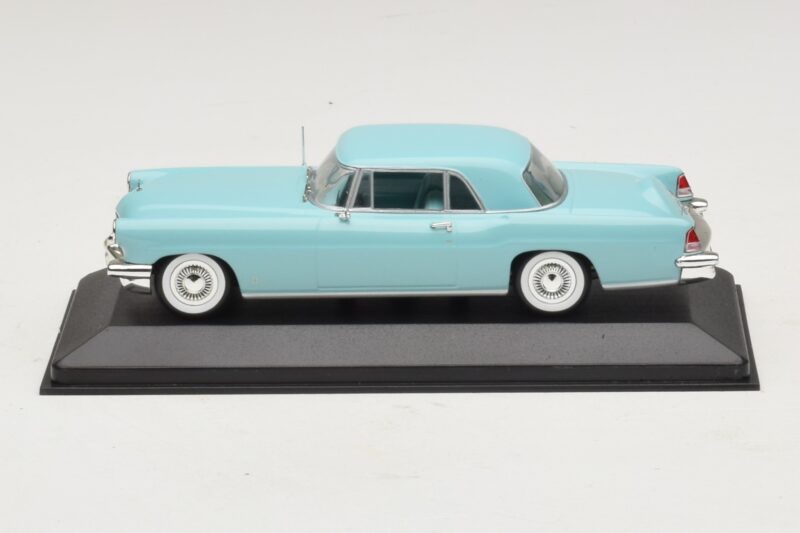
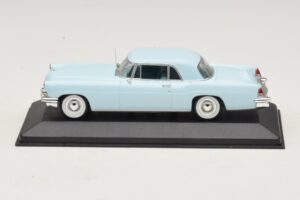
TL;DR: Minichamps' 1:43 diecast Lincoln Continental Mark II reproduces the 1956 flagship coupe in turquoise, a one-piece zinc alloy casting with crisp shut lines and chrome detailing. Built by a division created for this single model, the Mark II aimed above Cadillac and Rolls-Royce. A restrained design statement, now a compact display piece.
Few American cars of the 1950s resisted the era's chrome and tailfin excess. The Continental Mark II did, deliberately, and that restraint is exactly what Minichamps' 1:43 replica sets out to capture. At this scale the coupe's long bonnet and formal roofline still read as a statement of quiet, expensive confidence rather than showroom spectacle.
The body is a single zinc alloy casting, and openable parts play no role in this piece: doors, bonnet, and boot are moulded into one sealed shell. That construction choice pays off in panel consistency, the door line reads as one continuous groove rather than a seam with hinge tolerance to hide, and the coupe's long, low roofline holds its shape without the slight gaps an opening body would need. Weight in the hand confirms the material before the eye does; zinc alloy carries real mass, a density no resin casting at this scale matches. The Mark II's proportions, long bonnet, short boot, cabin pushed rearward, translate cleanly to 1:43 because the real car's design was already pared back to essentials.
Minichamps finishes this example in turquoise, a restrained shade that suited the Mark II's understated brief better than the brighter contemporary colours of the decade. The paint sits with even depth across the bonnet and boot, and the thin chrome surrounds, around the grille, the headlamp bezels, the window frames, stay crisp rather than bleeding into the body colour. Badging is kept small on the real car, Lincoln avoided the ornamentation other 1950s marques piled on, and the model follows that lead rather than inventing detail the original never carried. Wheel discs and the narrow chrome beltline moulding are picked out cleanly, the sort of finishing work that separates a considered 1:43 casting from a toy-grade one at a glance.
Ford created the Continental Division specifically to build the Mark II, a rare instance of a manufacturer spinning up an entire operation around a single car rather than slotting it into an existing range. William Clay Ford Sr. oversaw the project, and the brief was explicit: match the fit and finish of Rolls-Royce and outprice Cadillac's Eldorado Brougham without resorting to either marque's visual flourish. Assembly leaned on hand-finishing well beyond Ford's usual volume methods, a level of attention that shows in how the real car's panel gaps and brightwork were judged by contemporary road testers. That hand-built ambition is part of what makes a faithful small-scale replica worth seeking out rather than settling for a generic 1950s coupe.
Where rivals reached for height on their tailfins and width on their chrome grilles, the Mark II's designers drew a straight beltline, a spare grille, and a boot lid shaped to echo the original 1940s Continental's spare-wheel hump without literally fitting one. That discipline aged well; the Mark II reads as considered rather than dated in a way several flashier 1950s American cars do not. It lasted only two production years before Ford folded the Continental name back into Lincoln's main range, which keeps surviving examples, and faithful models of them, relatively scarce on a themed 1950s shelf.
On a shelf built around 1950s American luxury, the Mark II sits apart from the chrome-heavy Cadillacs and Buicks it was designed to outclass, and that contrast is worth building a display around rather than hiding. At 1:43 the footprint stays modest, a handful of these coupes fit comfortably alongside contemporary Lincolns, Mercurys, and European grand tourers from the same decade without crowding a cabinet shelf. Collectors assembling a chronology of American luxury beyond the obvious fin-and-chrome stereotypes find the Mark II argues its case quietly: understated design, hand-built ambition, a short production run. This turquoise example works equally well as a standalone centrepiece or as the restrained counterpoint in a livelier 1950s lineup.