Last one
Used
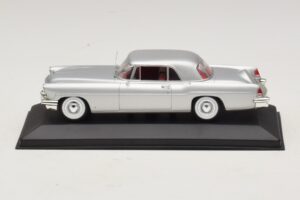
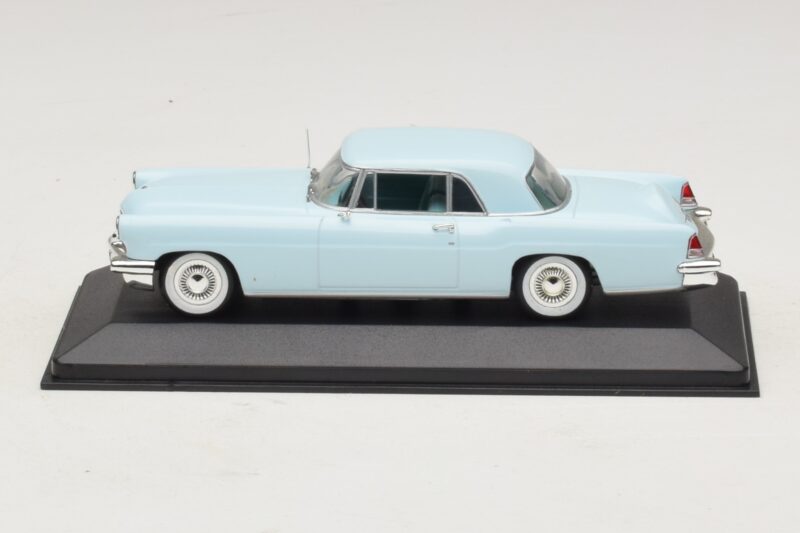
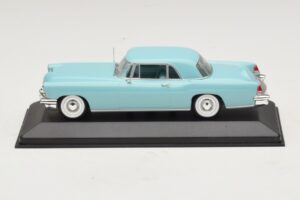
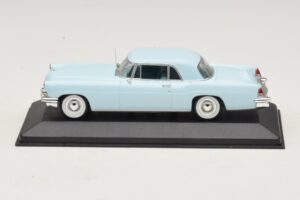
TL;DR: Minichamps' 1:43 diecast Lincoln Continental Mark II reproduces the 1956 luxury coupe in light blue, a car hand-assembled and sold at a price few American manufacturers dared ask. The body is a sealed one-piece casting, its understated lines and continental-kit rear deck captured without a single visible join.
Few American cars of the 1950s rejected flamboyance as deliberately as the Continental Mark II, and that restraint is exactly what Minichamps' casting is built to honour. Where contemporaries reached for fins and chrome, this Lincoln relied on proportion alone, a harder trick to pull off in miniature than any amount of ornament.
Minichamps casts the Mark II as a single sealed shell, and for a design built on flat panels and long, unbroken lines rather than ornament, that construction choice suits the subject better than a hinged body ever could. The real car's styling depended on restraint, clean sheet metal running from the headlamps to the distinctive hump on the rear deck echoing a spare tyre housing, and a one-piece casting holds that surface without the interruption a working door or bonnet would introduce.
The light blue finish sits on a hard diecast shell with a deep, even gloss, letting the long flanks catch light the way the original car's minimal brightwork was designed to. Chrome detailing is restrained here too, limited to the grille, bumpers and window surrounds rather than running the length of the body, which matches the restraint Lincoln's designers actually built into the car. Shut lines along the bonnet and boot are rendered as fine, continuous grooves rather than true openings, consistent at a width a hinged mechanism at this scale would struggle to replicate.
Given how plain the original design is, the casting lives or dies on proportion rather than detail density, and Minichamps keeps the glasshouse, beltline and that rear deck hump in correct relation to one another. That is the harder discipline at 1:43, where there is no ornament left to distract from a line that sits even slightly wrong.
Ford built the Continental Mark II for just two model years, 1956 and 1957, as a standalone product rather than a conventional Lincoln trim level, assembled largely by hand at a dedicated facility rather than on a standard production line. That approach meant build quality and finish well beyond anything else wearing a Lincoln badge, at a price that undercut Ford's own profit margin on every car sold. Few American manufacturers of the era were willing to lose money proving a point about restraint and craftsmanship, which is part of why the Mark II still carries the weight it does among collectors of the period.
Its design rejected the tailfin excess that defined most domestic styling through the later 1950s, instead relying on a long, low profile and a single chrome accent line to carry the whole car. That rear deck hump, a nod to the classic continental spare-tyre kit rather than a functional feature, became the model's signature cue and the detail most easily recognised today. Buyers of the original car included prominent public figures of the period, a reputation built on genuine exclusivity rather than marketing alone.
For a collection built around understated American luxury rather than chrome-and-fin spectacle, the Mark II represents the opposite end of 1950s Detroit styling from a car like a contemporary Cadillac, and that contrast is worth building a shelf around.
At 1:43, the Mark II occupies a compact footprint around 10cm, easy to slot beside other Minichamps American subjects from the same showroom years without needing a dedicated display case. For a collector pursuing luxury coupes specifically, this model offers a deliberate counterpoint to the tailfinned excess more commonly reproduced from the period, a reminder that understatement had its own following even in an era remembered for chrome. The sealed-body construction keeps the price accessible relative to a hand-built resin equivalent, while still holding the proportion accuracy that a design this minimal genuinely demands. Buyers assembling a run of American luxury from the mid-1950s will find few better-known counterpoints to the era's more flamboyant offerings.