Used

TL;DR: Minichamps' 1:43 Lamborghini Miura P400 reproduces the 1966 original in orange diecast, a sealed one-piece body capturing the low, wide stance Bertone gave the car that founded the mid-engine supercar template. A compact, colourful centrepiece for a 1960s supercar shelf.
Few cars changed what a sports car was expected to look like as abruptly as the Miura did in 1966. Lamborghini, barely three years into building road cars, let Bertone put a V12 sideways behind the driver and wrapped it in a shape low enough to make every front-engined rival look suddenly old-fashioned.
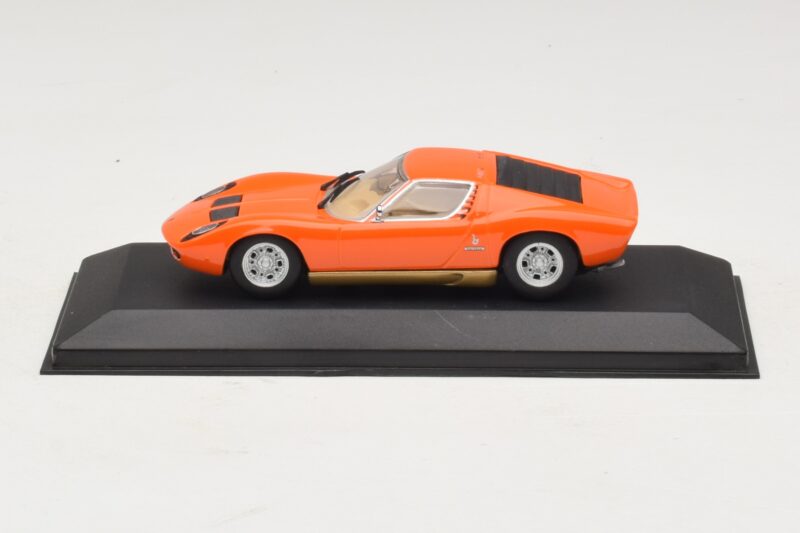
The Miura's body came from Bertone, styled by a young Marcello Gandini on one of his first major commissions, and its proportions, long nose, short tail, glasshouse set far back over the engine, became the reference point every mid-engine exotic since has measured itself against. When the finished car appeared at the Geneva show in 1966, having been previewed as a bare chassis the year before, the reaction was reportedly closer to disbelief than polite interest, and orders arrived faster than the young company could really handle. Orange was never a timid colour choice on a shape this dramatic, and Minichamps' rendering keeps the original's long, unbroken waistline intact, the detail that makes the Miura look like it is moving while parked.
Lamborghini's engineering solution was as bold as the styling: rather than mount the V12 longitudinally as contemporary racers did, the engine sat transversely behind the cabin, gearbox underneath, a packaging trick applied to a 4.0-litre twelve-cylinder. That layout is what let the Miura sit so low, and it set the template that the Countach, and effectively every mid-engine supercar afterward, would follow. The P400 designation referred to the engine's output in metric horsepower, a figure that made the Miura, on paper and in reputation, the fastest production road car of its moment.
This Miura arrives as a sealed, one-piece diecast body: the doors and engine cover are moulded shut rather than hinged, and nothing on the model opens. For a shape this dependent on an unbroken waistline, that construction choice works in the subject's favour rather than against it, since a hinge line across the Miura's low flank would interrupt exactly the visual trick Bertone built the car around. The panel gaps read as continuous, fine grooves rather than a series of slightly proud edges. Wire-style wheels, chrome trim around the headlamp eyelashes, a Bertone signature on the real car, and badge work are picked out cleanly rather than left as a single moulded colour, the finishing detail that separates a considered 1:43 release from a basic toy-grade casting.
Zinc alloy construction gives the casting the weight a Miura's dramatic shape deserves, and the orange paint sits on a hard metal shell deep enough to hold its colour under direct light rather than fading flat. At 1:43, the Miura's long, low proportions still read correctly, the stance stays low rather than compressed, which is where cheaper castings at this scale tend to go wrong. The compact footprint also means a run of 1960s Italian exotics, Miura alongside a contemporary Ferrari or Maserati, fits comfortably on one shelf without the space a trio of 1:18 cars would demand.
An orange Miura is built to be the loudest car on the shelf, and it should be treated that way rather than tucked among quieter saloons. Pair it with period rivals, a Ferrari 275 or a Maserati Ghibli, to show how differently Italy's three great houses answered the same brief in the same decade. At 1:43, that comparison costs a fraction of the shelf space a full-size supercar collection otherwise demands, which is exactly the appeal of building a 1960s exotic lineup at this scale rather than chasing individual 1:18 pieces. The Miura's reputation as the car that invented the supercar category gives this piece a reasonable claim to centrepiece status in any such display, and the colour choice only sharpens that effect.