{"ajaxurl":"https:\/\/models118.co.uk\/wp-admin\/admin-ajax.php?lang=en_GB","nonce":"639ff23817","homeUrl":"https:\/\/models118.co.uk\/","shopUrl":"https:\/\/models118.co.uk\/shop\/","cartUrl":"https:\/\/models118.co.uk\/cart-en-gb\/","checkoutUrl":"https:\/\/models118.co.uk\/checkout\/","skipCart":true,"collectionLimit":12,"i18n":{"addedToCart":"Added to basket","addToWishlist":"Add to wishlist","addedToWishlist":"Added to wishlist","removeFromWishlist":"Remove from wishlist","removedFromWishlist":"Removed from wishlist","undo":"Undo","error":"Something went wrong","loading":"Loading...","outOfStock":"Out of stock","viewCart":"View basket","proceedToCheckout":"Proceed to checkout","addedToCollection":"Added to your collection","reserved":"Added to your collection","soldOut":"Sold out","invalidEmail":"Please enter a valid email address","connectionError":"Connection error. Please try again.","tocToggle":"On this page","close":"Close","inCartTooltip":"Already in your basket \u2013 open your basket to check out","loginToSave":"Sign in to save this model","waitlistNotify":"Notify me","waitlistOnList":"On the waiting list \u2713","waitlistJoined":"You're on the waiting list. We'll email you the moment this model is available again.","waitlistRemoved":"Done \u2014 you're off the waiting list for this model.","waitlistRateLimit":"Too many attempts \u2014 please try again shortly","waitlistTurnstile":"We couldn't complete the check \u2014 please try again","waitlistError":"Sorry, something went wrong. Please try again in a moment."},"wishlist":{"loggedIn":false,"loginUrl":"https:\/\/models118.co.uk\/my-account\/","addAction":"models118_wishlist_add","removeAction":"models118_wishlist_remove"},"waitlist":{"loggedIn":false,"subscribeAction":"models118_waitlist_subscribe","toggleAction":"models118_waitlist_toggle","stateAction":"models118_waitlist_state"},"stats":{"models":2665,"brands":215,"manufacturers":129,"collectors":10000},"product":{"id":1701271,"sku":"940103002","condition":"new","availability":"in_stock","name":"Lamborghini Miura P400 Gold Maxichamps 1:43","brand":"Lamborghini","manufacturer":"Maxichamps","scale":"1:43","material":"Diecast","price":67,"regularPrice":67,"isOnSale":false,"savingsAmount":0,"stockQty":1,"stockStatus":"very_low","isDiscontinued":false,"image":"https:\/\/models118.co.uk\/wp-content\/uploads\/2026\/10\/lamborghini-miura-p400-gold-maxichamps-1-43-940103002-1-1-300x200.jpg","permalink":"https:\/\/models118.co.uk\/lamborghini-miura-p400-gold-maxichamps-1-43-940103002\/"}}
Cookies on Models118
We use cookies to remember your preferences, understand how the shop is used and show you models and offers that suit your interests. What you allow is up to you, and you can change it at any time.
Always active
The technical storage or access is strictly necessary for the legitimate purpose of enabling the use of a specific service explicitly requested by the subscriber or user, or for the sole purpose of carrying out the transmission of a communication over an electronic communications network.
The technical storage or access is necessary for the legitimate purpose of storing preferences that are not requested by the subscriber or user.
The technical storage or access that is used exclusively for statistical purposes.
The technical storage or access is required to create user profiles to send advertising, or to track the user on a website or across several websites for similar marketing purposes.
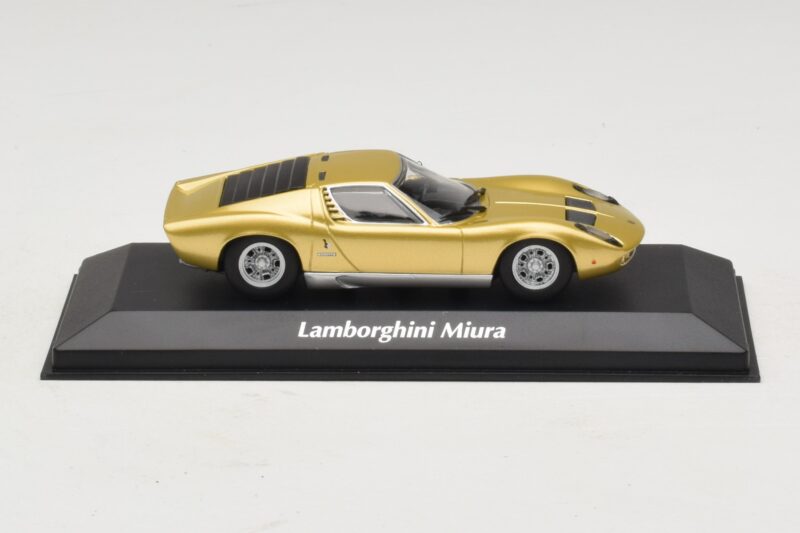
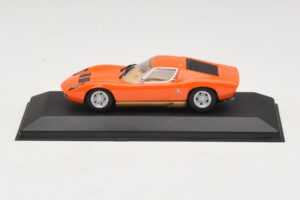
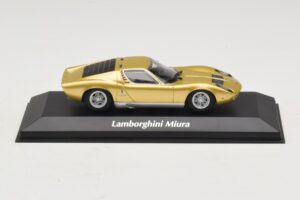
Maxichamps' 1:43 Lamborghini Miura P400 in gold is a diecast supercar from 1966, cast as a sealed one-piece body. The low roofline and curved flanks carry the model, and the gold finish needs a smooth, even surface to look rich. At around 10 cm it makes a compact centrepiece for a 1960s exotic display, with the weight of zinc alloy in the hand.
About the Lamborghini Miura P400 Gold Maxichamps 1:43
TL;DR: The Maxichamps Lamborghini Miura P400 Gold is a 1:43 diecast model of the 1966 mid-engined supercar, cast as a sealed one-piece body. The low roofline and curved flanks are the details to judge, and at around 10 cm it makes a compact centrepiece for a 1960s exotic display.
The Miura set a template for the mid-engined supercar when it appeared in 1966. Maxichamps' Lamborghini Miura P400 at 1:43, finished in gold, brings that low, curved silhouette down to a size that fits any shelf, with a sealed diecast body that keeps all the attention on the shape.
Maxichamps Lamborghini Miura P400 in Gold
A 1966 Geneva Debut
Lamborghini showed the Miura at the Geneva Motor Show in 1966, with a V12 mounted transversely behind the seats and bodywork by Bertone. Placing the engine there, in a road car, was unusual then, and it gave the car its low nose and compact cabin. For a collector, that layout translates into proportions: a short bonnet, a cab-forward cockpit and a long, tapering tail. If those proportions are right, the model reads as a Miura even before you check the details. The P400 designation refers to the original version.
Gold Paint and the Low Roofline
Gold is a bold choice, and it needs a controlled finish to look rich rather than brassy. On a smooth zinc alloy surface, a good gold shows depth and a gentle shift in tone as the body curves. The Miura's roofline is very low, and the windscreen rakes steeply into it; the glazing should sit flush and follow that line without a step. Check the shoulder line along the flank, which should rise and fall in one flowing curve. Because the body is one sealed casting, the colour is unbroken from nose to tail, which suits a shape defined by its continuity. View it from above as well, where the curve of the wings and the narrow waist of the cabin show up best.
Sealed Casting for a Low, Curved Shape
Compound Curves in Zinc Alloy
The Miura is almost all curves, and compound curves are the hardest thing to cast crisply in metal. Zinc alloy gives weight and stability, but its edges are slightly softer than cast resin can manage, so the arches and the rear deck may read a little less sharp. At 1:43 the difference is subtle and the heft in the hand is the compensation. Judge the model by whether the curve of the wings stays smooth and the proportions hold from every angle. Look at the car side-on first. The wheelbase, the length of the nose and the position of the cabin are the three proportions that identify a good Miura.
The Honest Trade-off Against Resin
A hand-finished resin Miura can capture the edges more sharply, and some buyers will pay for that. Diecast brings durability and a lower entry point instead. Neither is wrong. This model suits the collector who wants a Miura on the shelf now, with a rugged, handleable body, and who judges fidelity by stance and surface rather than by micro parts. With no opening panels, nothing moves or wears, so the model stays as it arrived.
Miura Beside Other 1960s Exotics
At around 10 cm, the Miura makes a compact centrepiece for a 1960s exotic display, and at 1:43 several cars can sit together without dominating the shelf. It pairs naturally with other mid-decade European sports cars, where its mid-engined layout stands out against front-engined rivals. Gold also gives it individual character in a row of reds and silvers. This is an accessible diecast, so expect good weight, tidy printing and a sealed shell that handles well, rather than hand-fitted detail. For anyone building the story of how the supercar emerged in the 1960s, it is a pivotal piece to own. Keep it in a closed case and out of direct light.
Create a free account and claim 5% off your first order — from hundreds of collectible 1:18, 1:43 and 1:12 models by Porsche, Mercedes-Benz, BMW and more.