{"ajaxurl":"https:\/\/models118.co.uk\/wp-admin\/admin-ajax.php?lang=en_GB","nonce":"d590ce0ccb","homeUrl":"https:\/\/models118.co.uk\/","shopUrl":"https:\/\/models118.co.uk\/shop\/","cartUrl":"https:\/\/models118.co.uk\/cart-en-gb\/","checkoutUrl":"https:\/\/models118.co.uk\/checkout\/","skipCart":true,"collectionLimit":12,"i18n":{"addedToCart":"Added to basket","addToWishlist":"Add to wishlist","addedToWishlist":"Added to wishlist","removeFromWishlist":"Remove from wishlist","removedFromWishlist":"Removed from wishlist","undo":"Undo","error":"Something went wrong","loading":"Loading...","outOfStock":"Out of stock","viewCart":"View basket","proceedToCheckout":"Proceed to checkout","addedToCollection":"Added to your collection","reserved":"Reserved!","soldOut":"Sold out","invalidEmail":"Please enter a valid email address","connectionError":"Connection error. Please try again.","loginToSave":"Sign in to save this model","waitlistNotify":"Notify me","waitlistOnList":"On the waiting list \u2713","waitlistJoined":"You're on the waiting list. We'll email you the moment this model is available again.","waitlistRemoved":"Done \u2014 you're off the waiting list for this model.","waitlistRateLimit":"Too many attempts \u2014 please try again shortly","waitlistTurnstile":"We couldn't complete the check \u2014 please try again","waitlistError":"Sorry, something went wrong. Please try again in a moment."},"wishlist":{"loggedIn":false,"loginUrl":"https:\/\/models118.co.uk\/my-account\/","addAction":"models118_wishlist_add","removeAction":"models118_wishlist_remove"},"waitlist":{"loggedIn":false,"subscribeAction":"models118_waitlist_subscribe","toggleAction":"models118_waitlist_toggle","stateAction":"models118_waitlist_state"},"stats":{"models":2159,"brands":206,"manufacturers":127,"collectors":10000},"product":{"id":490156,"sku":"08954BK","condition":"new","availability":"out_of_stock","name":"Jaguar E-Type 3.8 Series 1 Black Kyosho 1:18","brand":"Jaguar","manufacturer":"Kyosho","scale":"1:18","material":"Diecast","price":155.83,"regularPrice":155.83,"isOnSale":false,"savingsAmount":0,"stockQty":0,"stockStatus":"out_of_stock","isDiscontinued":true,"image":"https:\/\/models118.co.uk\/wp-content\/uploads\/2026\/06\/jaguar-e-type-38l-coupe-mk1-black-kyosho-1-18-300x200.jpg","permalink":"https:\/\/models118.co.uk\/jaguar-e-type-3-8-series-1-black-kyosho-1-18-08954bk\/"}}
Cookies on Models118
We use cookies to remember your preferences, understand how the shop is used and show you models and offers that suit your interests. What you allow is up to you, and you can change it at any time.
Always active
The technical storage or access is strictly necessary for the legitimate purpose of enabling the use of a specific service explicitly requested by the subscriber or user, or for the sole purpose of carrying out the transmission of a communication over an electronic communications network.
The technical storage or access is necessary for the legitimate purpose of storing preferences that are not requested by the subscriber or user.
The technical storage or access that is used exclusively for statistical purposes.
The technical storage or access is required to create user profiles to send advertising, or to track the user on a website or across several websites for similar marketing purposes.
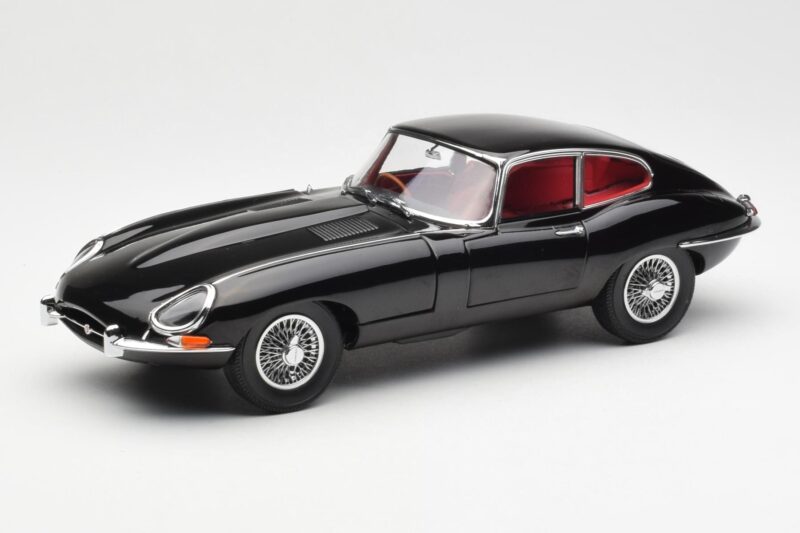
Kyosho's 1:18 diecast Jaguar E-Type 3.8 Series 1 recreates the 1961 coupe in black, with covered headlamps, opening bonnet and boot, and a correctly long, low silhouette. Enzo Ferrari is widely reported to have called the E-Type the most beautiful car ever made, and this diecast captures the proportions that earned that reputation, right down to the toggle switches inside. A strong, formal choice for a British classic sports car collection.
About the Jaguar E-Type 3.8 Series 1 Black Kyosho 1:18
TL;DR: Kyosho's 1:18 diecast Jaguar E-Type 3.8 Series 1 reproduces the 1961 coupe in black, with covered headlamps, opening bonnet and boot, and the long bonnet, short tail proportions that made the car famous. A formal, understated colour choice for a British classic sports car collection at diecast pricing.
Black does something no other E-Type colour manages: it lets the shape speak entirely for itself. Kyosho's Series 1 in black strips away distraction and leaves the proportions Enzo Ferrari reportedly called the most beautiful of any car.
Kyosho's Diecast Reading of the Series 1 Silhouette
Covered Headlamps and the Long Bonnet Line
The Series 1 3.8 is defined by details later E-Types lost: covered headlamps set flush into the front wings, toggle switches on the dashboard rather than rockers, and a bonnet long enough to house the 3.8 litre straight six ahead of the cabin. Kyosho keeps that bonnet-to-cabin ratio correct, the single most important proportion on any E-Type replica, and the black paint makes it easier to judge, since a dark colour reveals the curve of the wing line and the tuck of the tail without the distraction a brighter shade would add. The panel gaps along the long bonnet stay consistent from headlamp to scuttle, a genuine test on a shape this elongated.
Opening Bonnet, Boot and Cabin Trim
The bonnet lifts on hinges to reveal a simplified engine bay, and the boot opens to show the modest luggage space the E-Type's shape allowed behind the seats. Inside, the toggle switches and wood-effect dash trim reflect the Series 1's cabin correctly, distinct from the rocker switches fitted from the Series 2 onward, a detail that matters to anyone building a chronology of E-Type variants rather than treating the model as a generic sports car.
The E-Type's Reputation and the 1961 Launch
A Geneva Debut That Changed Expectations
Jaguar unveiled the E-Type at the Geneva Motor Show in 1961, and its combination of a low, aerodynamic shape with genuine performance at a fraction of the price of contemporary Italian exotics made an immediate impact. Enzo Ferrari is widely reported to have called it the most beautiful car ever made, a compliment made more remarkable by its source, and the car's long bonnet, cut-off tail and covered headlamps became the template every subsequent Jaguar sports car referenced. That reputation is exactly why a black Series 1, stripped of colour distraction, works so well as a diecast subject.
Positioning a Black Series 1 in a Classic Sports Collection
Shelf Presence Beside Brighter Liveries
At roughly 24 centimetres, the E-Type's long bonnet and short tail give it a distinctive footprint even among other 1:18 sports cars, and black lets it anchor a row rather than compete with brighter colours around it. Displayed beside a dark green or bright yellow example of the same casting, the black car reads as the formal baseline against which the others' character shows more clearly, a useful role in any collection built around variety within a single model.
Diecast Weight and Paint Depth on a Formal Colour
Diecast Weight and Paint Depth on a Dark Colour
Black is an unforgiving test of paint quality on any diecast, since it shows swirl marks and uneven coverage that a lighter colour would hide. Kyosho's finish holds up under direct light without patchiness across the long bonnet panels, and the zinc alloy body gives the model real substance in the hand, distinct from a lighter resin casting. That weight suits a car whose reputation rests on solid, purposeful engineering rather than delicacy.
Series 1 Against Later E-Type Diecast
Collectors chasing a full E-Type chronology will want to compare this Series 1's covered headlamps and toggle switches against later Series 2 or Series 3 replicas, which swapped in open headlamps and, eventually, a V12 under a shorter bonnet. Building that comparison on the shelf, rather than relying on badge alone, is the surest way to judge whether any given diecast has got the generation-specific details right.
Create a free account and claim 10% off your first order — from hundreds of collectible 1:18, 1:43 and 1:12 models by Porsche, Mercedes-Benz, BMW and more.
{"id":490156,"name":"Jaguar E-Type 3.8 Series 1 Black Kyosho 1:18","price":"£<\/span>155.83<\/bdi><\/span>","image":"https:\/\/models118.co.uk\/wp-content\/uploads\/2026\/06\/jaguar-e-type-38l-coupe-mk1-black-kyosho-1-18-400x400.jpg","permalink":"https:\/\/models118.co.uk\/jaguar-e-type-3-8-series-1-black-kyosho-1-18-08954bk\/","brand":"Jaguar"}