Used
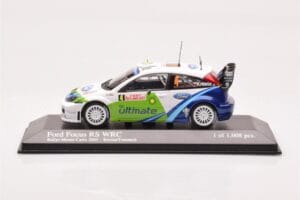
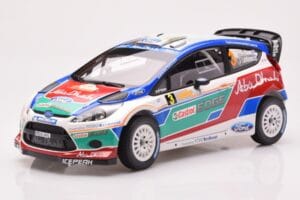
Ford Focus RS WRC #4 R. Kresta / J. Tomanek Rally Monte Carlo 2005 Minichamps 1:43
Only 2 left
Price:
£89.00
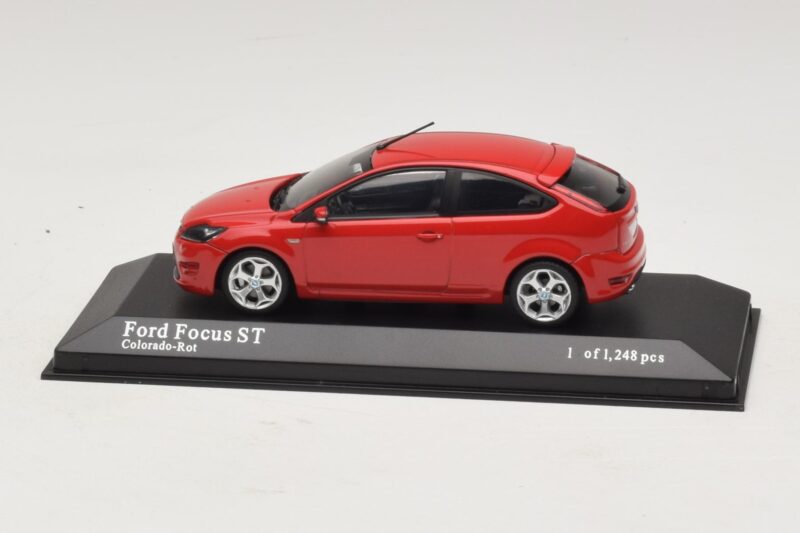
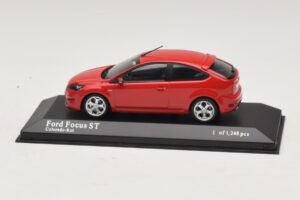
TL;DR: The Minichamps 1:43 Ford Focus ST Mk2 reproduces the 2008 hot hatch in red diecast. The sealed one-piece body carries the ST's bodykit lines, twin exhausts and correct stance, honouring the turbocharged five-cylinder engine that defined this generation. A strong anchor for a 2000s hot hatch collection.
Ford gave the Mk2 Focus ST an engine borrowed from an unlikely source, a Volvo-derived five-cylinder turbo that gave the car a genuinely distinctive character and soundtrack among its four-cylinder hot hatch rivals. Minichamps captures that character convincingly at 1:43 scale, right down to the twin tailpipes.
This casting arrives as a fixed, one-piece body, the hatch, doors and bonnet moulded solid into the shell rather than hinged. That construction holds the ST's wider bodykit lines true: the flared arches, deeper front bumper and integrated rear spoiler all read as one continuous shape rather than panels that need to align around a hinge. Shut lines are moulded as fine, consistent grooves, tracing the hatch outline and door edges without the widening a functional joint would introduce. The stance sits noticeably lower and wider than a standard Focus hatchback, capturing the ST's more aggressive ride height correctly.
Red paint on this casting carries a bright, slightly deeper finish typical of Ford's performance colour options for the period, distinct from the more muted palette offered on standard Focus trims. The twin exhaust tailpipes, a signature ST detail, are moulded and finished separately from the rear bumper rather than left as a flat printed outline. ST badging on the grille and tailgate stays legible under close inspection, and the wheels carry the larger, sportier alloy pattern the ST wore as standard. Getting that wheel and exhaust detail right matters on a hot hatch model, since those are the exact cues a knowledgeable buyer checks first to separate a proper ST from a dressed-up standard hatchback.
Rather than fitting a conventional four-cylinder turbo like most of its hot hatch rivals, Ford gave the Mk2 Focus ST a turbocharged five-cylinder engine shared in architecture with contemporary Volvo models. That unusual layout gave the car a genuinely different exhaust note, a distinctive off-beat thrum that set it apart from the more common four-cylinder soundtrack found elsewhere in the segment. That five-cylinder unit also delivered strong mid-range torque, the kind of pulling power that made the ST feel effortlessly quick in everyday driving rather than only at the top of the rev range.
Through the mid-to-late 2000s, hot hatch buyers had genuine choice: various rivals offered sharper handling or lower prices, but the Focus ST's five-cylinder engine and Ford's chassis tuning carved out its own space in the segment rather than simply competing on numbers. Where some rivals leaned on outright lap times to make their case, the Focus ST built its reputation on everyday usability paired with genuine character, a hatchback that felt special on a daily commute rather than only on a track day. That everyday-hero positioning is exactly what a well-detailed model of this generation should communicate on the shelf.
This Focus ST works well as the modern anchor of a hot hatch collection, the model that shows how far the segment had developed by the late 2000s compared with earlier decades. At 1:43 it sits easily alongside other performance hatchbacks from the same era, its distinctive five-cylinder identity giving it a genuine talking point beyond simple badge recognition. The sealed body asks nothing beyond regular dusting and steady handling. It pairs particularly well with earlier Escort-based performance models further along the same shelf, tracing Ford's hot hatch lineage across three decades in one continuous run.


Save £14.00