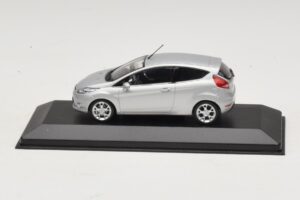
Used
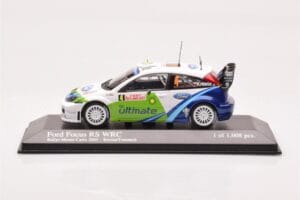
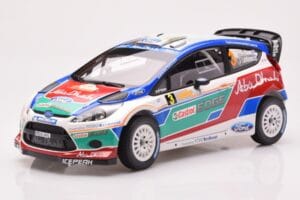
Ford Focus RS WRC #4 R. Kresta / J. Tomanek Rally Monte Carlo 2005 Minichamps 1:43
Only 2 left
Price:
£89.00
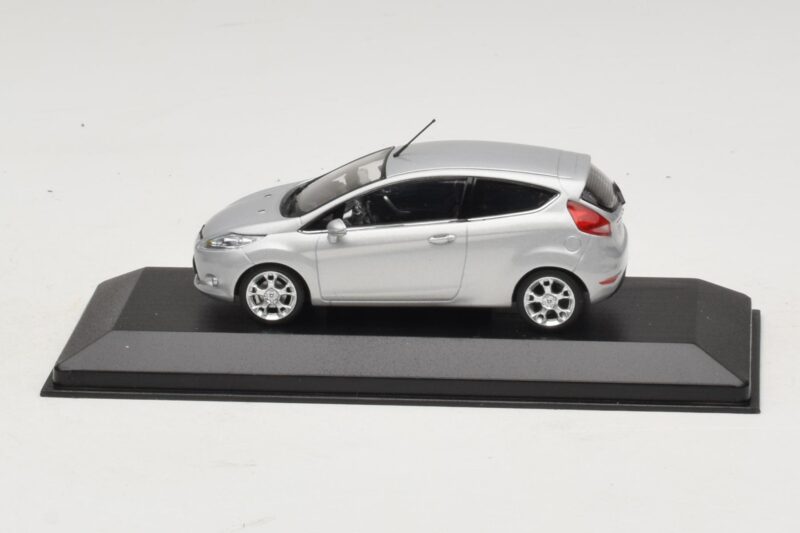
TL;DR: Minichamps' 1:43 Ford Fiesta Mk7 reproduces the 2008 global hatchback in Moondust Silver Metallic over a sealed diecast body. Zinc alloy construction holds tight panel lines and deep paint gloss. An honest, accessible entry point for a British hatchback shelf rather than a hero piece.
The Fiesta rarely gets the collector spotlight that rally-liveried Fords or race-winning M3s attract, and that is precisely the point of adding one. Minichamps' Mk7 reproduces Ford's first truly global small hatchback, the car that quietly outsold almost everything else on British roads through the 2000s and beyond.
Ford launched the Mk7 Fiesta in 2008 as the first product of its Kinetic Design language, a sharper, more expressive style than the outgoing Mk6 wore. It rode on a genuinely global platform, sold with only minor changes from Britain to Brazil, and it went on to become one of the best-selling cars in UK history through the following decade. Minichamps picks a mainstream hatchback rather than a hero trim, the honest way to represent a car whose real significance was volume, not glamour. The Fiesta's role in British motoring sits closer to the Golf GTI's than to any rally special, a car people actually drove to work rather than watched on a stage.
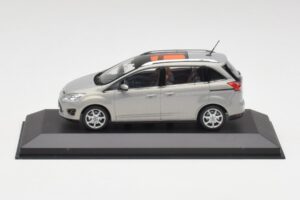
Moondust Silver Metallic was one of the Mk7's more popular factory finishes, and Minichamps' diecast rendering holds the flake pattern with a depth that reads correctly under a display lamp rather than flattening into plain grey. The body is a sealed, one-piece casting, so the story here is entirely about the exterior: the shutlines around the doors and boot run as consistent grooves, the wing mirrors and door handles are picked out separately from the body colour, and the glazing sits flush rather than proud. A sealed shell like this is standard practice for a mainstream subject at this scale, not a shortcut, and it lets the paint and trim carry the whole impression.
Zinc alloy diecast brings real heft to a model this size, noticeable the moment it clears its tray, and that density is part of what separates a serious 1:43 from a toy-shelf equivalent. Casting tolerances on diecast run a touch wider than resin allows, but on a compact hatchback the trade barely shows: the wheel arches keep their shape, the roofline stays true, and the metal body resists the warping a cheaper plastic shell can suffer over years on a sunny shelf. At this price segment, expect exactly this: accurate stance, correctly proportioned glazing, and paint that holds its gloss rather than premium hand-applied pinstriping.
1:43 is the compact-display scale, and a supermini like the Fiesta suits it well: the model sits at roughly ten centimetres long, small enough to line up a dozen across one shelf without crowding a larger 1:18 collection. Detail resolution at this scale is necessarily simplified compared with 1:18, so judge fidelity on what 1:43 can still deliver convincingly: the correct wheel design, an accurate grille shape, and a body colour matched to the real paint code rather than an approximation.
Building a themed British hatchback shelf works better with an honest everyday car in the mix than with wall-to-wall race liveries. The Mk7 Fiesta sits naturally alongside period rivals from the same supermini class, and its accessible diecast price point means a collector can afford several finishes without the outlay a limited resin run demands. It will never carry the story weight of a rally-winning Focus or a DTM-liveried M3, and there is no reason to pretend otherwise. What it offers instead is completeness: a shelf that tells the whole story of British motoring in the 2000s needs the car everyone actually drove, not only the ones people watched compete.
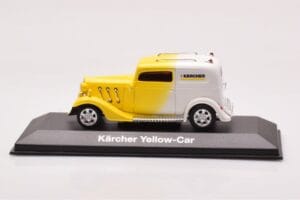
Save £14.00