{"ajaxurl":"https:\/\/models118.co.uk\/wp-admin\/admin-ajax.php?lang=en_GB","nonce":"8893ea4881","homeUrl":"https:\/\/models118.co.uk\/","shopUrl":"https:\/\/models118.co.uk\/shop\/","cartUrl":"https:\/\/models118.co.uk\/cart-en-gb\/","checkoutUrl":"https:\/\/models118.co.uk\/checkout\/","skipCart":true,"collectionLimit":12,"i18n":{"addedToCart":"Added to basket","addToWishlist":"Add to wishlist","addedToWishlist":"Added to wishlist","removeFromWishlist":"Remove from wishlist","removedFromWishlist":"Removed from wishlist","undo":"Undo","error":"Something went wrong","loading":"Loading...","outOfStock":"Out of stock","viewCart":"View basket","proceedToCheckout":"Proceed to checkout","addedToCollection":"Added to your collection","reserved":"Added to your collection","soldOut":"Sold out","invalidEmail":"Please enter a valid email address","connectionError":"Connection error. Please try again.","tocToggle":"On this page","close":"Close","inCartTooltip":"Already in your basket \u2013 open your basket to check out","loginToSave":"Sign in to save this model","waitlistNotify":"Notify me","waitlistOnList":"On the waiting list \u2713","waitlistJoined":"You're on the waiting list. We'll email you the moment this model is available again.","waitlistRemoved":"Done \u2014 you're off the waiting list for this model.","waitlistRateLimit":"Too many attempts \u2014 please try again shortly","waitlistTurnstile":"We couldn't complete the check \u2014 please try again","waitlistError":"Sorry, something went wrong. Please try again in a moment."},"wishlist":{"loggedIn":false,"loginUrl":"https:\/\/models118.co.uk\/my-account\/","addAction":"models118_wishlist_add","removeAction":"models118_wishlist_remove"},"waitlist":{"loggedIn":false,"subscribeAction":"models118_waitlist_subscribe","toggleAction":"models118_waitlist_toggle","stateAction":"models118_waitlist_state"},"stats":{"models":2425,"brands":214,"manufacturers":129,"collectors":10000},"product":{"id":1688724,"sku":"30317-W1","condition":"used","availability":"in_stock","name":"Caterham Super Seven Green Anson 1:18","brand":"Caterham","manufacturer":"Anson","scale":"1:18","material":"Diecast","price":47,"regularPrice":47,"isOnSale":false,"savingsAmount":0,"stockQty":1,"stockStatus":"very_low","isDiscontinued":false,"image":"https:\/\/models118.co.uk\/wp-content\/uploads\/2026\/10\/caterham-super-seven-green-anson-1-18-30317-w1-1-1-300x200.jpg","permalink":"https:\/\/models118.co.uk\/caterham-super-seven-green-anson-1-18-30317-w1\/"}}
Cookies on Models118
We use cookies to remember your preferences, understand how the shop is used and show you models and offers that suit your interests. What you allow is up to you, and you can change it at any time.
Always active
The technical storage or access is strictly necessary for the legitimate purpose of enabling the use of a specific service explicitly requested by the subscriber or user, or for the sole purpose of carrying out the transmission of a communication over an electronic communications network.
The technical storage or access is necessary for the legitimate purpose of storing preferences that are not requested by the subscriber or user.
The technical storage or access that is used exclusively for statistical purposes.
The technical storage or access is required to create user profiles to send advertising, or to track the user on a website or across several websites for similar marketing purposes.
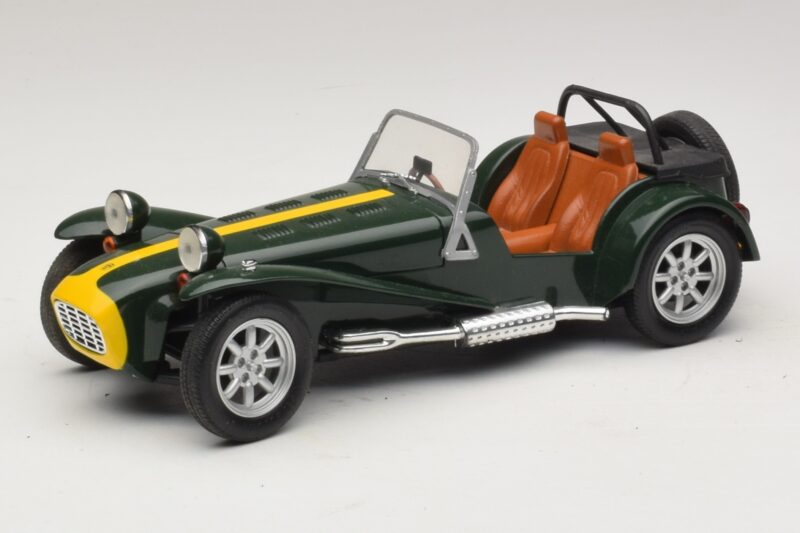
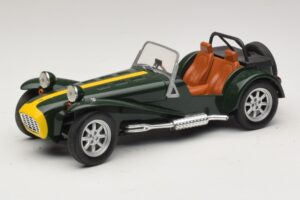
Anson's 1:18 diecast Caterham Super Seven reproduces the 1973 model that marked the handover from Lotus to Caterham Cars, finished in green with cycle wings and an open cockpit. The bonnet lifts on a working hinge to reveal the compact engine bay behind that stripped-down, lightweight British sports car formula. A small, honest shape that rewards close inspection and sits well as a contrast piece beside larger GT coupes and saloons on a themed shelf.
TL;DR: Anson's 1:18 diecast Caterham Super Seven marks the moment Colin Chapman's minimalist roadster passed from Lotus to Caterham Cars in 1973, finished here in green with cycle wings and a bonnet that lifts over the engine. A lightweight British sports car captured at genuine diecast scale.
Few cars wear their philosophy as plainly as the Seven: strip away everything that isn't needed for speed and handling, and keep it that way for decades. When Caterham took over production from Lotus in 1973, it inherited that stubbornness wholesale. Anson's 1:18 diecast renders the result in green, cycle-winged and open to the elements, exactly as minimal as the real thing insists on being.
Anson's Caterham Super Seven at 1:18
Colin Chapman's Minimalist Formula
Colin Chapman's original Lotus Seven arrived in 1957 built on a single idea: a sports car stripped of anything that added weight without adding speed. No boot, no proper doors, cycle wings over the front wheels, and a front-engine, rear-wheel-drive layout kept as simple as the regulations of the day allowed. It was never meant to be comfortable. It was meant to be immediate, the kind of car where every input from the driver shows up instantly in how the chassis behaves. That formula proved far more durable than Lotus itself expected, outlasting several other models in the range and refusing to go out of fashion.
The 1973 Handover and What It Preserved
In 1973, Lotus sold the rights to the Seven to Caterham Cars, a small specialist that had been selling and servicing the model as a dealer. Rather than reinvent the design, Caterham kept building it essentially unchanged, a decision that turned a Lotus curiosity into a British institution still in production today. The car this diecast represents sits right at that handover point, still carrying the lines Chapman drew but now wearing a Caterham badge rather than a Lotus one. Few transitions in British motoring history preserved so much of the original while changing so little about how the car actually felt to drive.
A Stripped-Back Shape in Diecast
Cycle Wings, Open Cockpit, Working Bonnet
Anson casts this Super Seven with a bonnet that lifts on a working hinge, exposing the compact engine bay behind a long, flat panel that dominates the car's proportions far more than the tiny cabin behind it. The cycle wings sit proud of the slender body, a detail that has to be modelled as separate pieces rather than moulded into a single panel if it is going to read correctly, and here they do. The open cockpit leaves the simple bucket seats and exposed gear lever visible without any glazing in the way, which is honestly how the real car is meant to be seen.
What the Scale Demands of Such a Small Car
A car this small and this minimal is unforgiving at 1:18, because there is nowhere for a casting to hide an inaccurate proportion behind bodywork or trim. The narrow track, the long bonnet relative to the cabin, and the low scuttle height all have to be right, or the model reads as a generic roadster rather than a Seven specifically. Anson's green finish sits well on the exposed panel surfaces, and the wire-style wheels fill the arches correctly rather than looking lost in them, which is the detail that most diecast interpretations of small British sports cars get wrong first.
A Lightweight Contrast on a Crowded Shelf
Most 1:18 displays lean toward substantial cars, saloons and GT coupes that fill a shelf on their own terms. A Super Seven does the opposite, and that is exactly its value in a mixed collection: a small, open, deliberately spare shape that throws everything around it into sharper relief. It pairs naturally with other British lightweights of the era, or sits as a palate-cleanser between heavier supercars and saloons. Anson's diecast will never be the most technically detailed model on a shelf, but it captures the one thing that matters most about this car, that stripped-down honesty Chapman built into it from the start. For a collector who values idea over spectacle, that is enough.
Create a free account and claim 5% off your first order — from hundreds of collectible 1:18, 1:43 and 1:12 models by Porsche, Mercedes-Benz, BMW and more.
{"id":1688724,"name":"Caterham Super Seven Green Anson 1:18","price":"£<\/span>47.00<\/bdi><\/span>","image":"https:\/\/models118.co.uk\/wp-content\/uploads\/2026\/10\/caterham-super-seven-green-anson-1-18-30317-w1-1-1-400x400.jpg","permalink":"https:\/\/models118.co.uk\/caterham-super-seven-green-anson-1-18-30317-w1\/","brand":"Caterham"}