{"ajaxurl":"https:\/\/models118.co.uk\/wp-admin\/admin-ajax.php?lang=en_GB","nonce":"2258313ba7","homeUrl":"https:\/\/models118.co.uk\/","shopUrl":"https:\/\/models118.co.uk\/shop\/","cartUrl":"https:\/\/models118.co.uk\/cart-en-gb\/","checkoutUrl":"https:\/\/models118.co.uk\/checkout\/","skipCart":true,"collectionLimit":12,"i18n":{"addedToCart":"Added to basket","addToWishlist":"Add to wishlist","addedToWishlist":"Added to wishlist","removeFromWishlist":"Remove from wishlist","removedFromWishlist":"Removed from wishlist","undo":"Undo","error":"Something went wrong","loading":"Loading...","outOfStock":"Out of stock","viewCart":"View basket","proceedToCheckout":"Proceed to checkout","addedToCollection":"Added to your collection","reserved":"Added to your collection","soldOut":"Sold out","invalidEmail":"Please enter a valid email address","connectionError":"Connection error. Please try again.","tocToggle":"On this page","close":"Close","inCartTooltip":"Already in your basket \u2013 open your basket to check out","loginToSave":"Sign in to save this model","waitlistNotify":"Notify me","waitlistOnList":"On the waiting list \u2713","waitlistJoined":"You're on the waiting list. We'll email you the moment this model is available again.","waitlistRemoved":"Done \u2014 you're off the waiting list for this model.","waitlistRateLimit":"Too many attempts \u2014 please try again shortly","waitlistTurnstile":"We couldn't complete the check \u2014 please try again","waitlistError":"Sorry, something went wrong. Please try again in a moment."},"wishlist":{"loggedIn":false,"loginUrl":"https:\/\/models118.co.uk\/my-account\/","addAction":"models118_wishlist_add","removeAction":"models118_wishlist_remove"},"waitlist":{"loggedIn":false,"subscribeAction":"models118_waitlist_subscribe","toggleAction":"models118_waitlist_toggle","stateAction":"models118_waitlist_state"},"stats":{"models":2269,"brands":214,"manufacturers":129,"collectors":10000},"product":{"id":1688699,"sku":"08926","condition":"used","availability":"in_stock","name":"BMW Isetta 250 Lufthansa Revell 1:18","brand":"BMW","manufacturer":"Revell","scale":"1:18","material":"Diecast","price":48,"regularPrice":48,"isOnSale":false,"savingsAmount":0,"stockQty":1,"stockStatus":"very_low","isDiscontinued":false,"image":"https:\/\/models118.co.uk\/wp-content\/uploads\/2026\/10\/bmw-isetta-250-lufthansa-revell-1-18-08926-1-1-300x200.jpg","permalink":"https:\/\/models118.co.uk\/bmw-isetta-250-lufthansa-revell-1-18-08926\/"}}
Cookies on Models118
We use cookies to remember your preferences, understand how the shop is used and show you models and offers that suit your interests. What you allow is up to you, and you can change it at any time.
Always active
The technical storage or access is strictly necessary for the legitimate purpose of enabling the use of a specific service explicitly requested by the subscriber or user, or for the sole purpose of carrying out the transmission of a communication over an electronic communications network.
The technical storage or access is necessary for the legitimate purpose of storing preferences that are not requested by the subscriber or user.
The technical storage or access that is used exclusively for statistical purposes.
The technical storage or access is required to create user profiles to send advertising, or to track the user on a website or across several websites for similar marketing purposes.
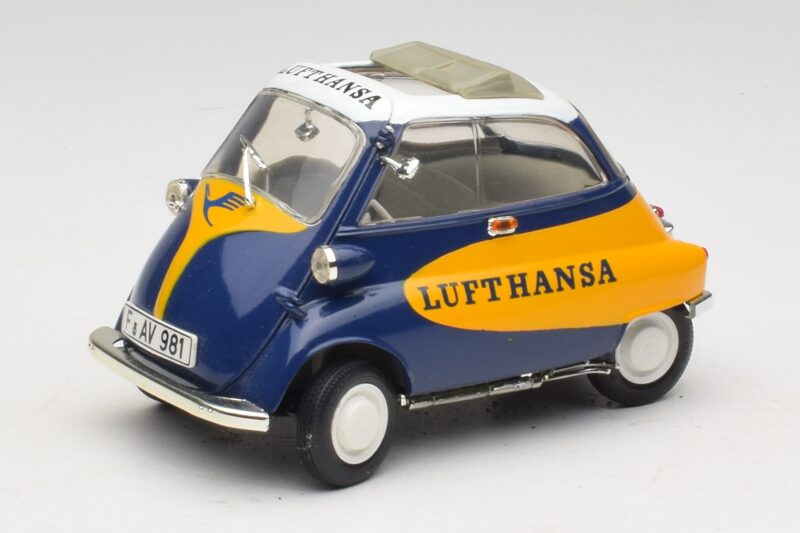
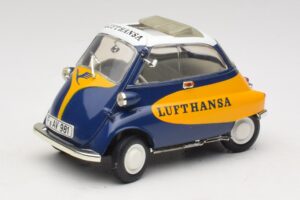
Revell's 1:18 BMW Isetta 250 wears genuine Lufthansa airport ground-transport livery on the 1955 bubble car that helped BMW survive the postwar years. The model's single front door genuinely opens, swinging outward with the steering column attached exactly as the real microcar's entry mechanism worked. A distinctive, instantly recognisable subject for collectors building a postwar European micro-car or corporate-fleet themed display.
TL;DR: Revell's 1:18 BMW Isetta 250 wears genuine Lufthansa ground-transport livery on the 1955 bubble car that helped BMW survive the postwar years. The model's single front door genuinely opens, hinged with the steering column exactly as the real microcar worked, built in diecast for collectors of postwar European micro-cars, a genuinely functional detail worth demonstrating.
Nothing about the Isetta's single-door layout was a styling flourish, it was the simplest solution for a cabin barely wide enough for two seats, and that door genuinely swings open on Revell's casting, steering wheel and column pivoting outward with it just as the real microcar's did. Painted in Lufthansa's airport ground-transport scheme, this example represents a working fleet vehicle rather than a private runabout.
Revell's Functioning Front Door on a Faithful Micro-Scale Casting
The Isetta's entire identity rests on its single, hinged front door, the entire front panel of the car swinging outward complete with the steering wheel and column attached to it, a genuinely unusual engineering solution born from the need to fit two occupants into an extremely narrow cabin. Revell reproduces that mechanism functionally rather than as decoration: the door swings open on this 1:18 casting exactly as it did on the real microcar, taking the steering column with it, which makes posing the model with the door open a genuinely informative display choice rather than just a party trick. Behind that door the cabin shows a simplified but legible dashboard and bench-style seating, the layout the real Isetta used to maximise what little interior space a car this small could offer. Diecast construction gives the model real weight for its compact footprint, appropriate for a microcar whose real-world charm came partly from how improbably small and light it actually was. The Lufthansa livery, the airline's distinctive branding applied across the body in period-correct colours and lettering, is tampo-printed with enough sharpness to hold up under close inspection, an important detail on a subject where the livery itself is a major part of the collecting interest rather than a secondary decoration. Getting that printing crisp matters more here than on almost any other subject in the catalogue.
The Isetta and BMW's Postwar Survival
BMW built the Isetta under licence from the Italian firm Iso Rivolta, adapting a design the Italian company had originally developed, and the timing could not have mattered more. In the mid-1950s BMW was in genuine financial difficulty, its prewar luxury car business devastated and a struggling German economy offering little immediate appetite for expensive motoring. The Isetta, cheap to build, cheap to buy and cheap to run on its small single-cylinder motorcycle engine, found exactly the market BMW desperately needed, and it sold in large enough numbers to help keep the company solvent through one of its most precarious periods. That the Isetta effectively bought BMW time to develop the larger cars that eventually restored its fortunes is a genuinely important piece of the marque's corporate history, not just an amusing footnote about a tiny, door-at-the-front oddity. Fleet and institutional buyers found uses for the Isetta beyond private ownership, and Lufthansa's adoption of the microcar for ground-transport duties around its airport operations reflects exactly that kind of practical, low-cost fleet thinking common across postwar European business. A Lufthansa-liveried Isetta therefore tells two stories at once: BMW's survival through an unglamorous but essential product, and the wider postwar culture of extracting maximum utility from minimal, affordable machinery. Both threads make this a more substantial subject than its diminutive size first suggests.
A Compact Subject with Outsized Collecting Interest
At 1:18, the Isetta's tiny footprint means several examples fit easily on a single shelf, inviting a themed micro-car grouping that larger subjects simply cannot support in the same space. Display it with the door swung open to show off the mechanism and interior, the feature that makes this casting genuinely worth owning rather than just another postwar runabout. The Lufthansa livery adds a corporate-fleet dimension that pure private-ownership microcars lack, appealing equally to BMW collectors, micro-car specialists and anyone drawn to unusual branded fleet vehicles. Few postwar subjects pack this much engineering and corporate history into a car this genuinely small. That combination of scale, mechanism and history is rare enough to justify a dedicated spot on the shelf.
Create a free account and claim 5% off your first order — from hundreds of collectible 1:18, 1:43 and 1:12 models by Porsche, Mercedes-Benz, BMW and more.