BMW X6M F86 Red Norev 1:18
Price:
94.00 €
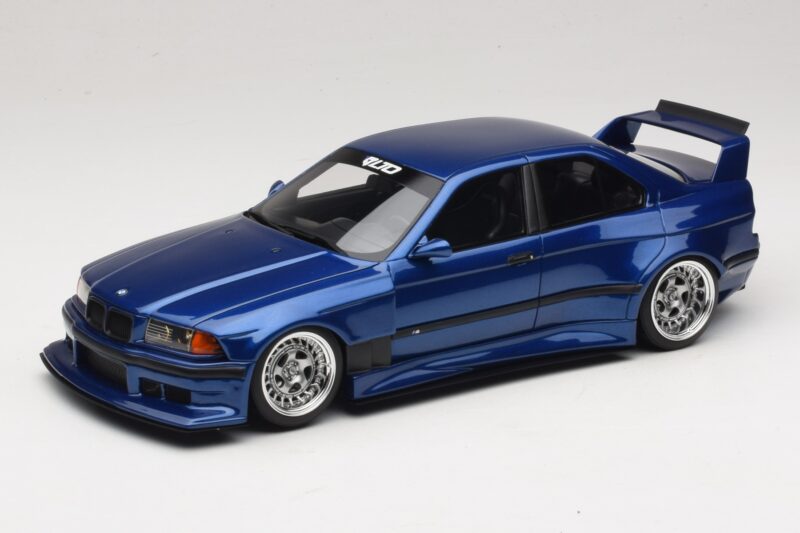
TL;DR: Otto's 1:18 resin BMW E36 LTO Turbo reproduces digital designer Khyzyl Saleem's widebody concept, finished in Avus Blue on a sealed resin body with no opening panels. It bridges rendered automotive design culture and physical scale modelling, cast in small numbers with sharp shutlines around its flared, vented bodywork.
Khyzyl Saleem built a following through digital renders long before any of his widebody concepts existed as real metal, and the E36-based LTO Turbo is one of the designs that crossed from screen to street. Otto's resin reproduction follows that same journey once more, translating a design born in rendering software into a physical 1:18 model finished in the historic BMW shade Avus Blue.
Khyzyl Saleem's reputation grew through a wave of digital automotive art in the 2010s, widebody renders and imagined liveries shared online long before the physical tuning industry caught up with the aesthetic he was proposing. The E36-generation BMW 3 Series, a car with a genuinely clean factory silhouette underneath, proved a popular canvas for that work, and the LTO Turbo represents one of the designs that eventually made the jump from render to a built car.
That crossover between digital-first design and physical fabrication is relatively recent in automotive culture, and it changes how a subject like this earns its place in a model collection: not through motorsport history or factory specification, but through a documented design lineage that started on a screen. The flared arches and vented bonnet that define the LTO Turbo's look are Saleem's own proportions rather than a factory kit or a historic tuning house's work, and that authorship is part of what a buyer is collecting alongside the BMW underneath it.
Otto builds this E36 in resin, a material suited particularly well to a widebody design defined by deep, continuous arch flares and complex compound curves. Resin takes tighter casting tolerances than diecast, holding sharper edges along the flare lines and finer detail in the vented bonnet than a metal die could reproduce at the same scale, at the cost of the mass a zinc alloy body would carry instead.
This casting has no opening doors, bonnet or boot, built as a single sealed shell, and that construction suits a design-focused subject well: with no hinge lines interrupting the arches, the flare reads as one continuous surface from the front wing to the rear quarter, exactly as it would in Saleem's original renders. Handling the model, the light weight relative to a diecast equivalent is immediately apparent, a trade-off resin buyers accept for the sharper detail resolution it delivers on a shape this dependent on precise arch geometry.
Avus Blue takes its name from the AVUS circuit in Berlin and carries genuine history within BMW's M colour palette, having appeared on earlier M3 generations before this widebody treatment ever existed. Applying it to a heavily modified E36 draws a deliberate line back to that motorsport-adjacent heritage, even though this specific build has no racing pedigree of its own. Under directed light the colour's depth shows clearly against the smooth resin surface, and the shade's relative darkness throws sharp shadow along the arch flares, making the widened stance read clearly from a normal shelf viewing distance. Underneath the widebody additions, the E36's factory proportions remain legible, the long bonnet and compact glasshouse that made the generation a popular tuning canvas in the first place.
This LTO Turbo sits apart from a conventional themed BMW M collection, better suited to a display built around modern tuning and design culture than one following factory M-car history in sequence. Its resin construction and sealed-body build place it above mass-market diecast in both finish quality and price, consistent with the small-batch production typical of design-led resin subjects. Paired with a factory-liveried E36 M3 nearby, the contrast tells a genuinely interesting story about how far a widebody design can travel from a car's original shape while keeping its underlying proportions recognisable.