BMW X6M F86 Red Norev 1:18
Price:
£81.00
Save £4.00
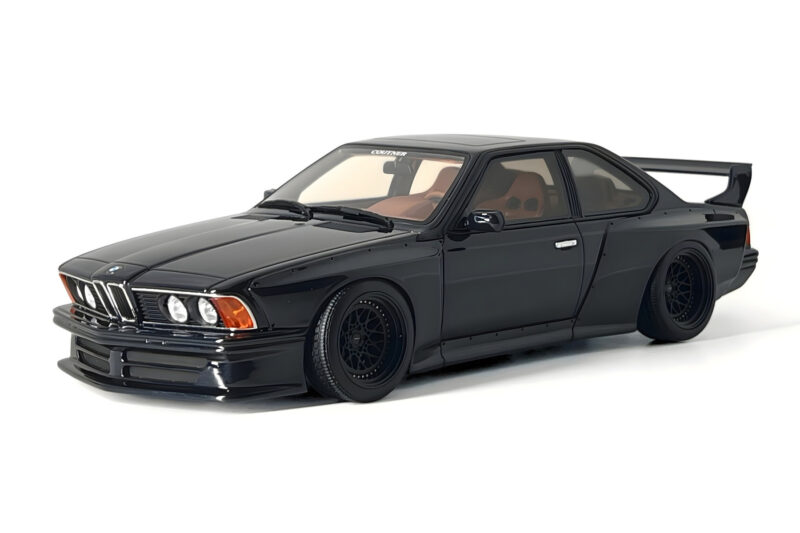
TL;DR: Otto's 1:18 BMW E24 635 CSi renders the classic shark-nose coupe as a widebody restomod, cast as a sealed resin shell in Deep Blue Metallic. Flared arches, deep-dish wheels and a fixed one-piece body carry the whole story on the exterior, bridging 1980s BMW engineering with modern customisation culture.
BMW built the E24 6 Series from 1976 to 1989, its long sloping nose earning the 'shark' nickname almost immediately, and the CSi variant carried that shape into European touring car racing. This build takes the opposite route from a period-correct restoration: a widebody kit widens the arches well beyond anything BMW offered from the factory, turning a stately grand tourer into something closer to a show car.
The E24 replaced the earlier E9 coupe as BMW's flagship two-door, and the CSi designation marked the fuel-injected, higher-output version aimed at long-distance autobahn cruising. Its low, sloped nose was as much an aerodynamic decision as a styling statement, and that shape carried the car into European touring car competition through the early 1980s, where lightened, race-prepared versions ran against Jaguar and Ford rivals. The production car never chased outright speed records, but its combination of a straight-six engine, a long wheelbase and handsome proportions made it one of the more coherent grand tourers BMW built in that era.
Widebody kits belong to a different tradition entirely, one built around visual impact rather than period authenticity, and applying one to a car as restrained as the E24 is a deliberate contrast. The wider arches on this build push well past the factory wheel arch line, housing a stance the original engineers never planned for. It is the kind of build that divides opinion among classic BMW owners precisely because it treats a design icon as raw material rather than a museum piece, and Otto's model does not try to soften that tension. The proportions here are the widebody kit's, not BMW's original ones.
Reproducing a widebody kit convincingly depends on getting the arch flare and the gap between tyre and bodywork exactly right, since that relationship is the entire visual point of the modification. Otto casts this 635 CSi as a single sealed resin shell, with no door or bonnet built to open, which removes the hinge tolerances that could otherwise soften those flared edges. The result is a continuous line running from the front wing, over the flare, and back along the sill, with no gap breaking the silhouette. For a build defined by its bodywork, that unbroken surface is exactly where the casting needs to succeed.
Deep Blue Metallic sits at the darker, more restrained end of the colour choices a widebody build like this could have taken, and it works in the model's favour: the paint reads as considered rather than shouted. Under a raking light the metallic flake picks out the curvature of the flared arches, tracing the widebody kit's shape more clearly than a flat colour would. Resin holds that gloss with real consistency across a body this size, and the deep-dish wheels, finished separately, provide the contrast that keeps the design from reading as one uniform block of colour.
Judging a widebody restomod model is a different exercise from judging a factory-original replica, because there is no single reference photo to check it against. What matters instead is internal consistency: does the ride height match the flare, do the wheels fill the arches the way the kit intended, and does the stance look deliberate rather than accidental. On this casting the front and rear track widths are matched to the flared bodywork rather than left at the standard E24's narrower stance, which is the detail separating a convincing widebody reproduction from a standard body with wide arches simply glued on. The shark nose is untouched, which is the right call: changing the front end would undermine the one element that still ties this build back to the original CSi. A collector who wants a bone-standard, factory-spec E24 CSi should look elsewhere, and that is worth saying plainly. This model exists for the opposite buyer, someone who wants the tension between a 1980s grand tourer's classic lines and a distinctly modern widebody silhouette sitting on the same shelf.
A widebody E24 works best in a display that already includes something more conventional to contrast it against, whether that is a standard-bodied CSi from the same era or another 1980s BMW coupe left in factory trim. Placed side by side, the difference in stance and arch width tells the whole story without needing a caption. The sealed body keeps things simple in practical terms, nothing to worry about over time, and the deep blue holds its own under most display lighting. At this price tier, resin construction with a factory-quality paint finish represents a fair trade against a smaller die-cast alternative that would struggle with the flare geometry. For a shelf built around modern BMW customisation, this is a strong anchor piece.


Save £24.00