{"ajaxurl":"https:\/\/models118.co.uk\/wp-admin\/admin-ajax.php?lang=en_GB","nonce":"a4c944ccd6","homeUrl":"https:\/\/models118.co.uk\/","shopUrl":"https:\/\/models118.co.uk\/shop\/","cartUrl":"https:\/\/models118.co.uk\/cart-en-gb\/","checkoutUrl":"https:\/\/models118.co.uk\/checkout\/","skipCart":true,"collectionLimit":12,"i18n":{"addedToCart":"Added to basket","addToWishlist":"Add to wishlist","addedToWishlist":"Added to wishlist","removeFromWishlist":"Remove from wishlist","removedFromWishlist":"Removed from wishlist","undo":"Undo","error":"Something went wrong","loading":"Loading...","outOfStock":"Out of stock","viewCart":"View basket","proceedToCheckout":"Proceed to checkout","addedToCollection":"Added to your collection","reserved":"Added to your collection","soldOut":"Sold out","invalidEmail":"Please enter a valid email address","connectionError":"Connection error. Please try again.","tocToggle":"On this page","close":"Close","inCartTooltip":"Already in your basket \u2013 open your basket to check out","loginToSave":"Sign in to save this model","waitlistNotify":"Notify me","waitlistOnList":"On the waiting list \u2713","waitlistJoined":"You're on the waiting list. We'll email you the moment this model is available again.","waitlistRemoved":"Done \u2014 you're off the waiting list for this model.","waitlistRateLimit":"Too many attempts \u2014 please try again shortly","waitlistTurnstile":"We couldn't complete the check \u2014 please try again","waitlistError":"Sorry, something went wrong. Please try again in a moment."},"wishlist":{"loggedIn":false,"loginUrl":"https:\/\/models118.co.uk\/my-account\/","addAction":"models118_wishlist_add","removeAction":"models118_wishlist_remove"},"waitlist":{"loggedIn":false,"subscribeAction":"models118_waitlist_subscribe","toggleAction":"models118_waitlist_toggle","stateAction":"models118_waitlist_state"},"stats":{"models":2665,"brands":215,"manufacturers":129,"collectors":10000},"product":{"id":1700033,"sku":"155742601","condition":"new","availability":"in_stock","name":"BMW 2002 Ti #1 Team Leru S. Manhalter 1000km Osterreichring Winner 1974 Minichamps 1:18","brand":"BMW","manufacturer":"Minichamps","scale":"1:18","material":"Diecast","price":142,"regularPrice":142,"isOnSale":false,"savingsAmount":0,"stockQty":3,"stockStatus":"very_low","isDiscontinued":false,"image":"https:\/\/models118.co.uk\/wp-content\/uploads\/2026\/10\/bmw-2002-ti-1-team-leru-s-manhalter-1000km-osterreichring-winner-1974-minichamps-1-18-155742601-1-1-300x200.jpg","permalink":"https:\/\/models118.co.uk\/bmw-2002-ti-1-team-leru-s-manhalter-1000km-osterreichring-winner-1974-minichamps-1-18-155742601\/"}}
Cookies on Models118
We use cookies to remember your preferences, understand how the shop is used and show you models and offers that suit your interests. What you allow is up to you, and you can change it at any time.
Always active
The technical storage or access is strictly necessary for the legitimate purpose of enabling the use of a specific service explicitly requested by the subscriber or user, or for the sole purpose of carrying out the transmission of a communication over an electronic communications network.
The technical storage or access is necessary for the legitimate purpose of storing preferences that are not requested by the subscriber or user.
The technical storage or access that is used exclusively for statistical purposes.
The technical storage or access is required to create user profiles to send advertising, or to track the user on a website or across several websites for similar marketing purposes.
BMW 2002 Ti #1 Team Leru S. Manhalter 1000km Osterreichring Winner 1974 Minichamps 1:18
New arrival
1/6
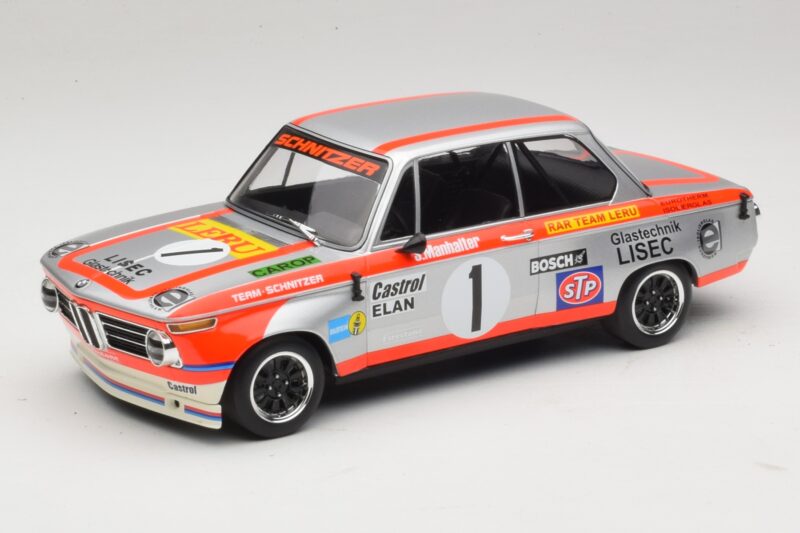
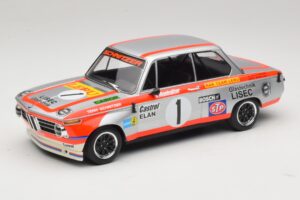
Minichamps' 1:18 diecast BMW 2002 Ti recreates the Team Leru #1 car of S. Manhalter, winner of the 1000km Osterreichring in 1974. A compact two-door saloon in racing trim, it is a sealed one-piece casting where the interest lies in stance, paintwork and period graphics. A neat winner's-car piece for 1970s touring-car displays.
About the BMW 2002 Ti #1 Team Leru S. Manhalter 1000km Osterreichring Winner 1974 Minichamps 1:18
TL;DR: The Minichamps BMW 2002 Ti 1:18 is a diecast replica of the #1 Team Leru car driven by S. Manhalter to victory in the 1974 1000km Osterreichring. Its sealed one-piece body puts the emphasis on compact proportions, paintwork and race graphics, suiting collectors of 1970s touring cars and BMW saloon racing.
Small, square and quick, the BMW 2002 became a touring-car staple. Winners tend to be remembered by their numbers and liveries, and this Team Leru car carries both. In 1:18 it shows how much presence a compact two-door saloon can have when it sits next to bigger racers on a shelf.
Minichamps BMW 2002 Ti at 1:18: Mass and Proportion
A Small Body Cast Tight
The 2002 is a short, upright two-door, and 1:18 reduces it to around 23 cm. That compactness works in the model's favour, because a smaller body concentrates detail: the glasshouse, the slim pillars, the bumper line and the arches all sit within a single glance. Zinc alloy gives the piece a satisfying density for its size, noticeably heavier in the hand than its footprint suggests. The casting is one sealed shell, so doors, bonnet and boot are represented by fixed shut lines rather than hinged panels. Those lines run continuous and even, and the eye gets a clean read of the body's simple slab sides. With no hinges there is no gap tolerance to accommodate, and that shows in how tidy the cuts look.
Livery Registration on a Winner's Car
Winner's liveries reward close inspection. Team Leru's number 1, the sponsor lettering and any colour breaks must line up with the body creases beneath them, and at this scale printed graphics should have sharp edges with no bleed. Hold the model under a directional lamp and check that the paint is smooth across the broad door panels, since a flat-sided saloon exposes orange peel or uneven coverage quickly. Wheel fitment matters too: look for a stance that sits level with the arch lips, neither jacked up nor slammed, because that single detail separates a convincing racer from an approximate one.
Touring Car Racing and the 1974 Osterreichring Win
Why the 2002 Ti Suits a Race Livery
BMW's 2002 range earned its place on circuits across Europe in the late 1960s and 1970s as a light, nimble saloon that punched above its weight. The Ti designation marks a more powerful road version, a natural base for competition preparation. That lineage matters for a collector: the car on your shelf is recognisably a compact family saloon, only wearing race numbers. Long-distance races on circuits such as the Osterreichring put reliability and consistency ahead of outright speed, so a win there says something about the whole package rather than a single quick lap.
Team Leru and a Precise Race Record
Team Leru and S. Manhalter are named on the model, and that specificity is part of the appeal: winner's cars with a precise race and year attached are easier to place in a chronology than generic racing liveries. The product data records this as the 1000km Osterreichring winner of 1974, entered as number 1, and it gives no further detail, so lap-by-lap storytelling is best sourced from race archives. What the model itself offers is a clean, period-correct representation of that single winning entry, which is exactly what a themed touring-car display needs.
Display Notes for a 1970s Touring Shelf
Pairing and Care
At roughly 23 cm, this is a comfortable fit for a standard model car display case, with room beside it for other 1:18 saloons. Pair it with period Ford and Mercedes touring racers and the 2002 becomes the compact counterpoint to bigger-engined rivals. Keep it out of direct sunlight, dust it with a soft brush, and handle it by the base rather than the bodywork so the printed graphics stay crisp. Diecast ages steadily, holding its shape on a shelf for years. A sealed body is the norm for racing models at this level, and it means nothing on the casting can work loose. Collectors who value race-and-year specificity will find this an easy model to buy with confidence.
Create a free account and claim 5% off your first order — from hundreds of collectible 1:18, 1:43 and 1:12 models by Porsche, Mercedes-Benz, BMW and more.
{"id":1700033,"name":"BMW 2002 Ti #1 Team Leru S. Manhalter 1000km Osterreichring Winner 1974 Minichamps 1:18","price":"£<\/span>142.00<\/bdi><\/span>","image":"https:\/\/models118.co.uk\/wp-content\/uploads\/2026\/10\/bmw-2002-ti-1-team-leru-s-manhalter-1000km-osterreichring-winner-1974-minichamps-1-18-155742601-1-1-400x400.jpg","permalink":"https:\/\/models118.co.uk\/bmw-2002-ti-1-team-leru-s-manhalter-1000km-osterreichring-winner-1974-minichamps-1-18-155742601\/","brand":"BMW"}