Used
Back in stock

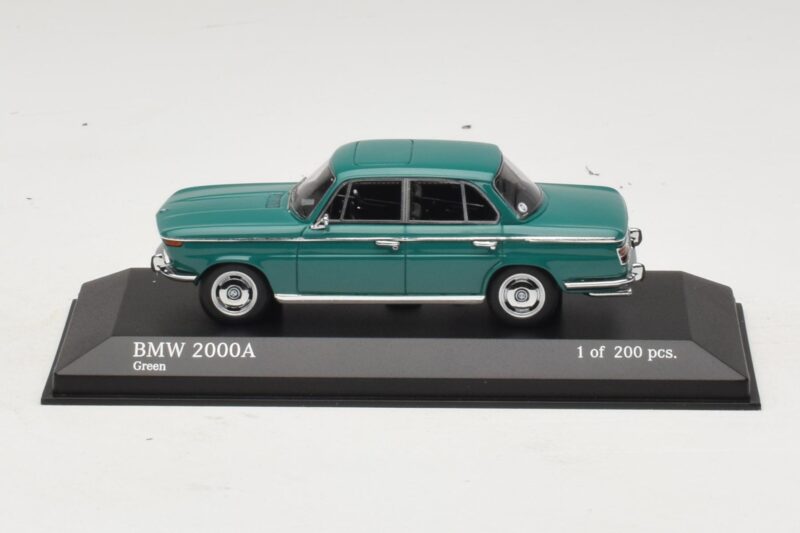
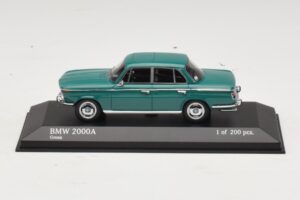
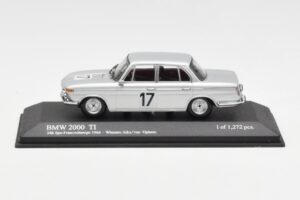
TL;DR: Minichamps' 1:43 BMW 2000A reproduces a 1962 New Class sedan in Green diecast, the sealed one-piece body holding crisp shut lines and the Hofmeister-kink glasshouse that defined BMW's post-war revival. A compact way to hold the sedan that saved BMW from being bought out.
BMW's New Class sedans arrived in the early 1960s at a moment when the company's survival was genuinely in doubt, and their success is why BMW still exists as an independent manufacturer today. Minichamps' 1:43 BMW 2000A puts that history on a shelf in Green diecast, its upright glasshouse and defined waistline crease reading as unmistakably BMW even six decades on.
Minichamps casts the 2000A as a single sealed body, which suits a sedan whose slim pillars and upright glasshouse depend on continuous, unbroken lines to read correctly at 1:43. The rear window surround follows the reverse-angle kink at the base of the C-pillar, a detail BMW design chief Wilhelm Hofmeister introduced on the New Class and one that later became known by his name across the entire industry. Door shuts and the boot line run as clean, single grooves with no hinge tolerance to disturb them, and the chrome window surrounds and bumpers are picked out separately from the body colour rather than moulded in one flat finish.
The Green finish sits on a hard metal shell with the kind of even, slightly muted gloss period BMW brochures favoured for a family sedan rather than a sports model. Under a display light the paint holds its depth without flattening into a single tone, and the glazing sits flush in its apertures rather than standing proud of the bodywork. At roughly ten centimetres long, the model captures the New Class sedan's tall, slightly boxy stance, a shape built for interior space and visibility rather than aerodynamic drama, and one that reads instantly as period-correct against later, lower BMW saloons.
By the late 1950s BMW was in genuine financial trouble, reduced to building bubble cars and a large, expensive luxury saloon that few could afford, and a takeover by Daimler-Benz was seriously discussed. The New Class sedans, launched from 1961, changed that trajectory entirely: a properly sized, properly priced family saloon that sold in the numbers BMW needed to survive as an independent company. The 2000A sits within that same generation, carrying the New Class's core proportions and engineering into the decade that followed, and it is genuinely difficult to overstate how much of BMW's later history depends on that recovery.
The glasshouse shape and waistline crease this model reproduces did not disappear with the New Class. Elements of that design language, the Hofmeister kink most visibly, carried through generation after generation of BMW saloon, coupe and even SUV design long after the 2000A itself left production. Collectors assembling a BMW design chronology often start here for exactly that reason: it is the point where the visual grammar begins, rather than a later refinement of it. Placed beside a modern BMW model, the family resemblance across six decades is genuinely visible.
For a collector building a BMW lineage by design generation rather than by racing pedigree, this 2000A is close to essential. It requires no motorsport backstory to justify its place, because the story it tells is about survival and design continuity rather than lap times. At 1:43 it sits comfortably alongside other saloons from the same period without demanding a disproportionate share of shelf space, and its price reflects a straightforward diecast casting rather than a limited resin run. Anyone searching for a BMW 2000A model car in this Green finish is generally after that foundational New Class piece specifically, the sedan that explains why every subsequent BMW saloon looks the way it does, and Minichamps gives that history an honestly finished, correctly proportioned home.









Save £14.00