Last one
Used
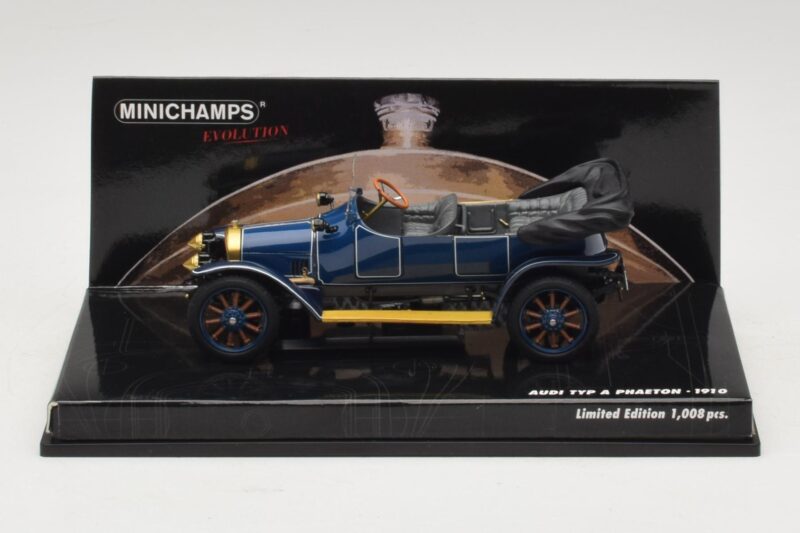
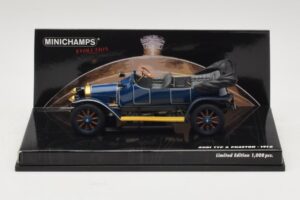
TL;DR: Minichamps' 1:43 Audi Typ A Phaeton reproduces Audi's very first production car, launched in 1910, its open Phaeton body cast as a sealed one-piece diecast shell in Blue. A direct link to August Horch's break from his own earlier company and the birth of the Audi name.
August Horch left the company that carried his own name in 1909 after a dispute with fellow directors, and rather than abandon car-making he founded a new firm the following year. Blocked from reusing 'Horch' as a trademark, he settled on its Latin translation, audi, meaning 'listen', and the Typ A became the very first car to wear that new name.
Phaeton bodies from this period carried no fixed roof and no doors in the modern sense, just low cutaways and folding fabric where needed, which makes a sealed diecast casting an entirely natural fit rather than a compromise. Minichamps casts the body, wings, and running boards as one continuous shell, so the high, narrow radiator, the exposed engine bay sides, and the folded hood sit exactly where the real Typ A's proportions put them. There is no shutline to judge here in the way there would be on a closed saloon, and that absence is simply true to the original car rather than a limitation of the model.
Blue paintwork over a car this old carries real risk of looking flat or toy-like, and the finish here avoids that by keeping the colour even across the long, narrow bonnet without breaking up under a display light. Brass-effect detailing on the headlamps, radiator surround, and horn reads warm against the blue rather than silver-cool, a small choice that matches how these Edwardian-era cars actually presented in period photographs. The wire-spoked wheels carry visible individual spokes rather than a moulded disc, a detail that matters enormously on a car with wheels this exposed and this large relative to the body.
August Horch's departure from his own namesake company was contentious enough that he was legally barred from using his surname for a new car brand, forcing the choice of a Latin alternative that has outlasted every dispute that caused it. The Typ A that emerged in 1910 was a modest, conventional car for its era, an open tourer with a small four-cylinder engine, built to establish the new firm as a credible manufacturer rather than to make a technical statement. That modesty is exactly why the Typ A rarely appears in period photographs alongside the grander cars of its decade, yet it is the car that made everything Audi built afterward possible.
Audi and Horch, ironically, both survived long enough to be pulled into the same company: Auto Union, formed in 1932 from the merger of Audi, Horch, DKW, and Wanderer, the union that gave Audi its four interlocked rings badge. That shared history means a Typ A and a Horch from the same era, both built by companies bearing August Horch's fingerprints, sit together on a shelf with more connective tissue than most pre-war marque pairings ever manage. For a collector already holding a pre-war Horch, adding this Typ A completes a lineage that modern Audi badges only hint at.
This is not a car that will dominate a shelf the way a flowing 1930s roadster might; its value is historical rather than visual. Placed at the start of a chronological Audi run, or alongside a Horch from the same combine, the Typ A does the quiet work of explaining where the four rings actually came from, a story most modern Audi owners never hear. Original examples from 1910 are essentially unobtainable outside museum collections, so a diecast replica is not a substitute for the real thing so much as the only realistic way to own a piece of this specific history. For collectors building a serious pre-war German lineup, that origin-point role earns the Typ A a place even without dramatic styling to sell it.





Save £14.00