{"ajaxurl":"https:\/\/models118.co.uk\/wp-admin\/admin-ajax.php?lang=en_GB","nonce":"605edaf6fd","homeUrl":"https:\/\/models118.co.uk\/","shopUrl":"https:\/\/models118.co.uk\/shop\/","cartUrl":"https:\/\/models118.co.uk\/cart-en-gb\/","checkoutUrl":"https:\/\/models118.co.uk\/checkout\/","skipCart":true,"collectionLimit":12,"i18n":{"addedToCart":"Added to basket","addToWishlist":"Add to wishlist","addedToWishlist":"Added to wishlist","removeFromWishlist":"Remove from wishlist","removedFromWishlist":"Removed from wishlist","undo":"Undo","error":"Something went wrong","loading":"Loading...","outOfStock":"Out of stock","viewCart":"View basket","proceedToCheckout":"Proceed to checkout","addedToCollection":"Added to your collection","reserved":"Reserved!","soldOut":"Sold out","invalidEmail":"Please enter a valid email address","connectionError":"Connection error. Please try again.","loginToSave":"Sign in to save this model","waitlistNotify":"Notify me","waitlistOnList":"On the waiting list \u2713","waitlistJoined":"You're on the waiting list. We'll email you the moment this model is available again.","waitlistRemoved":"Done \u2014 you're off the waiting list for this model.","waitlistRateLimit":"Too many attempts \u2014 please try again shortly","waitlistTurnstile":"We couldn't complete the check \u2014 please try again","waitlistError":"Sorry, something went wrong. Please try again in a moment."},"wishlist":{"loggedIn":false,"loginUrl":"https:\/\/models118.co.uk\/my-account\/","addAction":"models118_wishlist_add","removeAction":"models118_wishlist_remove"},"waitlist":{"loggedIn":false,"subscribeAction":"models118_waitlist_subscribe","toggleAction":"models118_waitlist_toggle","stateAction":"models118_waitlist_state"},"stats":{"models":2242,"brands":203,"manufacturers":126,"collectors":10000},"product":{"id":624908,"sku":"110029021","condition":"used","name":"BMW M8 F92 Black Sapphire Minichamps 1:18","brand":"BMW","manufacturer":"Minichamps","scale":"1:18","material":"Diecast","price":134,"regularPrice":134,"isOnSale":false,"savingsAmount":0,"stockQty":0,"stockStatus":"out_of_stock","isDiscontinued":true,"image":"https:\/\/models118.co.uk\/wp-content\/uploads\/2026\/06\/bmw-m8-f92-black-sapphire-minichamps-1-18-300x200.jpg","permalink":"https:\/\/models118.co.uk\/bmw-m8-f92-black-sapphire-minichamps-1-18-110029021\/"}}
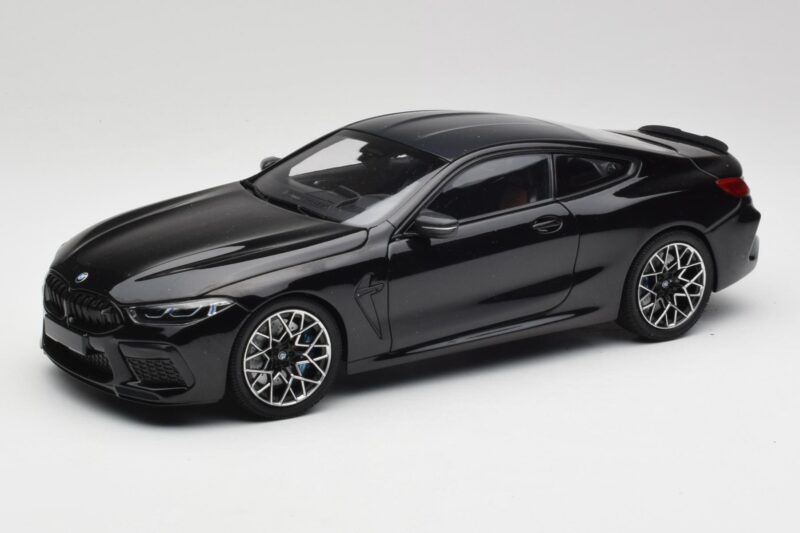
Minichamps' 1:18 diecast BMW M8 F92 wears deep Black Sapphire metallic paint on the coupe that revived BMW's flagship grand tourer after a two-decade gap since the original 8 Series. Diecast metal construction brings genuine weight, with opening doors, bonnet and boot revealing a detailed cabin. A mid-tier build for collectors tracking modern BMW M performance models.
About the BMW M8 F92 Black Sapphire Minichamps 1:18
TL;DR: Minichamps' 1:18 diecast BMW M8 F92 wears Black Sapphire metallic paint on the coupe that revived BMW's flagship grand tourer nameplate. Built in diecast metal with opening doors, bonnet and boot, it reproduces the twin-turbo M division halo car that returned after a two-decade gap since the original 8 Series.
BMW let the 8 Series badge sit dormant for two decades before reviving it as the M8, and this F92-generation coupe carries the weight of that gap, arriving as the brand's most powerful road-going grand tourer in a generation.
Minichamps' 1:18 BMW M8 F92 in Black Sapphire
Metallic Depth and Panel Fit
Black Sapphire metallic is a deep, almost purple-black colour that shifts under direct light rather than reading as flat black from across a room, and Minichamps' paint layer carries that shift convincingly on the M8's long bonnet and sculpted flanks. Panel gaps around the doors and boot lid stay tight and even, which matters on a coupe whose silhouette depends on unbroken shoulder lines from nose to tail. The kidney grille and M-specific bumper vents are moulded with enough definition to read correctly at arm's length, and the quad exhaust tips sit proud rather than looking blanked off.
Diecast Weight and Opening Features
Lifted from its case, the diecast body has genuine heft, the kind that signals a metal shell rather than a lightweight shortcut. Doors, bonnet and boot open on metal hinges, revealing a cabin with mapped seat stitching and a dashboard laid out correctly for the M8's digital instrument cluster. The wheels carry the correct M-spec multi-spoke design and sit within flared arches at the stance BMW's chassis engineers intended, which is where a mid-tier diecast either earns its keep or falls short.
A Grand Tourer Nameplate Revived After Two Decades
From the Original 8 Series to the F92
BMW built the original E31 8 Series from 1990 to 1999 as its range-topping coupe, a car with a V12 option and a low, wedge-shaped profile that never quite matched the sales of the 6 Series it eventually replaced in spirit. The nameplate then sat unused for nearly two decades while BMW's flagship duties passed to other models. European family buyers of that era valued dependable engineering over badge prestige, and BMW carried that same instinct into reviving the 8 Series only once the M8 had a genuinely compelling twin-turbocharged V8 and M xDrive all-wheel drive to back it up, positioning the car as both a long-distance cruiser and a genuine performance coupe rather than a styling exercise.
Positioning the M8 in a Grand Tourer Collection
Where This Sits Against Other 1:18 Coupes
Against other Minichamps grand tourers, the M8's opening panels and mapped interior sit at the same mid-tier standard the brand applies across its diecast road car range, priced below hand-finished resin but built to a noticeably higher standard than promotional-grade diecast. At roughly 24 centimetres, it holds its own on a shelf without demanding the extra depth a longer saloon needs. Collectors building a run of modern BMW M cars, or simply tracking how grand tourers have grown wider and more aggressive since the 1990s, will find this Black Sapphire M8 a solid anchor piece.
Display and Care for Metallic Paint
Metallic finishes like Black Sapphire show dust and fingerprints more readily than solid colours, so a dust-free cabinet with indirect lighting keeps the flake pattern looking fresh rather than dulled by handling. Direct sunlight will fade any diecast paint over years of display, metallic shades included, so positioning away from a window matters more than it does for a matte finish. Handling the model by the underside rather than the roof or bonnet avoids leaving marks on the glossiest panels, a habit worth forming early with any coupe whose paintwork is the main selling point.
Create a free account and claim 10% off your first order — from hundreds of collectible 1:18, 1:43 and 1:12 models by Porsche, Mercedes-Benz, BMW and more.
{"id":624908,"name":"BMW M8 F92 Black Sapphire Minichamps 1:18","price":"£<\/span>134.00<\/bdi><\/span>","image":"https:\/\/models118.co.uk\/wp-content\/uploads\/2026\/06\/bmw-m8-f92-black-sapphire-minichamps-1-18-400x400.jpg","permalink":"https:\/\/models118.co.uk\/bmw-m8-f92-black-sapphire-minichamps-1-18-110029021\/","brand":"BMW"}
Need a hand finding a model?
Models118 Assistant
0
Expand chatCollapse chat
Start a new chat
Basket
Your basket is empty.
Cookies on Models118
We use cookies to remember your preferences, understand how the shop is used and show you models and offers that suit your interests. What you allow is up to you, and you can change it at any time.
Functional
Always active
The technical storage or access is strictly necessary for the legitimate purpose of enabling the use of a specific service explicitly requested by the subscriber or user, or for the sole purpose of carrying out the transmission of a communication over an electronic communications network.
Preferences
The technical storage or access is necessary for the legitimate purpose of storing preferences that are not requested by the subscriber or user.
Statistics
The technical storage or access that is used exclusively for statistical purposes.The technical storage or access that is used exclusively for anonymous statistical purposes. Without a subpoena, voluntary compliance on the part of your Internet Service Provider, or additional records from a third party, information stored or retrieved for this purpose alone cannot usually be used to identify you.
Marketing
The technical storage or access is required to create user profiles to send advertising, or to track the user on a website or across several websites for similar marketing purposes.
We use cookies to remember your preferences, understand how the shop is used and show you models and offers that suit your interests. What you allow is up to you, and you can change it at any time.
Functional
Always active
The technical storage or access is strictly necessary for the legitimate purpose of enabling the use of a specific service explicitly requested by the subscriber or user, or for the sole purpose of carrying out the transmission of a communication over an electronic communications network.
Preferences
The technical storage or access is necessary for the legitimate purpose of storing preferences that are not requested by the subscriber or user.
Statistics
The technical storage or access that is used exclusively for statistical purposes.The technical storage or access that is used exclusively for anonymous statistical purposes. Without a subpoena, voluntary compliance on the part of your Internet Service Provider, or additional records from a third party, information stored or retrieved for this purpose alone cannot usually be used to identify you.
Marketing
The technical storage or access is required to create user profiles to send advertising, or to track the user on a website or across several websites for similar marketing purposes.