{"ajaxurl":"https:\/\/models118.co.uk\/wp-admin\/admin-ajax.php?lang=en_GB","nonce":"55d93b5436","homeUrl":"https:\/\/models118.co.uk\/","shopUrl":"https:\/\/models118.co.uk\/shop\/","cartUrl":"https:\/\/models118.co.uk\/cart-en-gb\/","checkoutUrl":"https:\/\/models118.co.uk\/checkout\/","skipCart":true,"collectionLimit":12,"i18n":{"addedToCart":"Added to basket","addToWishlist":"Add to wishlist","addedToWishlist":"Added to wishlist","removeFromWishlist":"Remove from wishlist","removedFromWishlist":"Removed from wishlist","undo":"Undo","error":"Something went wrong","loading":"Loading...","outOfStock":"Out of stock","viewCart":"View basket","proceedToCheckout":"Proceed to checkout","addedToCollection":"Added to your collection","reserved":"Added to your collection","soldOut":"Sold out","invalidEmail":"Please enter a valid email address","connectionError":"Connection error. Please try again.","tocToggle":"On this page","close":"Close","inCartTooltip":"Already in your basket \u2013 open your basket to check out","loginToSave":"Sign in to save this model","waitlistNotify":"Notify me","waitlistOnList":"On the waiting list \u2713","waitlistJoined":"You're on the waiting list. We'll email you the moment this model is available again.","waitlistRemoved":"Done \u2014 you're off the waiting list for this model.","waitlistRateLimit":"Too many attempts \u2014 please try again shortly","waitlistTurnstile":"We couldn't complete the check \u2014 please try again","waitlistError":"Sorry, something went wrong. Please try again in a moment."},"wishlist":{"loggedIn":false,"loginUrl":"https:\/\/models118.co.uk\/my-account\/","addAction":"models118_wishlist_add","removeAction":"models118_wishlist_remove"},"waitlist":{"loggedIn":false,"subscribeAction":"models118_waitlist_subscribe","toggleAction":"models118_waitlist_toggle","stateAction":"models118_waitlist_state"},"stats":{"models":2281,"brands":213,"manufacturers":128,"collectors":10000},"product":{"id":614091,"sku":"107123531","condition":"used","availability":"out_of_stock","name":"Maserati BiTurbo Spyder Black Minichamps 1:18","brand":"Maserati","manufacturer":"Minichamps","scale":"1:18","material":"Resin","price":176.67,"regularPrice":176.67,"isOnSale":false,"savingsAmount":0,"stockQty":0,"stockStatus":"out_of_stock","isDiscontinued":true,"image":"https:\/\/models118.co.uk\/wp-content\/uploads\/2026\/06\/maserati-biturbo-spyder-nero-minichamps-1-18-300x200.jpg","permalink":"https:\/\/models118.co.uk\/maserati-biturbo-spyder-black-minichamps-1-18-107123531\/"}}
Cookies on Models118
We use cookies to remember your preferences, understand how the shop is used and show you models and offers that suit your interests. What you allow is up to you, and you can change it at any time.
Always active
The technical storage or access is strictly necessary for the legitimate purpose of enabling the use of a specific service explicitly requested by the subscriber or user, or for the sole purpose of carrying out the transmission of a communication over an electronic communications network.
The technical storage or access is necessary for the legitimate purpose of storing preferences that are not requested by the subscriber or user.
The technical storage or access that is used exclusively for statistical purposes.
The technical storage or access is required to create user profiles to send advertising, or to track the user on a website or across several websites for similar marketing purposes.
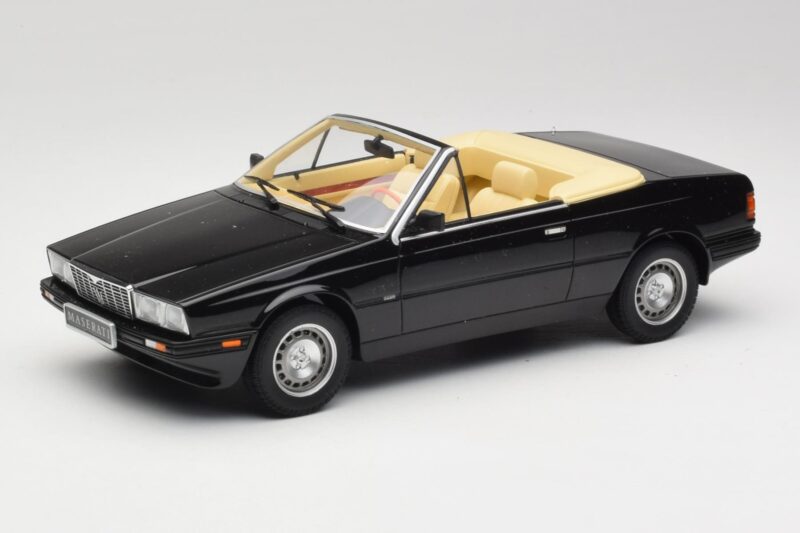
Minichamps' 1:18 sealed resin Maserati BiTurbo Spyder reproduces the Zagato-styled convertible from Maserati's 1986 turbocharged range, finished in black to flatter its tight, angular creases. Sharp resin panel lines and a detailed cabin visible through the glazing make this an understated but distinctive addition for collectors building a Modern Classics theme around Maserati's overlooked turbo era.
About the Maserati BiTurbo Spyder Black Minichamps 1:18
TL;DR: Minichamps' 1:18 sealed resin reproduces the Maserati BiTurbo Spyder in black, the Zagato-styled convertible that gave Maserati's turbocharged 1986 range an open-top option. Sharp resin panel lines suit the Spyder's tight, angular Zagato shape, making this a distinctive Modern Classics piece for collectors exploring Maserati beyond its better-known GT models.
The BiTurbo Spyder rarely gets the attention its coupe sibling receives, yet Zagato's convertible reworking of Maserati's turbo-era range produced one of the more distinctive open two-seaters of the 1980s. Minichamps renders it in black, a colour that suits the Spyder's tucked-in haunches and low waistline particularly well.
Zagato's Spyder and Maserati's Turbocharged Revival
A Different Answer to the BiTurbo Coupe
Maserati launched the Biturbo in 1981 as the first production road car fitted with twin turbochargers as standard, a technical statement built to win back customers who had drifted toward BMW and Mercedes during the marque's difficult years under De Tomaso ownership. The Spyder arrived shortly after as a two-seat convertible variant, commissioned out to the Zagato coachworks rather than built to the coupe's own proportions, which gives the open car a tighter cabin and a more purposeful stance than the four-seat original. By 1986 the range had matured, and the Spyder had settled into its own identity rather than reading as an afterthought convertible.
Black Paint on an Angular 1980s Shape
Black is an unforgiving colour on any diecast or resin body, since it shows every inconsistency in panel line and surface finish rather than hiding them under metallic flake, and it works particularly well here because the Spyder's Zagato-drawn creases and flat bonnet planes are exactly the sort of geometry black paint flatters. The colour also matches how many Biturbo Spyders were actually specified in period, giving this casting an honest period-correct feel rather than a colour chosen purely for shelf contrast.
Sealed Resin Construction and Why It Suits This Shape
Minichamps builds this casting in resin rather than diecast, which means the body is a single sealed shell with no opening doors, bonnet, or boot. That sounds like a limitation until the alternative is considered: a diecast Spyder would need hinge tolerances built into the same tight, creased bodywork that gives this car its identity, and those tolerances tend to soften sharp Zagato lines into slightly rounded compromises. Resin sidesteps that problem entirely, holding crisp, consistent shut lines around the doors and a flat, uninterrupted bonnet plane that reads exactly as drawn. The trade-off is no engine bay or interior access beyond what is visible through the glazing, a fair exchange on a subject defined more by its surfacing than by mechanical theatre.
Interior Visibility Through Sealed Glazing
Though the body is sealed, the cabin remains visible through the windscreen and side glass, and Minichamps details the dashboard, seats, and fold of the soft top convincingly enough that the closed construction rarely feels like a compromise. Paint depth on the black bodywork holds up well under direct light, showing the subtle creases along the wing line rather than swallowing them into a flat void, which is the real test of a dark resin finish.
Where the BiTurbo Fits Among Maserati Collectibles
A Companion to the Biturbo Coupe
Collectors building a Maserati theme around the marque's less-celebrated turbo era find the Spyder a natural companion to a Biturbo coupe or a later Maserati 222, tracing the brand's recovery years rather than jumping straight to the Ghibli or Bora.
At roughly 21cm, this open two-seater sits comfortably among other 1:18 Modern Classics without demanding disproportionate shelf space. It is a subject worth choosing precisely because it is not the obvious Maserati pick: the Biturbo range gets overlooked in favour of the marque's earlier or later high points, and a well-finished resin Spyder rewards a collector willing to look past famous names for a genuinely distinctive shape.
Create a free account and claim 10% off your first order — from hundreds of collectible 1:18, 1:43 and 1:12 models by Porsche, Mercedes-Benz, BMW and more.