{"ajaxurl":"https:\/\/models118.co.uk\/wp-admin\/admin-ajax.php?lang=en_GB","nonce":"df31c18213","homeUrl":"https:\/\/models118.co.uk\/","shopUrl":"https:\/\/models118.co.uk\/shop\/","cartUrl":"https:\/\/models118.co.uk\/cart-en-gb\/","checkoutUrl":"https:\/\/models118.co.uk\/checkout\/","skipCart":true,"collectionLimit":12,"i18n":{"addedToCart":"Added to basket","addToWishlist":"Add to wishlist","addedToWishlist":"Added to wishlist","removeFromWishlist":"Remove from wishlist","removedFromWishlist":"Removed from wishlist","undo":"Undo","error":"Something went wrong","loading":"Loading...","outOfStock":"Out of stock","viewCart":"View basket","proceedToCheckout":"Proceed to checkout","addedToCollection":"Added to your collection","reserved":"Reserved!","soldOut":"Sold out","invalidEmail":"Please enter a valid email address","connectionError":"Connection error. Please try again.","loginToSave":"Sign in to save this model","waitlistNotify":"Notify me","waitlistOnList":"On the waiting list \u2713","waitlistJoined":"You're on the waiting list. We'll email you the moment this model is available again.","waitlistRemoved":"Done \u2014 you're off the waiting list for this model.","waitlistRateLimit":"Too many attempts \u2014 please try again shortly","waitlistTurnstile":"We couldn't complete the check \u2014 please try again","waitlistError":"Sorry, something went wrong. Please try again in a moment."},"wishlist":{"loggedIn":false,"loginUrl":"https:\/\/models118.co.uk\/my-account\/","addAction":"models118_wishlist_add","removeAction":"models118_wishlist_remove"},"waitlist":{"loggedIn":false,"subscribeAction":"models118_waitlist_subscribe","toggleAction":"models118_waitlist_toggle","stateAction":"models118_waitlist_state"},"stats":{"models":2148,"brands":205,"manufacturers":127,"collectors":10000},"product":{"id":302559,"sku":"08931BK","condition":"new","name":"Rolls-Royce Phantom I Cabriolet Black Kyosho 1:18","brand":"Rolls-Royce","manufacturer":"Kyosho","scale":"1:18","material":"Diecast","price":148.33,"regularPrice":148.33,"isOnSale":false,"savingsAmount":0,"stockQty":0,"stockStatus":"out_of_stock","isDiscontinued":true,"image":"https:\/\/models118.co.uk\/wp-content\/uploads\/2026\/03\/rolls-royce-phantom-1-cabriolet-black-kyosho-1-18-300x200.jpg","permalink":"https:\/\/models118.co.uk\/rolls-royce-phantom-i-cabriolet-black-kyosho-1-18-08931bk\/"}}
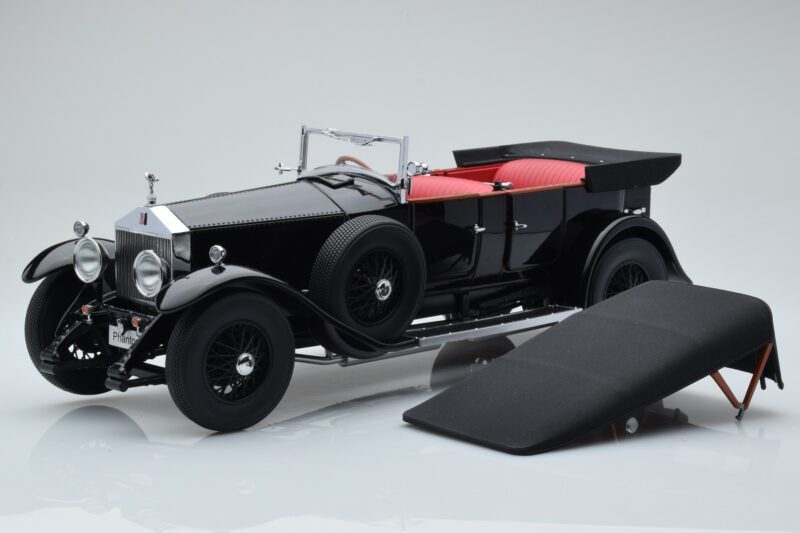
Kyosho's 1:18 diecast Rolls-Royce Phantom I Cabriolet reproduces the 1925 model that succeeded the Silver Ghost, finished in black with an open-top coachbuilt body typical of the era. Folding roof detail and bright period trim make it a distinctive anchor for a vintage or pre-war luxury display.
About the Rolls-Royce Phantom I Cabriolet Black Kyosho 1:18
TL;DR: Kyosho's 1:18 diecast Rolls-Royce Phantom I Cabriolet reproduces the 1925 model that replaced the Silver Ghost, finished in black with an open-top coachbuilt body typical of the pre-war era. A distinctive anchor piece for collectors building a vintage or early luxury display.
Before Rolls-Royce sold complete cars in the modern sense, it sold chassis for outside coachbuilders to clothe however a customer commissioned. This black cabriolet, open-topped and formal at once, represents that vanished world in miniature.
The Phantom I and the Coachbuilt Era
Replacing the Silver Ghost
Rolls-Royce introduced the Phantom I in 1925 as the successor to the Silver Ghost, the model that had built the marque's reputation for silence and durability over the preceding two decades. The new car carried a larger, more powerful engine and updated chassis engineering while keeping the same emphasis on effortless, unhurried performance rather than outright speed. It was built in both Britain and, for a period, the United States, reflecting how significant the American luxury market had become to Rolls-Royce by the mid-1920s.
A Chassis, Not a Complete Car
What Rolls-Royce actually sold was a rolling chassis: engine, drivetrain, and running gear, with no fixed body attached. Wealthy owners then commissioned independent coachbuilders to design and construct bodywork to their own taste, which is why no two Phantom Is necessarily looked alike. A cabriolet body, open-topped with a folding roof and formal proportions, was one of the era's most fashionable choices, combining open-air motoring with a silhouette smart enough for the most exclusive addresses.
Kyosho's Scale Take on an Open Cabriolet Body
Folding Roof and Open-Top Proportions
Kyosho reproduces the cabriolet's folding roof mechanism and open-top stance with real care, keeping the long bonnet, upright radiator shell, and low beltline that defined coachbuilt luxury of the period. The proportions favour length and presence over compactness, and the model's diecast weight suits a subject that was, in period, a genuinely substantial motor car. Fine details like the running boards and folded roof fabric texture are rendered rather than smoothed over, which matters on a body this ornate.
Black Paint Against Period Brightwork
Black was a common, almost expected colour for formal coachwork of the 1920s, and Kyosho's finish is deep and even rather than flat, letting the polished radiator shell, headlamps, and other brightwork stand out sharply against it. That contrast between dark paintwork and bright metal trim is exactly how these cars were meant to read from the kerbside, and getting it right matters more on a pre-war subject than on almost any modern one.
An Anchor Piece for a Vintage Shelf
At this scale, the Phantom I's long wheelbase and formal cabriolet body give it real presence on a shelf, closer in footprint to a modern grand tourer than to a compact classic. It sits well as a standalone centrepiece for a vintage or coachbuilt-era display, or as the opening chapter of a longer Rolls-Royce lineage running through later Phantom generations. Given its open-top body, keep the folding roof fabric detail away from direct handling, and store it where humidity stays low, since coachbuilt-era detailing on pre-war subjects tends to show wear at the seams first. Pre-war subjects like this one are less commonly reproduced than post-war classics, which gives this model discovery value beyond its craftsmanship alone.
Create a free account and claim 10% off your first order — from hundreds of collectible 1:18, 1:43 and 1:12 models by Porsche, Mercedes-Benz, BMW and more.
{"id":302559,"name":"Rolls-Royce Phantom I Cabriolet Black Kyosho 1:18","price":"£<\/span>148.33<\/bdi><\/span>","image":"https:\/\/models118.co.uk\/wp-content\/uploads\/2026\/03\/rolls-royce-phantom-1-cabriolet-black-kyosho-1-18-400x400.jpg","permalink":"https:\/\/models118.co.uk\/rolls-royce-phantom-i-cabriolet-black-kyosho-1-18-08931bk\/","brand":"Rolls-Royce"}
Cookies on Models118
We use cookies to remember your preferences, understand how the shop is used and show you models and offers that suit your interests. What you allow is up to you, and you can change it at any time.
Functional
Always active
The technical storage or access is strictly necessary for the legitimate purpose of enabling the use of a specific service explicitly requested by the subscriber or user, or for the sole purpose of carrying out the transmission of a communication over an electronic communications network.
Preferences
The technical storage or access is necessary for the legitimate purpose of storing preferences that are not requested by the subscriber or user.
Statistics
The technical storage or access that is used exclusively for statistical purposes.The technical storage or access that is used exclusively for anonymous statistical purposes. Without a subpoena, voluntary compliance on the part of your Internet Service Provider, or additional records from a third party, information stored or retrieved for this purpose alone cannot usually be used to identify you.
Marketing
The technical storage or access is required to create user profiles to send advertising, or to track the user on a website or across several websites for similar marketing purposes.
We use cookies to remember your preferences, understand how the shop is used and show you models and offers that suit your interests. What you allow is up to you, and you can change it at any time.
Functional
Always active
The technical storage or access is strictly necessary for the legitimate purpose of enabling the use of a specific service explicitly requested by the subscriber or user, or for the sole purpose of carrying out the transmission of a communication over an electronic communications network.
Preferences
The technical storage or access is necessary for the legitimate purpose of storing preferences that are not requested by the subscriber or user.
Statistics
The technical storage or access that is used exclusively for statistical purposes.The technical storage or access that is used exclusively for anonymous statistical purposes. Without a subpoena, voluntary compliance on the part of your Internet Service Provider, or additional records from a third party, information stored or retrieved for this purpose alone cannot usually be used to identify you.
Marketing
The technical storage or access is required to create user profiles to send advertising, or to track the user on a website or across several websites for similar marketing purposes.