{"ajaxurl":"https:\/\/models118.co.uk\/wp-admin\/admin-ajax.php?lang=en_GB","nonce":"2bd8ec74fc","homeUrl":"https:\/\/models118.co.uk\/","shopUrl":"https:\/\/models118.co.uk\/shop\/","cartUrl":"https:\/\/models118.co.uk\/cart-en-gb\/","checkoutUrl":"https:\/\/models118.co.uk\/checkout\/","skipCart":true,"collectionLimit":12,"i18n":{"addedToCart":"Added to basket","addToWishlist":"Add to wishlist","addedToWishlist":"Added to wishlist","removeFromWishlist":"Remove from wishlist","removedFromWishlist":"Removed from wishlist","undo":"Undo","error":"Something went wrong","loading":"Loading...","outOfStock":"Out of stock","viewCart":"View basket","proceedToCheckout":"Proceed to checkout","addedToCollection":"Added to your collection","reserved":"Added to your collection","soldOut":"Sold out","invalidEmail":"Please enter a valid email address","connectionError":"Connection error. Please try again.","tocToggle":"On this page","close":"Close","inCartTooltip":"Already in your basket \u2013 open your basket to check out","loginToSave":"Sign in to save this model","waitlistNotify":"Notify me","waitlistOnList":"On the waiting list \u2713","waitlistJoined":"You're on the waiting list. We'll email you the moment this model is available again.","waitlistRemoved":"Done \u2014 you're off the waiting list for this model.","waitlistRateLimit":"Too many attempts \u2014 please try again shortly","waitlistTurnstile":"We couldn't complete the check \u2014 please try again","waitlistError":"Sorry, something went wrong. Please try again in a moment."},"wishlist":{"loggedIn":false,"loginUrl":"https:\/\/models118.co.uk\/my-account\/","addAction":"models118_wishlist_add","removeAction":"models118_wishlist_remove"},"waitlist":{"loggedIn":false,"subscribeAction":"models118_waitlist_subscribe","toggleAction":"models118_waitlist_toggle","stateAction":"models118_waitlist_state"},"stats":{"models":2615,"brands":213,"manufacturers":128,"collectors":10000},"product":{"id":1681060,"sku":"439071085","condition":"new","availability":"in_stock","name":"Bussing D2U Heckeinstieg Doornkaat Minichamps 1:43","brand":"Bussing","manufacturer":"Minichamps","scale":"1:43","material":"Diecast","price":73,"regularPrice":73,"isOnSale":false,"savingsAmount":0,"stockQty":2,"stockStatus":"very_low","isDiscontinued":false,"image":"https:\/\/models118.co.uk\/wp-content\/uploads\/2026\/09\/bussing-d2u-heckeinstieg-doornkaat-minichamps-1-43-439071085-1-1-300x200.jpg","permalink":"https:\/\/models118.co.uk\/bussing-d2u-heckeinstieg-doornkaat-minichamps-1-43-439071085\/"}}
Cookies on Models118
We use cookies to remember your preferences, understand how the shop is used and show you models and offers that suit your interests. What you allow is up to you, and you can change it at any time.
Always active
The technical storage or access is strictly necessary for the legitimate purpose of enabling the use of a specific service explicitly requested by the subscriber or user, or for the sole purpose of carrying out the transmission of a communication over an electronic communications network.
The technical storage or access is necessary for the legitimate purpose of storing preferences that are not requested by the subscriber or user.
The technical storage or access that is used exclusively for statistical purposes.
The technical storage or access is required to create user profiles to send advertising, or to track the user on a website or across several websites for similar marketing purposes.
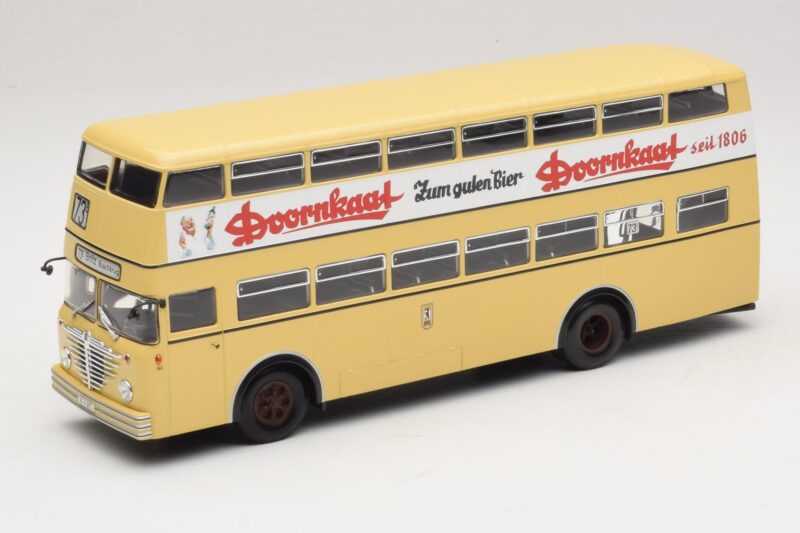
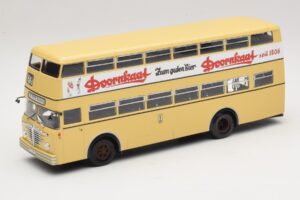
Minichamps' 1:43 diecast Büssing D2U reproduces the 1965 rear-entry city bus in Doornkaat's branded advertising livery, a striking scheme from a golden age of bus-side branding in West Germany. The sealed zinc alloy body carries the correct open rear-platform styling, printed livery graphics, and Büssing's distinctive lion badge on the grille. A confident subject for a commercial-vehicle collection alongside cars and trucks.
About the Bussing D2U Heckeinstieg Doornkaat Minichamps 1:43
TL;DR: Minichamps' 1:43 diecast Büssing D2U reproduces the 1965 rear-entry city bus in Doornkaat's branded advertising livery, a striking scheme from West Germany's golden age of bus-side branding. The sealed zinc alloy body carries correct open-platform styling, printed livery graphics, and Büssing's distinctive lion badge for a confident commercial-vehicle collectible.
Büssing built its reputation over sixty years before merging into MAN, and its buses were as much a fixture of postwar German streets as Mercedes'. This D2U wears the Doornkaat gin livery, one of the bolder advertising schemes to grace a city bus in the 1960s, when brands competed loudly for attention on public transport.
Minichamps' 1:43 Büssing D2U in Doornkaat Livery
The Doornkaat Advertising Scheme
Doornkaat, the German korn spirit brand, took its advertising onto the sides of city buses with a livery bold enough to be read at speed, and Minichamps reproduces the scheme with printed graphics that hold their registration cleanly against the base colour. The lettering wraps confidently along the flank, and the brand's distinctive typeface comes through sharp rather than blurred, a common failing on cheaper bus models where advertising text turns into an illegible smear. It's exactly the kind of livery that gave German cities their visual character through the 1960s, a genuinely fun subject next to the more restrained municipal liveries that dominate most bus-model ranges. That confidence is exactly why collectors of period bus liveries single Doornkaat out first.
Rear-Entry Bus Styling on a Sealed Body
The D2U's Heckeinstieg configuration puts the passenger entrance at the rear, an open boarding platform rather than a set of front or centre doors, and that distinctive rear-end shape is where a lot of the model's character sits. Minichamps casts the whole body as a single sealed shell, with no doors to open, which keeps the rear platform's step and handrail detail crisp rather than compromised by a hinge mechanism. Zinc alloy gives the bus real weight for its length, and the lion emblem on the grille, Büssing's long-standing badge, is picked out cleanly rather than lost in the overall livery.
Büssing and Germany's Post-War Bus Fleets
A Lion-Badged Bus and Truck Specialist
Büssing was among the oldest names in German commercial vehicles, founded at the turn of the twentieth century and building buses and trucks under its lion emblem for decades before eventually merging into MAN in 1971. Through the postwar years, Büssing's buses were a familiar sight in West German cities, competing directly with Mercedes for municipal and private-operator contracts. That rivalry gives Büssing models a genuine place alongside better-known Mercedes buses in any serious commercial-vehicle collection.
The D2U in 1960s City Service
The D2U served as a mainstream city bus through the 1960s, built for the stop-start rhythm of urban routes rather than long-distance touring, with a rear-entry layout that suited high passenger turnover on busy streets. Its straightforward, upright styling prioritised visibility and interior space over aerodynamics, a common approach among city buses of the era. That functional design is exactly what makes an advertising livery like Doornkaat's stand out so strongly against it. Surviving D2Us in original livery are now scarce, which is exactly why a faithfully reproduced example like this has become a reference point for collectors researching period German bus liveries.
A Bold Livery for a Commercial-Vehicle Display
A branded bus like this Doornkaat D2U brings genuine colour to a shelf that might otherwise be dominated by municipal white and cream liveries, and it pairs naturally with other advertising-liveried buses and trucks from the same period. Büssing's badge gives it a distinct identity from the more commonly modelled Mercedes buses of the era, adding welcome variety to a German commercial-vehicle theme. The sealed diecast construction keeps the build straightforward and the price accessible, and at 1:43 several buses fit comfortably along a single shelf without dominating the display. For a collector who wants a talking point rather than another municipal colour scheme, a bold advertising livery like this earns its place first.
Create a free account and claim 10% off your first order — from hundreds of collectible 1:18, 1:43 and 1:12 models by Porsche, Mercedes-Benz, BMW and more.