


New arrival
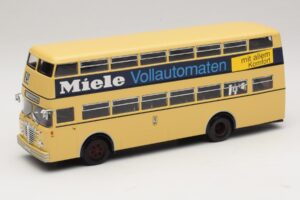
Büssing diecast models reproduce the heavy trucks and light commercials the German manufacturer built through the 1960s, before its lion-badged identity merged into MAN. Minichamps casts the range in 1:43 diecast, giving collectors of post-war road haulage a documented route into a marque that most passenger-car collections never touch.
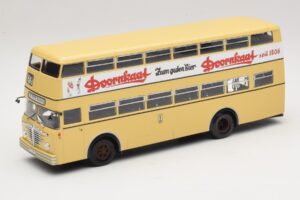
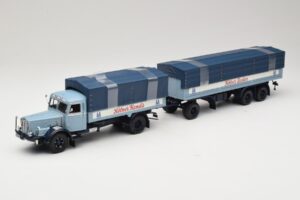
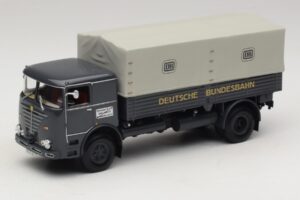
TL;DR: Büssing diecast models reproduce the lion-badged German trucks and light commercials built before the marque merged into MAN, cast in 1:43 scale by Minichamps and centred on the 1960s haulage fleet. The category suits collectors documenting post-war German commercial vehicles rather than passenger cars.
Büssing built its reputation on heavy trucks and buses carrying a distinctive lion badge, a marque that shaped German road haulage for decades before disappearing into MAN's wider commercial vehicle business. Minichamps documents that history in 1:43 diecast, concentrating on the heavy trucks and light commercials that carried the Büssing name through the 1960s. For collectors of commercial vehicle miniatures, the range offers a way to trace a marque most passenger-car collections never touch.
Büssing built its name on the strength of its badge as much as its engineering: the Braunschweiger Löwe, a lion taken from the coat of arms of the city where the marque was founded, sat on the nose of every truck and bus the company produced. That badge became shorthand for durable, heavy-duty German engineering through decades of post-war reconstruction, when haulage firms needed vehicles that could run hard routes without failure. The marque eventually lost its independence, folded into MAN's wider commercial vehicle operation, which is why Büssing survives today mainly as a historical name, and why diecast reproductions carry real documentary weight for collectors of German transport history. The category sits apart from passenger-car brand collections in both subject and audience, appealing to enthusiasts of road haulage and municipal transport history rather than saloon or sports car collectors.
Minichamps applies the same 1:43 diecast standard to its commercial vehicle range that it uses across marque-specific car collections, and the checks a collector runs are largely the same:
Truck and trailer models carry more flat surface area than passenger cars at the same scale, so paint quality is arguably easier to judge here than on a saloon or coupe casting. Pricing for this category sits in the mid-range typical of 1:43 diecast commercial vehicles, reflecting the tooling investment required for cab, chassis and load-bed detail. Because commercial vehicle subjects are produced in smaller numbers than passenger cars, a Büssing release often has less direct competition to compare it against.
1:43 works differently for a truck than for a saloon car. A Büssing rigid truck at this scale still measures a reasonable length on a shelf, and an articulated combination with a trailer attached takes up considerably more room than a single passenger car model, worth factoring into any display plan. Diecast construction gives the cab and chassis the weight and durability a static commercial vehicle display benefits from, since these models are often handled and rearranged more than a hero passenger car kept as a stand-alone piece. Compared with 1:18, which very few truck ranges use because of the size an articulated lorry would occupy, 1:43 is effectively the practical maximum for this category. It also matches the scale most collectors already use for passenger car diecast, making mixed displays straightforward.
The 1960s placement of this collection reflects Büssing's final full decade as an independent manufacturer, a period when West German road haulage was expanding rapidly alongside the wider economic recovery. Heavy duty trucks from this era carried the loads that built the country's post-war infrastructure, while the marque's light commercial vehicles served smaller haulage and municipal roles that heavy rigids were not suited to. Collecting across both vehicle classes gives a fuller picture of a period haulage fleet than focusing solely on the largest trucks. Because the marque's independent history ended not long after this decade, the 1960s range represents something close to the full scope of what Büssing achieved before its identity was absorbed elsewhere, giving the era focus a natural completeness a still-active marque's range would lack.
An articulated Büssing model with its trailer attached needs considerably more shelf depth than a passenger car, so plan cabinet space around the longest combination rather than an average length. Rigid trucks and light commercials are more forgiving, closer to a large 1:43 saloon in footprint, and mix easily with heavier pieces if arranged by size rather than strictly by type. Keep the collection out of direct sunlight to protect painted cab panels and printed livery graphics, and dust regularly, since flat truck bodywork shows dust more obviously than a curved car shape would. Original packaging is worth retaining just as it is for passenger cars, partly for resale context and partly because truck models are produced in smaller numbers.
Building a Büssing collection works best as part of a broader commercial vehicle project rather than an isolated marque chase, since the range itself is narrower than a mainstream passenger car brand would offer. Many collectors use it as one chapter within a wider post-war German haulage collection, pairing it with other historic truck and bus marques from the same period. Starting with a rigid truck rather than an articulated combination keeps the initial shelf-space commitment manageable, with trailer combinations added once space is confirmed. Because Minichamps is the manufacturer behind the assortment in this category, quality is consistent across the pieces available, which removes one of the usual variables a collector has to manage when building a themed shelf.
1:43 keeps even an articulated combination to a manageable shelf length while matching the scale most collectors already use for passenger car diecast. Larger scales become impractical once a trailer is attached, which is why very few manufacturers produce heavy commercial vehicles above 1:43.
Büssing built trucks and buses under its lion badge through the post-war decades before merging into MAN's wider commercial vehicle operation, ending its run as an independent marque. That history is part of why diecast reproductions carry documentary value for collectors.
It can, but a dedicated commercial vehicle shelf usually reads better, since truck and trailer models demand more depth per piece and tell a different story than passenger cars from the same period. Grouping by vehicle type keeps the display coherent.
The assortment behind this category is built around Minichamps, which applies its usual 1:43 diecast standard to cab, chassis and livery detail. That consistency makes quality easier to judge across the collection than mixed-manufacturer commercial vehicle ranges.