{"ajaxurl":"https:\/\/models118.co.uk\/wp-admin\/admin-ajax.php?lang=en_GB","nonce":"2bd8ec74fc","homeUrl":"https:\/\/models118.co.uk\/","shopUrl":"https:\/\/models118.co.uk\/shop\/","cartUrl":"https:\/\/models118.co.uk\/cart-en-gb\/","checkoutUrl":"https:\/\/models118.co.uk\/checkout\/","skipCart":true,"collectionLimit":12,"i18n":{"addedToCart":"Added to basket","addToWishlist":"Add to wishlist","addedToWishlist":"Added to wishlist","removeFromWishlist":"Remove from wishlist","removedFromWishlist":"Removed from wishlist","undo":"Undo","error":"Something went wrong","loading":"Loading...","outOfStock":"Out of stock","viewCart":"View basket","proceedToCheckout":"Proceed to checkout","addedToCollection":"Added to your collection","reserved":"Added to your collection","soldOut":"Sold out","invalidEmail":"Please enter a valid email address","connectionError":"Connection error. Please try again.","tocToggle":"On this page","close":"Close","inCartTooltip":"Already in your basket \u2013 open your basket to check out","loginToSave":"Sign in to save this model","waitlistNotify":"Notify me","waitlistOnList":"On the waiting list \u2713","waitlistJoined":"You're on the waiting list. We'll email you the moment this model is available again.","waitlistRemoved":"Done \u2014 you're off the waiting list for this model.","waitlistRateLimit":"Too many attempts \u2014 please try again shortly","waitlistTurnstile":"We couldn't complete the check \u2014 please try again","waitlistError":"Sorry, something went wrong. Please try again in a moment."},"wishlist":{"loggedIn":false,"loginUrl":"https:\/\/models118.co.uk\/my-account\/","addAction":"models118_wishlist_add","removeAction":"models118_wishlist_remove"},"waitlist":{"loggedIn":false,"subscribeAction":"models118_waitlist_subscribe","toggleAction":"models118_waitlist_toggle","stateAction":"models118_waitlist_state"},"stats":{"models":2615,"brands":213,"manufacturers":128,"collectors":10000},"product":{"id":1678462,"sku":"439030089","condition":"new","availability":"in_stock","name":"Setra S8 Reisegluck Minichamps 1:43","brand":"Setra","manufacturer":"Minichamps","scale":"1:43","material":"Diecast","price":73,"regularPrice":73,"isOnSale":false,"savingsAmount":0,"stockQty":1,"stockStatus":"very_low","isDiscontinued":false,"image":"https:\/\/models118.co.uk\/wp-content\/uploads\/2026\/09\/setra-s8-reisegluck-minichamps-1-43-439030089-1-1-300x200.jpg","permalink":"https:\/\/models118.co.uk\/setra-s8-reisegluck-minichamps-1-43-439030089\/"}}
Cookies on Models118
We use cookies to remember your preferences, understand how the shop is used and show you models and offers that suit your interests. What you allow is up to you, and you can change it at any time.
Always active
The technical storage or access is strictly necessary for the legitimate purpose of enabling the use of a specific service explicitly requested by the subscriber or user, or for the sole purpose of carrying out the transmission of a communication over an electronic communications network.
The technical storage or access is necessary for the legitimate purpose of storing preferences that are not requested by the subscriber or user.
The technical storage or access that is used exclusively for statistical purposes.
The technical storage or access is required to create user profiles to send advertising, or to track the user on a website or across several websites for similar marketing purposes.
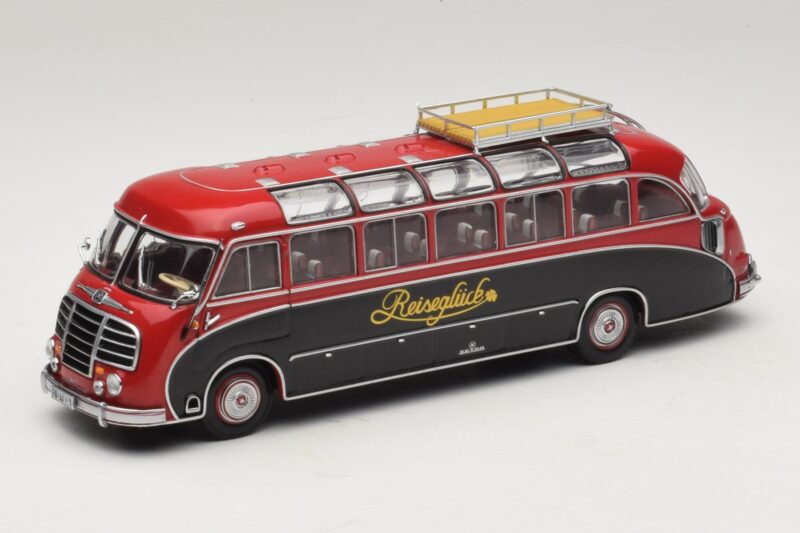
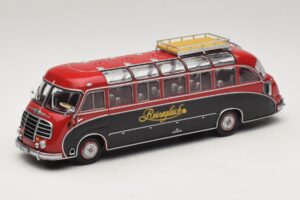
Minichamps' 1:43 diecast Setra S8 reproduces one of coach travel's pioneering self-supporting bodies, finished in a Reisegluck touring livery from the early 1950s. The sealed diecast shell captures the S8's rounded roofline and continuous waistline stripe without a door shut line to interrupt the paint. Setra's self-supporting construction, the innovation behind the brand's name, makes this an unusually significant starting point for coach collecting rather than just another period commercial vehicle.
TL;DR: Minichamps' 1:43 diecast Setra S8 reproduces one of European coach travel's pioneering self-supporting bodies, finished in a Reisegluck touring livery from the early 1950s. The sealed diecast shell captures the S8's rounded, monocoque-inspired lines, a genuine departure from the separate-chassis coaches that came before it.
Setra's name comes from the German 'selbsttragend', meaning self-supporting, a reference to the unibody construction that set the brand apart from rivals still building coaches on a separate truck chassis. The S8 was among the earliest coaches to demonstrate that approach, launched in the early 1950s as post-war Europe rebuilt its transport networks. This diecast reproduces that pioneering design in a period touring livery.
Minichamps' Sealed-Body Casting of an Early Self-Supporting Coach
Reisegluck Livery and Period Colour Accuracy
Minichamps casts this S8 as a sealed one-piece body, a construction approach that suits a coach whose bodywork forms one continuous, curved shell rather than a design built around opening panels. The Reisegluck touring livery carries the kind of two-tone paint scheme common on early 1950s coaches, a lighter body colour offset by a contrasting waistline stripe that runs the full length of the vehicle without interruption. That continuous stripe is exactly the sort of detail a sealed body handles well, since there is no door shut line to break the paint's flow along the flank. Lettering and any period-style branding sit crisply applied rather than smudged or misaligned.
Rounded Panel Lines and Glazing at 1:43
The S8's rounded roofline and gently curved side windows reflect the aerodynamic thinking that was beginning to influence coach design in the early 1950s, a marked contrast to the boxier, flat-panelled buses that preceded it. Minichamps captures that curvature in the casting's roof and window line, with individual window apertures picked out cleanly rather than blurred into a single glazed strip. Wing mirrors and the split windscreen, a common feature of the period, are moulded into the body rather than applied separately, a sensible economy at 1:43 where such small fittings add little visible detail from normal viewing distance. Wheel arches sit correctly proportioned for a vehicle of this size and era. That proportion work is what makes a coach casting convincing at a glance.
The S8 and Setra's Self-Supporting Body Innovation
Why 'Selbsttragend' Mattered in Early 1950s Coach Building
Before self-supporting construction became standard, coaches were typically built by mounting a separate body onto a truck-derived chassis, an approach that added weight and limited how low and aerodynamic the finished vehicle could be. Setra's unibody method integrated the body and structural frame into a single unit, reducing weight and allowing a lower floor and roofline than chassis-based rivals could easily match. That innovation mattered enormously for a coach industry rebuilding itself across a war-damaged Europe, where operators needed vehicles that were both economical to run and comfortable enough to win passengers back to long-distance road travel over rail alternatives. That practical, economically-driven engineering logic is easy to overlook decades later, but it is exactly what made the S8 significant in its own time.
A Founding Model for a Brand That Still Builds Coaches Today
The S8 sits at the very beginning of Setra's model history, a foundational design that established the self-supporting principle the brand would continue refining across decades of later coaches. For a diecast collector, that makes the S8 a genuinely significant starting point for any collection built around commercial vehicle or coach history, marking the moment a now well-established manufacturing philosophy first reached production. Few diecast ranges cover this corner of transport history in any detail, which gives a well-executed S8 casting a rarity value within commercial vehicle collecting that has little to do with production numbers and everything to do with subject scarcity.
A Niche Choice for Commercial Vehicle Collectors
Commercial vehicle and coach diecast occupies a genuinely niche corner of the hobby, overshadowed by sports cars and racing subjects but valued precisely for that scarcity by the collectors who pursue it. This S8 suits a shelf built around transport history broadly rather than motorsport specifically, sitting comfortably alongside period buses, delivery vehicles, or other early post-war commercial subjects. At 1:43, the coach's genuinely large real-world size translates into a manageable footprint, avoiding the display space problems a larger-scale bus model would create. Buyers new to commercial vehicle collecting should judge fidelity on roofline curvature and window proportion first, the details that most reliably separate a considered coach casting from a generic bus body wearing a period livery.
Create a free account and claim 10% off your first order — from hundreds of collectible 1:18, 1:43 and 1:12 models by Porsche, Mercedes-Benz, BMW and more.