


Last one
New arrival
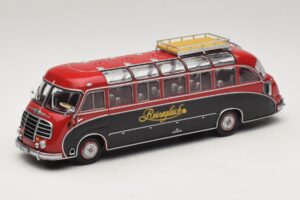
Setra takes its name from selbsttragend, the German word for self-supporting, a reference to the integral body construction that made the marque’s coaches structurally different from anything else on the road in the early 1950s. This 1:43 scale diecast range, produced by Minichamps, brings that engineering distinction to the shelf for collectors building a themed German coach or commercial vehicle display.
TL;DR: Setra diecast coach and bus models in 1:43 scale document 1950s German coach building, produced by Minichamps in diecast metal. The Setra name comes from selbsttragend, self-supporting, reflecting the marque's early integral monocoque body construction that set it apart from chassis-and-body coach builders of the era.
Setra earned its name before it earned its reputation: selbsttragend, self-supporting, describes the integral body construction that set the marque apart from coach builders still bolting bodywork onto a separate chassis. The 1:43 scale diecast range from Minichamps captures that early 1950s engineering shift, giving collectors access to a coach marque whose construction philosophy mattered as much as its styling. For anyone building a themed German commercial vehicle shelf, Setra supplies the passenger transport side of the story.
The Setra name is a compressed engineering statement: selbsttragend, self-supporting, referring to a body built as a single structural unit rather than a coachwork shell mounted onto a separate ladder chassis. Kassbohrer, the manufacturer behind the Setra brand, introduced this integral construction in its S8 model in the early 1950s, an approach credited among the earliest applications of monocoque thinking to coach design in Germany.
The practical benefits were real. A self-supporting body could be lighter than a traditional chassis-and-bodywork combination carrying the same passenger load, which improved fuel economy and handling on the long-distance routes coaches were built for. It also allowed a lower floor and a more spacious cabin than chassis-based construction typically permitted, since there was no separate frame running beneath the passenger compartment eating into interior height. That combination of lighter weight and better packaging is what made Setra's approach influential well beyond its own coaches, and it is the detail the 1:43 scale range sets out to represent rather than simply reproducing a generic 1950s bus shape.
A coach model succeeds or fails on different details than a car or truck. There is no engine bay to admire and no wheel arch flare to get right; the entire visual identity sits in a handful of proportions that reward close comparison against the real vehicle:
Minichamps' 1:43 scale discipline, developed largely on motorsport and passenger car subjects, translates into coach work through careful attention to that glazing rhythm and body line accuracy. A collector assessing a Setra model should look first at whether these elements hold together, since they are what most quickly separate a well-tooled coach model from an approximate one.
A coach presents a different casting challenge than a car or even a truck, simply because of its length relative to its height and width. Diecast zinc alloy holds that long, low body shape without the sagging or warping risk a lighter material might carry over a body this elongated, and the material's weight gives a 1:43 coach a satisfying solidity in the hand despite its slender profile.
Glazing is a particularly important element on any coach model, since the self-supporting body construction Setra pioneered relied on generous window area for both structural and passenger-comfort reasons. A well-made model uses clear, evenly fitted glazing across the full length of the body, avoiding the slightly milky or uneven look that lower-quality moulded parts can show. Whether a specific Setra model includes any opening features, luggage doors or destination signage that illuminates, is a detail that varies by individual piece and is stated on the product listing itself rather than assumed from the marque or the material. Paintwork on coach subjects tends to carry more colour and livery variation than the flat industrial tones of haulage trucks, giving Setra models genuine visual presence on a shelf.
A full-size coach is one of the longest vehicles a scale model manufacturer tackles, often exceeding twelve metres in reality, which makes scale choice especially consequential. At 1:18, a Setra coach would stretch to well over half a metre in length, a display commitment few collectors can accommodate alongside anything else. At 1:43, the same coach settles into a manageable length that sits comfortably beside cars, trucks and other commercial vehicles on standard shelving.
That practicality matters because a coach rarely works as an isolated subject the way a hero sports car does; its appeal comes from context, sitting within a wider transport theme rather than standing alone as a single statement piece. The 1:43 scale also keeps the glazing and bodyline details that define a coach's character at a size where they remain legible without needing an oversized model to display them properly. It is also the scale at which most Setra variants tend to appear, making a themed coach collection realistically achievable over time.
Setra coaches occupy a distinct place within a broader 1950s German commercial vehicle theme, representing the passenger transport side of a story that Krupp and Magirus-Deutz tell through freight haulage and fire apparatus. A collector building a comprehensive post-war German transport display benefits from including at least one Setra subject to round out that picture, since coaches served a genuinely different purpose from the goods and emergency vehicles the other marques represent.
Collectors drawn specifically to coach and bus history often approach Setra differently, tracking liveries associated with specific long-distance operators or regional transport companies rather than collecting by chassis variant alone. That approach rewards research into period route networks and operator colour schemes, turning a shelf of coaches into a documented record of how people actually travelled across Germany in the 1950s rather than a simple collection of similarly shaped vehicles.
A coach's long, low profile and extensive glazing bring specific display considerations that shorter vehicles do not. The generous window area that made Setra's self-supporting design distinctive is also the part of the model most likely to show fingerprints and dust, so handling by the underside or chassis rather than gripping the glazed body protects both the finish and the clarity of the windows.
The model's length also matters for shelf planning: a 1:43 coach takes up considerably more linear shelf space than a car or even most trucks, so positioning it at the end of a row or on its own dedicated section avoids crowding shorter subjects around it. A glass-fronted cabinet protects the extensive glazing from dust more effectively than open shelving, which matters more here simply because there is more glass to keep clean. Livery-specific coaches, representing a particular operator, tend to hold stronger collector interest over time than generic factory colours, so keeping original packaging and any accompanying documentation adds real value for a subject where provenance and specific livery identification matter to fellow collectors.
Setra derives from selbsttragend, German for self-supporting, referring to the integral body construction Kassbohrer introduced on its coaches in the early 1950s. Rather than bolting bodywork onto a separate chassis, the body itself formed the structural unit, an approach credited among the earliest of its kind in German coach building.
Every Setra model in this range is 1:43 scale diecast, produced by Minichamps. That combination suits the coach's long, low profile, giving the model structural stability and genuine weight while keeping its length practical for standard shelving alongside cars and trucks.
Setra represents the passenger transport side of 1950s German commercial vehicle history, complementing haulage marques like Krupp and Magirus-Deutz's fire apparatus. Adding a Setra coach rounds out a themed post-war German transport shelf by covering how people, rather than goods, moved during the same period.
Check the window pitch and roofline curve against period photographs, since these define a coach's identity more than any single panel line. Clear, evenly fitted glazing and a convincingly reproduced operator livery both signal a model that captures Setra's design properly rather than a generic coach shape.