Last one
New arrival
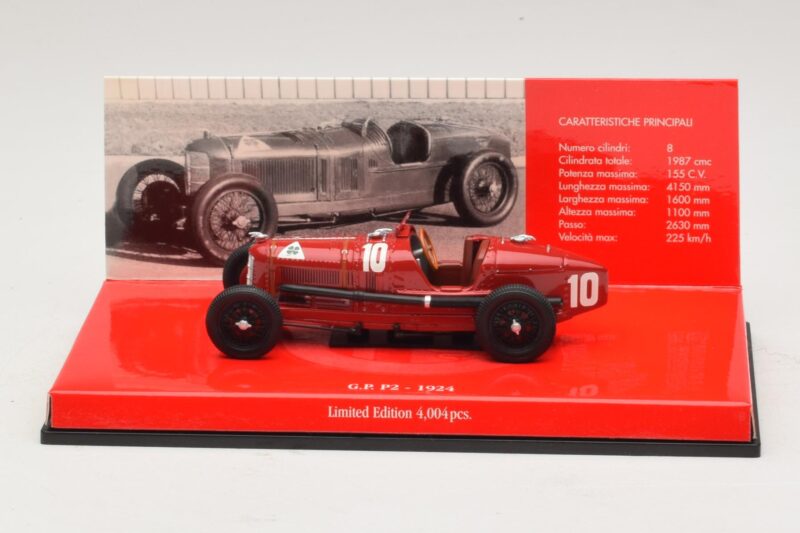
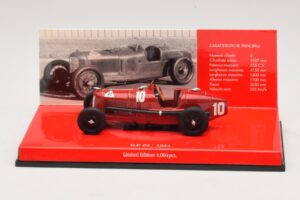
TL;DR: Minichamps' 1:43 Alfa Romeo P2 reproduces Vittorio Jano's 1924 grand prix design, #10 in red sealed diecast. The narrow single-seater body is cast as one continuous shell, exposing the supercharged straight-eight that carried Alfa Romeo to its first World Championship. A cornerstone subject for pre-war motorsport collectors.
Vittorio Jano's P2 changed what a grand prix car could be, pairing a supercharged straight-eight engine with a narrow, purpose-built chassis at a time when most rivals still raced modified touring cars. Minichamps' 1:43 casting reproduces the #10 car in red, tracking the slender bonnet, exposed engine detail and cycle-winged stance that made the P2 look genuinely purpose-built rather than adapted.
Jano designed the P2 for Alfa Romeo's 1924 season, fitting a supercharged twin-cam straight-eight into a chassis stripped to essentials, narrow enough that the driver sat almost astride the transmission tunnel rather than beside it. The car won on its competition debut and went on to take the French Grand Prix that year with Antonio Ascari at the wheel, results that fed directly into Alfa Romeo's 1925 title as the first winner of the World Manufacturers' Championship.
Minichamps' casting captures that narrow, purposeful stance: the bonnet tapers sharply toward a small, low radiator, the cockpit sits exposed with minimal bodywork around the driver, and the cycle-style wings follow the wheels closely. The exhaust pipe runs externally along the flank as a separately tooled detail, and the exposed engine block ahead of the cockpit reads with genuine mechanical presence. Red paint is applied evenly across the narrow bodywork, and the #10 race number on the cowl is tampo-printed with sharp, legible edges. Wire wheels are correctly spoked rather than simplified.
An open-wheel, open-cockpit subject like the P2 has no bonnet or boot to hinge in the first place, so the sealed one-piece construction common to 1:43 diecast suits it without compromise. What the casting needs to get right instead is the exposed mechanical detail that would otherwise be hidden under bodywork on a closed car: the supercharger housing, the external exhaust run and the narrow chassis rails are all visible on the real P2, and Minichamps tools each as a distinct raised feature rather than smoothing them into the main casting.
The zinc alloy body carries real weight despite the car's slender profile, and that density helps the model sit securely on a shelf rather than feeling flimsy. Paint sits directly on the primed metal in a deep, consistent red, with no patchiness around the compound curves of the tapered bonnet, and the tampo-printed race number holds crisp edges. The driver's seat and exposed steering column are moulded with correct period proportions. This sits comfortably at Minichamps' mid-tier finish for pre-war subjects.
For anyone building a collection around the origins of grand prix racing, the P2 is close to essential: it is the car that won motorsport's first world championship for manufacturers, and its narrow, purpose-built layout marks the point where racing cars stopped being adapted road cars. It sits naturally alongside other 1920s Grand Prix subjects, Bugatti or Delage machinery of the same period, as a design comparison of how different manufacturers solved the same problem in that formative decade. At roughly 9cm long, it needs minimal shelf space, and its bright red livery gives a pre-war motorsport display a strong visual anchor among the era's more muted machinery. Few subjects offer this much documented significance at such an accessible 1:43 price point.


Save £14.00