Last one
Used
This model is currently sold out. Enter your email and we'll let you know when it's back in stock. We'll also send you news about new models. You can unsubscribe at any time.
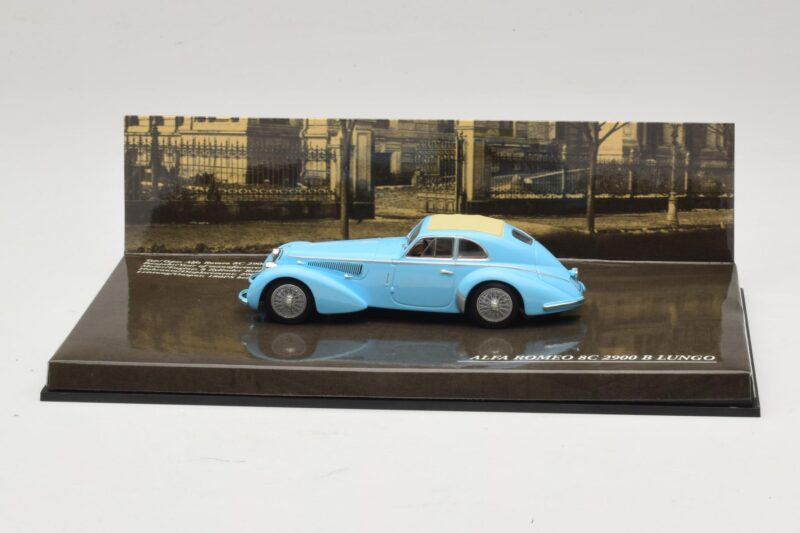
TL;DR: Minichamps' 1:43 Alfa Romeo 8C 2900B Lungo reproduces one of pre-war Italy's most celebrated grand tourers, its Touring-bodied flowing wings cast as a sealed, one-piece diecast shell in Light Blue. A road-going relative of the racing 8C that dominated the Mille Miglia across the mid-1930s.
The 8C 2900B softened the race-bred 2900A into something buyers could actually order and drive, keeping the independent suspension and straight-eight engine but wrapping them in Carrozzeria Touring's flowing, superleggera-built bodywork. The Lungo, or long-wheelbase, version leaned toward grand touring comfort over outright sportiness, and it remains one of the most admired shapes to come out of 1930s Italy.
Touring's superleggera method built a lightweight tube frame under thin aluminium panelling, and the result was a body defined almost entirely by its surfacing rather than by hard creases or shut lines. A sealed diecast shell suits that kind of shape well: there is no hinge geometry to disrupt the continuous sweep from the front wing, over the cutaway door, and into the tapering tail. Minichamps casts that whole run as one uninterrupted line, which is arguably truer to how the original body actually reads than a version with opening doors would be, since the real car's doors were never a visual break point to begin with. That fidelity to a sealed silhouette is part of what makes this casting an honest miniature rather than a simplified guess at a shape most buyers only know from photographs.
Light Blue is a considered choice against the dark reds and blacks most 8C models wear in miniature, and it flatters the car's soft, rounded surfacing in a way a darker shade would not. The paint holds real depth along the crown of the front wing, catching light differently there than in the flatter door panel, evidence of proper layering rather than a single flat coat. Fine chrome-effect trim picks out the headlamp bodies, the split bumper, and the wire wheels without blurring into the surrounding paint, and the wheels themselves carry defined spokes rather than a flat printed pattern, a detail this subject depends on.
The 2900 name earned its reputation through the racing 2900A, which took the top places at the Mille Miglia across the mid-1930s and established the model as one of the fastest, most capable grand touring chassis of its era. The 2900B followed as a road-going evolution of that success, aimed at wealthy customers who wanted the pedigree and the presence of the racing car without its stripped-out cockpit, and Touring's coachwork gave it a level of visual drama that few contemporaries could match. Surviving examples now rank among the most valuable pre-war cars sold at auction anywhere, a value driven as much by that competition pedigree as by the coachwork itself.
Underneath the flowing bodywork, the 2900B carried independent suspension at both ends, a genuinely advanced specification for a production road car in the late 1930s, when most rivals still relied on simple beam axles. Combined with the straight-eight engine's smooth, high-revving character, that chassis gave the 2900B a reputation for covering long distances at speed with a composure few other pre-war cars could offer, which is exactly the quality the Lungo body was designed to showcase. That chassis sophistication is also why the 2900B is remembered as an engineering landmark in its own right, not simply as a beautiful body wrapped around an older platform.
An 8C 2900B like this one is built to anchor a display rather than sit among a broader run of everyday classics; its shape and story both reward being given room rather than crowding it next to smaller, plainer pre-war cars. Pair it with other Carrozzeria Touring-bodied Alfas if the collection allows, or let it stand as the single Italian counterpoint to a run of German pre-war luxury cars from the same decade. Original 8C 2900s sell for sums that put them permanently out of reach for almost every collector, which makes a carefully finished 1:43 replica the realistic route to owning this shape at all, and worth the premium over a more common pre-war subject.