Last one
New arrival
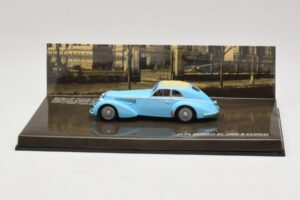
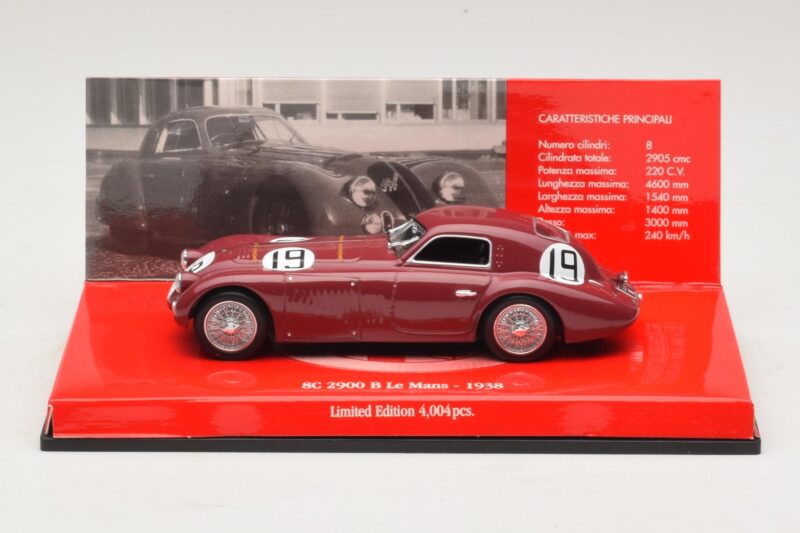
TL;DR: Minichamps' 1:43 Alfa Romeo 8C 2900B reproduces the #19 Sommer/Biondetti Le Mans entry from 1938 in sealed diecast. Touring's streamlined racing body is cast as one continuous shell, with race number and period sponsor detail tampo-printed on. A significant pre-war subject for historic motorsport collectors.
Alfa Romeo's 8C 2900B stands among the most advanced racing cars of the late 1930s, its supercharged straight-eight and independent suspension wrapped in Carrozzeria Touring bodywork shaped for speed rather than show. Minichamps' 1:43 casting reproduces the #19 entry driven by Raymond Sommer and Clemente Biondetti, tracking Touring's flowing wings and low, tapered tail closely.
The 8C 2900B carried Alfa Romeo's straight-eight engine, supercharged and mounted in a chassis with independent suspension at both ends, a genuinely advanced specification for a car racing in the late 1930s. Carrozzeria Touring's body prioritised airflow over ornament, with enclosed wheel arches, a low, faired-in tail and a narrow, tapered nose that gave the car a distinctly modern silhouette against the more upright racers of the period.
Minichamps' 1:43 casting reproduces the #19 car entered for Raymond Sommer and Clemente Biondetti, carrying the race number on the nose and door in period-correct positioning, along with the two-tone bonnet strap detail Alfa's works cars commonly wore. The flowing front wings, a signature of Touring's design language, are tooled with genuinely thin leading edges, and the tail tapers correctly to the narrow point Touring's aerodynamicists favoured. Wire wheels sit within the enclosed arches at the right offset, and the exposed exhaust piping along the flank is picked out as a separate raised detail.
As with virtually every 1:43 pre-war racing subject, this 8C 2900B is cast as a single sealed body rather than built with opening doors or a lifting bonnet, and here that construction choice suits the car particularly well. Touring's coachwork was designed as one continuous aerodynamic surface, with wheel arches, running boards and tail all faired into a single visual line, so a sealed casting can hold that unbroken silhouette without a shut line breaking up the flanks.
The zinc alloy construction gives the model genuine weight for its footprint, a density that suits a subject whose real counterpart was built from aluminium panels over a substantial chassis. Paint sits on a primed metal shell in the correct pre-war Alfa racing red, deep and even, and the tampo-printed race number sits flush against the surface with sharp edges. The cockpit opening reveals a simplified but correctly proportioned bucket seat and exposed gear linkage. This sits at Minichamps' familiar mid-tier finish for 1:43 pre-war subjects.
The 8C 2900B sits at the serious end of pre-war motorsport collecting, a subject for anyone building a shelf around 1930s endurance and Grand Prix racing rather than dabbling casually. Its streamlined shape gives it real visual contrast against the more upright, cycle-fendered racers of the same period, so it works well as a design counterpoint within a broader pre-war display rather than only as a standalone piece. At roughly 11cm long, the model needs a touch more shelf depth than a typical 1:43 saloon owing to its long tail and flowing wings, worth checking before slotting it into a tightly packed cabinet row. Alongside period rivals from Delahaye or Talbot-Lago, it makes the case for why 1930s sports-racers still reward close study today.




Save £14.00