{"ajaxurl":"https:\/\/models118.co.uk\/wp-admin\/admin-ajax.php?lang=en_GB","nonce":"b5ef73b935","homeUrl":"https:\/\/models118.co.uk\/","shopUrl":"https:\/\/models118.co.uk\/shop\/","cartUrl":"https:\/\/models118.co.uk\/cart-en-gb\/","checkoutUrl":"https:\/\/models118.co.uk\/checkout\/","skipCart":true,"collectionLimit":12,"i18n":{"addedToCart":"Added to basket","addToWishlist":"Add to wishlist","addedToWishlist":"Added to wishlist","removeFromWishlist":"Remove from wishlist","removedFromWishlist":"Removed from wishlist","undo":"Undo","error":"Something went wrong","loading":"Loading...","outOfStock":"Out of stock","viewCart":"View basket","proceedToCheckout":"Proceed to checkout","addedToCollection":"Added to your collection","reserved":"Reserved!","soldOut":"Sold out","invalidEmail":"Please enter a valid email address","connectionError":"Connection error. Please try again.","loginToSave":"Sign in to save this model","waitlistNotify":"Notify me","waitlistOnList":"On the waiting list \u2713","waitlistJoined":"You're on the waiting list. We'll email you the moment this model is available again.","waitlistRemoved":"Done \u2014 you're off the waiting list for this model.","waitlistRateLimit":"Too many attempts \u2014 please try again shortly","waitlistTurnstile":"We couldn't complete the check \u2014 please try again","waitlistError":"Sorry, something went wrong. Please try again in a moment."},"wishlist":{"loggedIn":false,"loginUrl":"https:\/\/models118.co.uk\/my-account\/","addAction":"models118_wishlist_add","removeAction":"models118_wishlist_remove"},"waitlist":{"loggedIn":false,"subscribeAction":"models118_waitlist_subscribe","toggleAction":"models118_waitlist_toggle","stateAction":"models118_waitlist_state"},"stats":{"models":2657,"brands":213,"manufacturers":128,"collectors":10000},"product":{"id":1671438,"sku":"100911045","condition":"used","availability":"in_stock","name":"Audi V8 Quattro DTM #45 F. Biela Team AZR 1991 Minichamps 1:18","brand":"Audi","manufacturer":"Minichamps","scale":"1:18","material":"Diecast","price":184.17,"regularPrice":184.17,"isOnSale":false,"savingsAmount":0,"stockQty":1,"stockStatus":"very_low","isDiscontinued":false,"image":"https:\/\/models118.co.uk\/wp-content\/uploads\/2026\/09\/audi-v8-quattro-dtm-45-f-biela-team-azr-1991-minichamps-1-18-100911045-1-1-300x200.jpg","permalink":"https:\/\/models118.co.uk\/audi-v8-quattro-dtm-45-f-biela-team-azr-1991-minichamps-1-18-100911045\/"}}
Cookies on Models118
We use cookies to remember your preferences, understand how the shop is used and show you models and offers that suit your interests. What you allow is up to you, and you can change it at any time.
Always active
The technical storage or access is strictly necessary for the legitimate purpose of enabling the use of a specific service explicitly requested by the subscriber or user, or for the sole purpose of carrying out the transmission of a communication over an electronic communications network.
The technical storage or access is necessary for the legitimate purpose of storing preferences that are not requested by the subscriber or user.
The technical storage or access that is used exclusively for statistical purposes.
The technical storage or access is required to create user profiles to send advertising, or to track the user on a website or across several websites for similar marketing purposes.
Audi V8 Quattro DTM #45 F. Biela Team AZR 1991 Minichamps 1:18
1/8
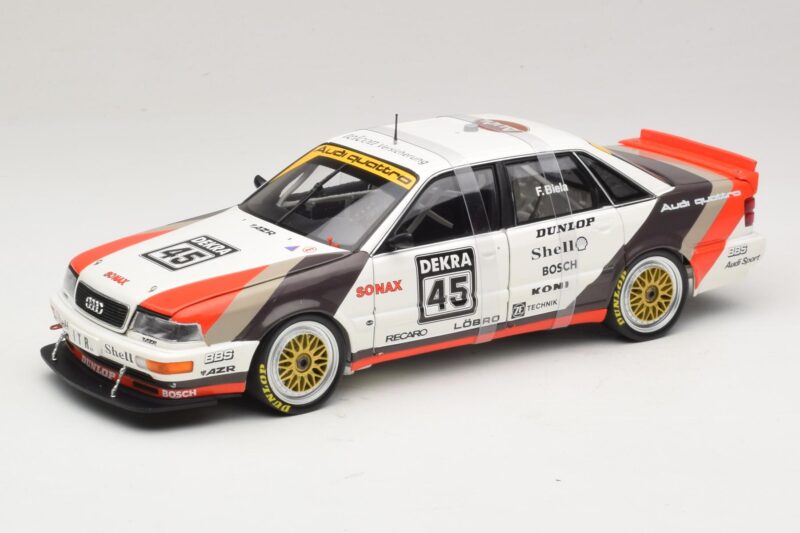
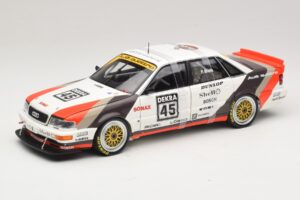
Minichamps' 1:18 diecast Audi V8 quattro reproduces Frank Biela's #45 Team AZR car from the 1991 DTM title-winning season, when quattro's four-wheel-drive traction outmatched rear-driven BMW and Mercedes rivals so decisively that the rules changed soon afterward. The doors and bonnet open on this casting, exposing the roll cage and the quattro drivetrain packaging behind the livery.
About the Audi V8 Quattro DTM #45 F. Biela Team AZR 1991 Minichamps 1:18
TL;DR: Minichamps' 1:18 diecast reproduces Frank Biela's #45 Audi V8 quattro from the 1991 DTM season, the year Audi's four-wheel-drive advantage carried Biela to the championship before the rules changed. The doors and bonnet open on this casting, exposing the roll cage behind the Audi Zentrum Reutlingen livery.
Audi's quattro all-wheel-drive system had already rewritten rallying by the time it arrived in touring cars, and the V8 quattro's dominance of the early-1990s DTM forced the championship to eventually restrict the technology it couldn't otherwise contain. Minichamps casts Biela's title-winning #45 car from Team AZR, doors open to the roll cage that replaced the road car's luxury cabin entirely.
Quattro's Brief, Dominant DTM Era
Audi brought genuine four-wheel-drive traction to a championship built around rear-wheel-drive coupes when it entered the V8 quattro in DTM at the turn of the 1990s, and the advantage showed immediately, particularly out of slow corners where rear-driven rivals from BMW and Mercedes-Benz simply couldn't match the traction quattro delivered. Frank Biela took the drivers' title in 1991 driving for Audi, a result that owed as much to that mechanical advantage as to Biela's own skill, since the quattro system let drivers get back on the power earlier than a two-wheel-drive car could manage on the same corner exit. That dominance didn't sit comfortably with rival manufacturers or with a series built around close, visible competition, and DTM's governing body moved to restrict four-wheel-drive systems not long afterward, effectively ending quattro's run at the top of the championship within a couple of seasons. The V8 quattro itself paired a 3.6-litre V8, later enlarged to 4.2 litres in some specifications, with a drivetrain adapted from Audi's rally-proven quattro system, a genuinely unusual combination for a touring car grid built almost entirely around conventional rear-wheel-drive layouts.
Team AZR's Livery and the Opening Cabin
Audi Zentrum Reutlingen ran as one of the dealer-network-affiliated teams supporting the manufacturer's factory effort, a structure common in early-1990s DTM where several nominally independent squads campaigned cars built to essentially factory specification. Opening the door on this casting exposes exactly what a DTM car of this era actually contained: a tubular roll cage, a single racing seat mounted centrally rather than offset, and none of the luxury trim the road-going V8 saloon carried in showrooms. Diecast construction gives the model real heft, and the panel gaps around the opening bodywork stay tight enough not to interrupt the AZR livery's colour blocks and sponsor graphics across the door skin. Lifting the bonnet reveals the V8 mounted well back in the chassis for the quattro system's front differential and driveshaft routing, a packaging challenge unique to this car among its rear-driven DTM rivals and one worth comparing directly against a BMW or Mercedes touring car from the same grid. Getting that engine bay layout right is what separates a model built with genuine attention to this car's mechanical distinctiveness from one that treats it as just another period touring car.
Biela's Title Season and DTM's Turning Point
Frank Biela went on to a decorated career that included multiple Le Mans 24 Hours victories for Audi's later sports car programme, but his 1991 DTM title with the V8 quattro marked him as a serious talent years before that endurance racing success arrived. The #45 AZR livery from that championship season carries specific sponsor and colour details distinct from Audi's other DTM entries fielded the same year, since the manufacturer ran multiple teams and liveries simultaneously across its factory-supported effort. Comparing this car against the BMW and Mercedes entries it beat that season illustrates exactly why the rules changed: quattro's traction advantage wasn't marginal, it was decisive enough to reshape an entire championship's competitive order within a couple of seasons.
Placing Quattro's DTM Dominance on a Shelf
This Biela title car anchors a collection built around touring car engineering's occasional rule-breaking moments, sitting alongside contemporary BMW and Mercedes entries to show exactly what quattro's rivals were up against on track. Diecast construction and the opening bodywork place this model in the same mid-premium tier as other detailed early-1990s DTM reproductions, with the value resting on both historical significance and the accuracy of the AZR livery's sponsor detail. For collectors tracing how technical regulations evolve in response to on-track dominance, this V8 quattro offers a more concrete story than most touring car subjects manage, and it rewards a buyer who already appreciates the technical side of touring car history over pure livery collecting.
Create a free account and claim 10% off your first order — from hundreds of collectible 1:18, 1:43 and 1:12 models by Porsche, Mercedes-Benz, BMW and more.
{"id":1671438,"name":"Audi V8 Quattro DTM #45 F. Biela Team AZR 1991 Minichamps 1:18","price":"£<\/span>184.17<\/bdi><\/span>","image":"https:\/\/models118.co.uk\/wp-content\/uploads\/2026\/09\/audi-v8-quattro-dtm-45-f-biela-team-azr-1991-minichamps-1-18-100911045-1-1-400x400.jpg","permalink":"https:\/\/models118.co.uk\/audi-v8-quattro-dtm-45-f-biela-team-azr-1991-minichamps-1-18-100911045\/","brand":"Audi"}