{"ajaxurl":"https:\/\/models118.co.uk\/wp-admin\/admin-ajax.php?lang=en_GB","nonce":"8688bd9d48","homeUrl":"https:\/\/models118.co.uk\/","shopUrl":"https:\/\/models118.co.uk\/shop\/","cartUrl":"https:\/\/models118.co.uk\/cart-en-gb\/","checkoutUrl":"https:\/\/models118.co.uk\/checkout\/","skipCart":true,"collectionLimit":12,"i18n":{"addedToCart":"Added to basket","addToWishlist":"Add to wishlist","addedToWishlist":"Added to wishlist","removeFromWishlist":"Remove from wishlist","removedFromWishlist":"Removed from wishlist","undo":"Undo","error":"Something went wrong","loading":"Loading...","outOfStock":"Out of stock","viewCart":"View basket","proceedToCheckout":"Proceed to checkout","addedToCollection":"Added to your collection","reserved":"Added to your collection","soldOut":"Sold out","invalidEmail":"Please enter a valid email address","connectionError":"Connection error. Please try again.","tocToggle":"On this page","close":"Close","inCartTooltip":"Already in your basket \u2013 open your basket to check out","loginToSave":"Sign in to save this model","waitlistNotify":"Notify me","waitlistOnList":"On the waiting list \u2713","waitlistJoined":"You're on the waiting list. We'll email you the moment this model is available again.","waitlistRemoved":"Done \u2014 you're off the waiting list for this model.","waitlistRateLimit":"Too many attempts \u2014 please try again shortly","waitlistTurnstile":"We couldn't complete the check \u2014 please try again","waitlistError":"Sorry, something went wrong. Please try again in a moment."},"wishlist":{"loggedIn":false,"loginUrl":"https:\/\/models118.co.uk\/my-account\/","addAction":"models118_wishlist_add","removeAction":"models118_wishlist_remove"},"waitlist":{"loggedIn":false,"subscribeAction":"models118_waitlist_subscribe","toggleAction":"models118_waitlist_toggle","stateAction":"models118_waitlist_state"},"stats":{"models":2418,"brands":213,"manufacturers":128,"collectors":10000},"product":{"id":1659308,"sku":"AM59558L","condition":"used","availability":"in_stock","name":"Panasonic Toyota Racing TF106 #11 J. Trulli 2006 Minichamps 1:18","brand":"Toyota","manufacturer":"Minichamps","scale":"1:18","material":"Diecast","price":96,"regularPrice":96,"isOnSale":false,"savingsAmount":0,"stockQty":2,"stockStatus":"very_low","isDiscontinued":false,"image":"https:\/\/models118.co.uk\/wp-content\/uploads\/2026\/08\/panasonic-toyota-racing-tf106-11-j-trulli-2006-minichamps-1-18-am59558l-1-1-300x200.jpg","permalink":"https:\/\/models118.co.uk\/panasonic-toyota-racing-tf106-11-j-trulli-2006-minichamps-1-18-am59558l\/"}}
Cookies on Models118
We use cookies to remember your preferences, understand how the shop is used and show you models and offers that suit your interests. What you allow is up to you, and you can change it at any time.
Always active
The technical storage or access is strictly necessary for the legitimate purpose of enabling the use of a specific service explicitly requested by the subscriber or user, or for the sole purpose of carrying out the transmission of a communication over an electronic communications network.
The technical storage or access is necessary for the legitimate purpose of storing preferences that are not requested by the subscriber or user.
The technical storage or access that is used exclusively for statistical purposes.
The technical storage or access is required to create user profiles to send advertising, or to track the user on a website or across several websites for similar marketing purposes.
Panasonic Toyota Racing TF106 #11 J. Trulli 2006 Minichamps 1:18
1/7
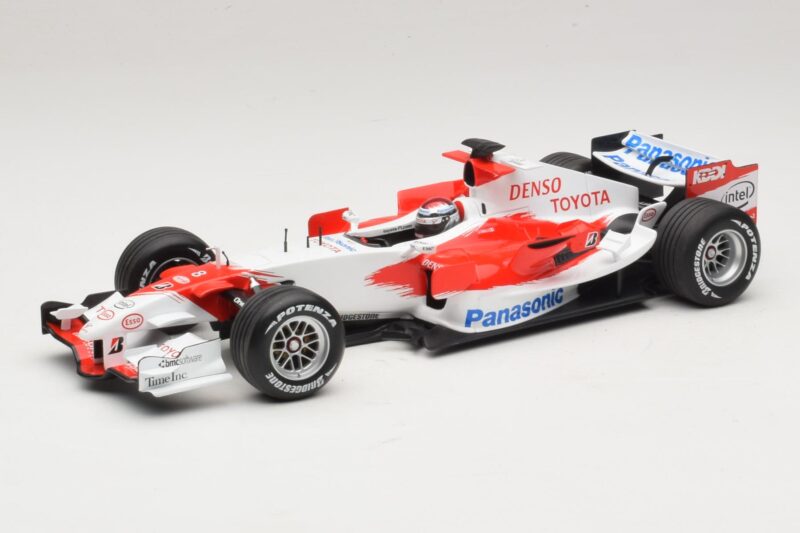
Minichamps' 1:18 diecast Panasonic Toyota TF106 reproduces Jarno Trulli's 2006 Formula One entry, the number 11 car from Toyota's first season under the new 2.4-litre V8 rules. Built as a single sealed casting, a natural approach for an open-cockpit racer with no bonnet or doors to model as hinges, the body carries tampo-printed Panasonic and Bridgestone graphics matched to the sister car. Zinc alloy weight gives it the same shelf presence as the rest of the 2006 grid, with sealed-body construction consistent across Minichamps' whole Formula One range that year.
About the Panasonic Toyota Racing TF106 #11 J. Trulli 2006 Minichamps 1:18
TL;DR: Minichamps' 1:18 diecast Panasonic Toyota TF106 reproduces Jarno Trulli's #11 entry from Toyota's 2006 Formula One season, the year V8 engines replaced V10s across the grid. The sealed zinc-alloy body carries tampo-printed Panasonic livery, a natural construction choice for an open-cockpit car with no bonnet or doors.
Jarno Trulli brought a reputation for blistering single-lap pace to Toyota in 2005, a trait the F1 paddock knew well from his Renault years, when a strong grid slot rarely translated into an equally strong finish. By 2006 he carried number 11 for Panasonic Toyota Racing, the team's senior seat, as the sport adopted smaller V8 engines across the board.
Minichamps' TF106 and Jarno Trulli's Number 11
From Renault Points to Toyota's Senior Seat
Trulli moved to Toyota for 2005 after three seasons at Renault, where he had taken a maiden grand prix victory at Monaco in 2004, a result that remained the high point of his career. At Toyota he held the senior of the two race seats, wearing number 11 opposite Ralf Schumacher's 12, a pairing built around two drivers with very different reputations but comparable experience levels entering the sport's biggest technical change in years. That relative seniority reflected past results more than raw pace on any given weekend, and by 2006 both Toyota drivers had several full seasons of experience navigating the sport's often brutal driver market.
A Qualifying Reputation That Followed Him
Trulli's single-lap speed was rarely in question. What followed him through the mid-2000s was a media narrative about race pace lagging behind his grid position, a gap widely enough discussed at the time that it earned its own shorthand in F1 commentary. Whatever the fairness of that reputation, it made the TF106 seasons a genuine test: strong Saturdays needed to convert into results on a Sunday against works teams with considerably larger budgets and, in Toyota's case, a brand-new V8 engine still finding its reliability. Toyota's Cologne factory introduced an upgraded TF106B specification mid-season, an attempt to give both cars, Trulli's included, more competitive pace for the second half of the year.
Casting a Sealed Body in Zinc Alloy
Tampo Print Detail Over a Sealed Shell
As with the rest of Minichamps' F1 range, this TF106 is diecast in zinc alloy rather than resin, giving it a density noticeably heavier than its physical size would suggest when lifted from the box. There are no opening doors, bonnet or boot on this casting, which matches the real car exactly: an open-wheel, open-cockpit Formula One chassis has no such panels to begin with, so a sealed body is simply the accurate way to reproduce one rather than a cost-saving shortcut. The result sits noticeably above entry-level diecast, where seam lines and softer paint are common trade-offs for a lower price point.
Matching Panasonic Toyota's Livery Registration
Panasonic's blue and white branding runs across the sidepods, engine cover and front wing endplates, applied through tampo printing rather than transfers, which keeps sharp edges on text that would otherwise blur at this scale. Number 11 sits on the nose and sidepod in the same typeface Toyota used trackside, alongside Bridgestone tyre lettering reproduced on the wheels themselves. Getting these details aligned across a compound-curved bodywork surface, rather than a flat panel, is where Minichamps' F1 line earns its reputation among drivers-and-liveries collectors specifically, as opposed to buyers chasing a particular chassis regardless of paint scheme, a distinction that matters when a display case holds several similar-liveried F1 diecasts side by side.
Cockpit Detail and the Open Era of 1:18 Formula Cars
The 2006 season predates the halo cockpit protection device introduced years later, so the driver's compartment on this model is fully open and visible from above, exactly as spectators saw it trackside. Trulli's name and number sit on the cockpit surround, and the seatbelt harness and roll structure are moulded in with enough definition to read clearly under display lighting rather than disappearing into shadow. At 1:18 the whole car measures around 25 centimetres from nose to diffuser, a far more compact footprint than a road car at the same scale carries, which lets several Formula One entries share a single shelf run without crowding. Because the body has no hinged panels to brace open, it sits flat and stable on a stand without the risk of a raised bonnet drifting shut over time, a small practical advantage when several similar cars are displayed together. British collectors assembling a 2006 grid, or simply a Toyota pairing, will find this Trulli car sits naturally alongside Ralf Schumacher's sister TF106, the two liveries matched down to the sponsor placement, differing only in the number and the driver's name printed on the chassis. A directed light across the cockpit rim also picks out the moulded roll hoop's raised lip, a small sculpting detail easy to miss under flat ambient lighting.
Completing a Two-Car Toyota Garage
This TF106 occupies the same mid-tier ground within Minichamps' catalogue as other factory-team F1 diecasts from the mid-2000s: priced below the championship-winning cars and marquee drivers that command a premium, and built to the same sealed-body standard across the whole range rather than offering opening panels as an upgrade option. The honest limitation is that nobody lifts an engine cover to inspect the RVX-06 V8 underneath, because the real car carries no such cover to model. What the piece delivers instead is accurate proportion, correct livery registration and a specific driver-and-number combination that a generic 'Toyota F1' model could never provide. For a collector already holding Ralf Schumacher's number 12 car, adding Trulli's number 11 completes the 2006 factory pairing rather than leaving one half of the garage unrepresented. Buyers shopping specifically for this pairing will find both cars listed with matching production specifications, making a side-by-side purchase straightforward rather than a hunt across separate catalogue numbers.
Create a free account and claim 10% off your first order — from hundreds of collectible 1:18, 1:43 and 1:12 models by Porsche, Mercedes-Benz, BMW and more.
{"id":1659308,"name":"Panasonic Toyota Racing TF106 #11 J. Trulli 2006 Minichamps 1:18","price":"£<\/span>96.00<\/bdi><\/span>","image":"https:\/\/models118.co.uk\/wp-content\/uploads\/2026\/08\/panasonic-toyota-racing-tf106-11-j-trulli-2006-minichamps-1-18-am59558l-1-1-400x400.jpg","permalink":"https:\/\/models118.co.uk\/panasonic-toyota-racing-tf106-11-j-trulli-2006-minichamps-1-18-am59558l\/","brand":"Toyota"}