{"ajaxurl":"https:\/\/models118.co.uk\/wp-admin\/admin-ajax.php?lang=en_GB","nonce":"8a70d40d00","homeUrl":"https:\/\/models118.co.uk\/","shopUrl":"https:\/\/models118.co.uk\/shop\/","cartUrl":"https:\/\/models118.co.uk\/cart-en-gb\/","checkoutUrl":"https:\/\/models118.co.uk\/checkout\/","skipCart":true,"collectionLimit":12,"i18n":{"addedToCart":"Added to basket","addToWishlist":"Add to wishlist","addedToWishlist":"Added to wishlist","removeFromWishlist":"Remove from wishlist","removedFromWishlist":"Removed from wishlist","undo":"Undo","error":"Something went wrong","loading":"Loading...","outOfStock":"Out of stock","viewCart":"View basket","proceedToCheckout":"Proceed to checkout","addedToCollection":"Added to your collection","reserved":"Reserved!","soldOut":"Sold out","invalidEmail":"Please enter a valid email address","connectionError":"Connection error. Please try again.","loginToSave":"Sign in to save this model","waitlistNotify":"Notify me","waitlistOnList":"On the waiting list \u2713","waitlistJoined":"You're on the waiting list. We'll email you the moment this model is available again.","waitlistRemoved":"Done \u2014 you're off the waiting list for this model.","waitlistRateLimit":"Too many attempts \u2014 please try again shortly","waitlistTurnstile":"We couldn't complete the check \u2014 please try again","waitlistError":"Sorry, something went wrong. Please try again in a moment."},"wishlist":{"loggedIn":false,"loginUrl":"https:\/\/models118.co.uk\/my-account\/","addAction":"models118_wishlist_add","removeAction":"models118_wishlist_remove"},"waitlist":{"loggedIn":false,"subscribeAction":"models118_waitlist_subscribe","toggleAction":"models118_waitlist_toggle","stateAction":"models118_waitlist_state"},"stats":{"models":2167,"brands":205,"manufacturers":127,"collectors":10000},"product":{"id":133532,"sku":"08957B","condition":"new","name":"Alfa Romeo Giulietta SV #24 Targa Florio 1958 Kyosho 1:18","brand":"Alfa Romeo","manufacturer":"Kyosho","scale":"1:18","material":"Diecast","price":119,"regularPrice":119,"isOnSale":false,"savingsAmount":0,"stockQty":0,"stockStatus":"out_of_stock","isDiscontinued":true,"image":"https:\/\/models118.co.uk\/wp-content\/uploads\/2026\/03\/alfa-romeo-giulietta-sv-n24-targa-florio-1958-kyosho-1-18-300x200.jpg","permalink":"https:\/\/models118.co.uk\/alfa-romeo-giulietta-sv-24-targa-florio-1958-kyosho-1-18-08957b\/"}}
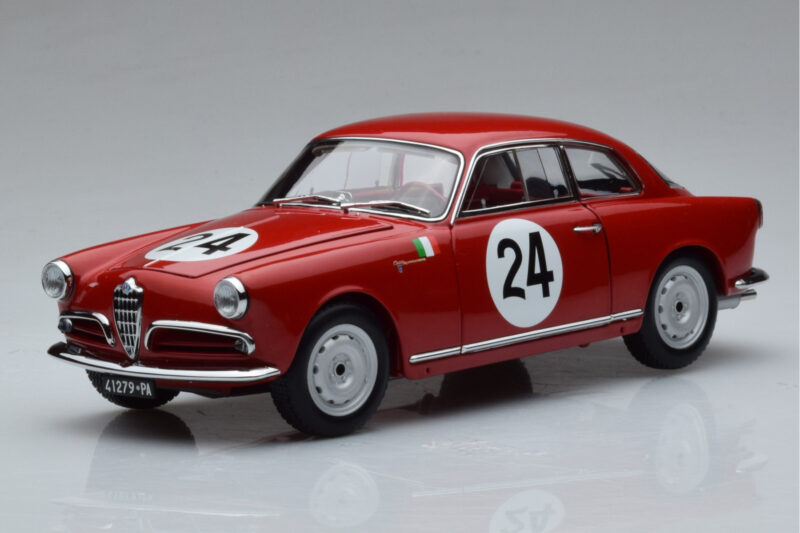
Kyosho's 1:18 diecast Alfa Romeo Giulietta SV carries number 24 racing livery from the 1958 Targa Florio, in the stripped, lightweight specification Alfa built for competition. Sharp decal registration and a stripped cabin sit inside a diecast body with genuine shelf-settling weight. A genuine slice of 1950s GT racing for a Targa Florio or Alfa Romeo themed collection.
About the Alfa Romeo Giulietta SV #24 Targa Florio 1958 Kyosho 1:18
TL;DR: Kyosho's 1:18 diecast reproduces the Alfa Romeo Giulietta Sprint Veloce as raced at the 1958 Targa Florio, car number 24, in the lightweight competition specification Alfa Romeo built for Sicily's demanding road race. Racing decals and number panels sit crisply over the body. A genuine slice of 1950s GT racing history.
Targa Florio didn't reward comfort or restraint; it rewarded cars built light and driven hard over Sicily's mountain roads. Kyosho's Giulietta SV, liveried as car number 24 from the 1958 running, carries that competition purpose in a 1:18 diecast body built for a GT racing shelf.
Kyosho's Race-Liveried Giulietta SV in 1:18
Number 24 Livery and Decal Application
Racing liveries live or die on decal quality, and Kyosho applies the number 24 roundel and supporting race markings with sharp edges and consistent placement rather than the slightly soft registration that lets a livery-focused model down. The body carries the competition trim the Sprint Veloce ran with, stripped of the brightwork a road-going Giulietta Sprint would have kept, which is itself part of accurately telling this car's story. The body colour beneath the racing graphics stays consistent panel to panel, avoiding the slight colour drift that can occur when decals are laid over a base coat mixed in small batches.
Diecast Weight on a Lightweight Racing Subject
There's a slight irony in reproducing a car built around weight-saving in solid zinc alloy diecast, but the heft actually suits how the model sits and displays: it settles firmly on a shelf without the tendency to shift that lighter resin pieces sometimes show. That stability matters more than usual here, since the model is best displayed at a slight angle to show the door number, and a lighter piece can creep out of position over time. The doors open to reveal a stripped-out cabin appropriate to a competition car, with none of the trim a road Giulietta would have carried.
The Giulietta SV and Targa Florio's Demands
A Road Race Built for Lightweight GTs
The Giulietta Sprint Veloce was Alfa Romeo's answer to a straightforward problem: the standard Sprint coupe was well built but heavier than serious GT competition demanded. The SV addressed that with an aluminium body over the same chassis and running gear, shedding weight without abandoning the car buyers already knew. Targa Florio, run since 1906 on the twisting Piccolo delle Madonie circuit in the Sicilian mountains, was exactly the kind of event that rewarded that approach: a road race, not a circuit sprint, where a light, well-balanced GT could out-handle heavier, more powerful machinery over hours of demanding terrain. By 1958, the Giulietta SV had become a familiar sight in Italian GT racing, campaigned by factory-supported teams and privateers alike across events just like this one.
Building a 1950s GT Racing Shelf
Scale, Companions and Display Angle
At roughly 20cm, this Giulietta sits comfortably alongside other 1950s GT racers without dominating a mixed-era shelf, and its stripped competition trim makes an instructive contrast next to a road-specification Sprint of the same period. Display it at a slight angle rather than dead-on and the number roundel and door decals read clearly from across a room, which is really the point of a livery-driven piece like this. The Piccolo delle Madonie circuit's brutal reputation, closer to a road rally than a conventional racetrack, is part of why liveried GT models from this event carry particular weight among collectors of 1950s motorsport. Against ultra-premium resin reproductions of similar subjects, Kyosho's diecast holds up well on detail while sitting at a more accessible point in the market.
Create a free account and claim 10% off your first order — from hundreds of collectible 1:18, 1:43 and 1:12 models by Porsche, Mercedes-Benz, BMW and more.
We use cookies to remember your preferences, understand how the shop is used and show you models and offers that suit your interests. What you allow is up to you, and you can change it at any time.
Functional
Always active
The technical storage or access is strictly necessary for the legitimate purpose of enabling the use of a specific service explicitly requested by the subscriber or user, or for the sole purpose of carrying out the transmission of a communication over an electronic communications network.
Preferences
The technical storage or access is necessary for the legitimate purpose of storing preferences that are not requested by the subscriber or user.
Statistics
The technical storage or access that is used exclusively for statistical purposes.The technical storage or access that is used exclusively for anonymous statistical purposes. Without a subpoena, voluntary compliance on the part of your Internet Service Provider, or additional records from a third party, information stored or retrieved for this purpose alone cannot usually be used to identify you.
Marketing
The technical storage or access is required to create user profiles to send advertising, or to track the user on a website or across several websites for similar marketing purposes.
We use cookies to remember your preferences, understand how the shop is used and show you models and offers that suit your interests. What you allow is up to you, and you can change it at any time.
Functional
Always active
The technical storage or access is strictly necessary for the legitimate purpose of enabling the use of a specific service explicitly requested by the subscriber or user, or for the sole purpose of carrying out the transmission of a communication over an electronic communications network.
Preferences
The technical storage or access is necessary for the legitimate purpose of storing preferences that are not requested by the subscriber or user.
Statistics
The technical storage or access that is used exclusively for statistical purposes.The technical storage or access that is used exclusively for anonymous statistical purposes. Without a subpoena, voluntary compliance on the part of your Internet Service Provider, or additional records from a third party, information stored or retrieved for this purpose alone cannot usually be used to identify you.
Marketing
The technical storage or access is required to create user profiles to send advertising, or to track the user on a website or across several websites for similar marketing purposes.