{"ajaxurl":"https:\/\/models118.co.uk\/wp-admin\/admin-ajax.php?lang=en_GB","nonce":"458841a702","homeUrl":"https:\/\/models118.co.uk\/","shopUrl":"https:\/\/models118.co.uk\/shop\/","cartUrl":"https:\/\/models118.co.uk\/cart-en-gb\/","checkoutUrl":"https:\/\/models118.co.uk\/checkout\/","skipCart":true,"collectionLimit":12,"i18n":{"addedToCart":"Added to basket","addToWishlist":"Add to wishlist","addedToWishlist":"Added to wishlist","removeFromWishlist":"Remove from wishlist","removedFromWishlist":"Removed from wishlist","undo":"Undo","error":"Something went wrong","loading":"Loading...","outOfStock":"Out of stock","viewCart":"View basket","proceedToCheckout":"Proceed to checkout","addedToCollection":"Added to your collection","reserved":"Reserved!","soldOut":"Sold out","invalidEmail":"Please enter a valid email address","connectionError":"Connection error. Please try again.","loginToSave":"Sign in to save this model","waitlistNotify":"Notify me","waitlistOnList":"On the waiting list \u2713","waitlistJoined":"You're on the waiting list. We'll email you the moment this model is available again.","waitlistRemoved":"Done \u2014 you're off the waiting list for this model.","waitlistRateLimit":"Too many attempts \u2014 please try again shortly","waitlistTurnstile":"We couldn't complete the check \u2014 please try again","waitlistError":"Sorry, something went wrong. Please try again in a moment."},"wishlist":{"loggedIn":false,"loginUrl":"https:\/\/models118.co.uk\/my-account\/","addAction":"models118_wishlist_add","removeAction":"models118_wishlist_remove"},"waitlist":{"loggedIn":false,"subscribeAction":"models118_waitlist_subscribe","toggleAction":"models118_waitlist_toggle","stateAction":"models118_waitlist_state"},"stats":{"models":2047,"brands":205,"manufacturers":127,"collectors":10000},"product":{"id":452553,"sku":"100910006","condition":"used","availability":"out_of_stock","name":"Williams Renault FW14 #6 R. Patrese F1 1991 Minichamps 1:18","brand":"Williams","manufacturer":"Minichamps","scale":"1:18","material":"Diecast","price":138,"regularPrice":138,"isOnSale":false,"savingsAmount":0,"stockQty":0,"stockStatus":"out_of_stock","isDiscontinued":true,"image":"https:\/\/models118.co.uk\/wp-content\/uploads\/2026\/06\/f1-williams-renault-fw14-r-patrese-1991-minichamps-1-18-300x200.jpg","permalink":"https:\/\/models118.co.uk\/williams-renault-fw14-6-r-patrese-f1-1991-minichamps-1-18-100910006\/"}}
Cookies on Models118
We use cookies to remember your preferences, understand how the shop is used and show you models and offers that suit your interests. What you allow is up to you, and you can change it at any time.
Always active
The technical storage or access is strictly necessary for the legitimate purpose of enabling the use of a specific service explicitly requested by the subscriber or user, or for the sole purpose of carrying out the transmission of a communication over an electronic communications network.
The technical storage or access is necessary for the legitimate purpose of storing preferences that are not requested by the subscriber or user.
The technical storage or access that is used exclusively for statistical purposes.
The technical storage or access is required to create user profiles to send advertising, or to track the user on a website or across several websites for similar marketing purposes.
Williams Renault FW14 #6 R. Patrese F1 1991 Minichamps 1:18
Sold out
1/8
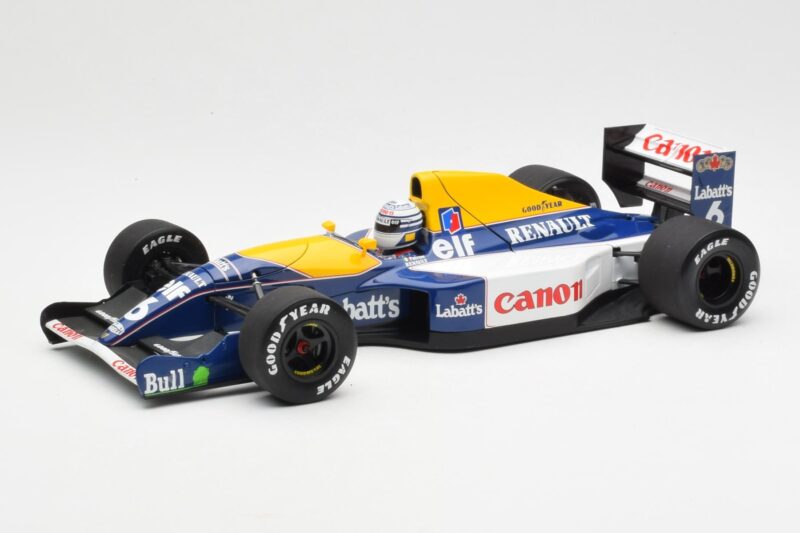
Minichamps' 1:18 diecast Williams Renault FW14 reproduces Riccardo Patrese's #6 car from the 1991 Formula 1 season, the Adrian Newey design that took Nigel Mansell to five wins that year and set up the following season's title. Detailed livery, cockpit and period-correct bodywork make this a focused piece for an early-1990s Formula 1 diecast collection.
About the Williams Renault FW14 #6 R. Patrese F1 1991 Minichamps 1:18
TL;DR: Minichamps' 1:18 diecast Williams Renault FW14 reproduces Riccardo Patrese's #6 car from the 1991 Formula 1 season. Adrian Newey's design won five races that year with teammate Nigel Mansell and laid the groundwork for the following season's championship, at standard diecast tier for early-1990s Formula 1 collectors.
The FW14 arrived in 1991 as Adrian Newey's first full Williams design, and it very nearly delivered the championship in its debut season before doing so comfortably the year after. Minichamps builds this example around Riccardo Patrese, the experienced hand who ran alongside Nigel Mansell through that pivotal year.
A Newey Design That Nearly Won First Time Out
Renault Power and a Season of Near-Misses
Williams paired the FW14 with Renault's V10, and across 1991 Nigel Mansell took five race wins while Patrese added consistent points from the sister car, yet Ayrton Senna's McLaren held on to claim the title by season's end. The FW14 lost ground early in the year to reliability issues before turning into the class of the field by its second half, a trajectory that made the following season's dominance feel inevitable rather than sudden.
Patrese's Role Alongside Mansell
Riccardo Patrese had already built one of the longest careers on the grid by 1991, and his experience gave Williams a stable second driver while Mansell chased wins outright. The #6 car rarely grabbed the same headlines as its teammate, but Patrese's steady scoring through the season mattered directly to Williams' constructors' championship push, a contribution this livery-specific model preserves in a way a generic team car cannot. That groundwork paid off fully in 1992, when the developed FW14B carried active suspension to a dominant title, making this 1991 car the version that proved the concept first. Collectors who value teammate pairings over single stars often find Patrese's steady season the more interesting half of the story.
Minichamps' Reading of an Early-1990s Grand Prix Car
Livery Placement and the #6 Identity
The model carries the Williams Renault's white, blue and yellow scheme with sponsor decals set exactly where they ran on Patrese's car, and the #6 board sits with sharp, flat printing rather than a soft transfer. Wing endplates and nose colours line up cleanly across every panel, the kind of registration that separates a season-specific livery done properly from one reused loosely across several F1 castings.
Cockpit, Wheels and Diecast Weight
A moulded driver figure sits in a correctly detailed cockpit, and the front and rear wings follow the FW14's period profile rather than a generic single-seater shape. The diecast build gives the model genuine weight in the hand, and the wheels carry the right offset within the bodywork, small details that matter most when a model sits on a stand rather than in its box. Kept out of direct light, the printed decals should hold their colour for years, an important point on a car defined by sponsor-heavy period livery. Even the tyre branding stays legible at close range, a detail easy to skip on a lower-tier casting.
Placing an Early-1990s Williams on the Shelf
At roughly 24 centimetres, the FW14 takes a modest footprint next to other open-wheel castings, which makes building a full early-1990s grid a realistic project rather than a space problem. Paired with a Mansell-liveried #5 car from the same season, this Patrese example completes the constructors' championship story from both seats rather than just the headline driver. For a collector tracing Adrian Newey's design career from Williams through to his later work elsewhere, the FW14 is a genuine starting point rather than a footnote. Displayed alongside later Newey designs from Williams, McLaren or Red Bull, this FW14 also works as the first chapter in a much longer design lineage.
Create a free account and claim 10% off your first order — from hundreds of collectible 1:18, 1:43 and 1:12 models by Porsche, Mercedes-Benz, BMW and more.
{"id":452553,"name":"Williams Renault FW14 #6 R. Patrese F1 1991 Minichamps 1:18","price":"£<\/span>138.00<\/bdi><\/span>","image":"https:\/\/models118.co.uk\/wp-content\/uploads\/2026\/06\/f1-williams-renault-fw14-r-patrese-1991-minichamps-1-18-400x400.jpg","permalink":"https:\/\/models118.co.uk\/williams-renault-fw14-6-r-patrese-f1-1991-minichamps-1-18-100910006\/","brand":"Williams"}