{"ajaxurl":"https:\/\/models118.co.uk\/wp-admin\/admin-ajax.php?lang=en_GB","nonce":"639ff23817","homeUrl":"https:\/\/models118.co.uk\/","shopUrl":"https:\/\/models118.co.uk\/shop\/","cartUrl":"https:\/\/models118.co.uk\/cart-en-gb\/","checkoutUrl":"https:\/\/models118.co.uk\/checkout\/","skipCart":true,"collectionLimit":12,"i18n":{"addedToCart":"Added to basket","addToWishlist":"Add to wishlist","addedToWishlist":"Added to wishlist","removeFromWishlist":"Remove from wishlist","removedFromWishlist":"Removed from wishlist","undo":"Undo","error":"Something went wrong","loading":"Loading...","outOfStock":"Out of stock","viewCart":"View basket","proceedToCheckout":"Proceed to checkout","addedToCollection":"Added to your collection","reserved":"Added to your collection","soldOut":"Sold out","invalidEmail":"Please enter a valid email address","connectionError":"Connection error. Please try again.","tocToggle":"On this page","close":"Close","inCartTooltip":"Already in your basket \u2013 open your basket to check out","loginToSave":"Sign in to save this model","waitlistNotify":"Notify me","waitlistOnList":"On the waiting list \u2713","waitlistJoined":"You're on the waiting list. We'll email you the moment this model is available again.","waitlistRemoved":"Done \u2014 you're off the waiting list for this model.","waitlistRateLimit":"Too many attempts \u2014 please try again shortly","waitlistTurnstile":"We couldn't complete the check \u2014 please try again","waitlistError":"Sorry, something went wrong. Please try again in a moment."},"wishlist":{"loggedIn":false,"loginUrl":"https:\/\/models118.co.uk\/my-account\/","addAction":"models118_wishlist_add","removeAction":"models118_wishlist_remove"},"waitlist":{"loggedIn":false,"subscribeAction":"models118_waitlist_subscribe","toggleAction":"models118_waitlist_toggle","stateAction":"models118_waitlist_state"},"stats":{"models":2665,"brands":215,"manufacturers":129,"collectors":10000},"product":{"id":1706390,"sku":"WARBURG001","condition":"new","availability":"in_stock","name":"Wartburg A311 Dark Blue White Minichamps 1:43","brand":"Wartburg","manufacturer":"Minichamps","scale":"1:43","material":"Diecast","price":100,"regularPrice":100,"isOnSale":false,"savingsAmount":0,"stockQty":1,"stockStatus":"very_low","isDiscontinued":false,"image":"https:\/\/models118.co.uk\/wp-content\/uploads\/2026\/10\/wartburg-a311-dark-blue-white-minichamps-1-43-warburg001-1-1-300x200.jpg","permalink":"https:\/\/models118.co.uk\/wartburg-a311-dark-blue-white-minichamps-1-43-warburg001\/"}}
Cookies on Models118
We use cookies to remember your preferences, understand how the shop is used and show you models and offers that suit your interests. What you allow is up to you, and you can change it at any time.
Always active
The technical storage or access is strictly necessary for the legitimate purpose of enabling the use of a specific service explicitly requested by the subscriber or user, or for the sole purpose of carrying out the transmission of a communication over an electronic communications network.
The technical storage or access is necessary for the legitimate purpose of storing preferences that are not requested by the subscriber or user.
The technical storage or access that is used exclusively for statistical purposes.
The technical storage or access is required to create user profiles to send advertising, or to track the user on a website or across several websites for similar marketing purposes.
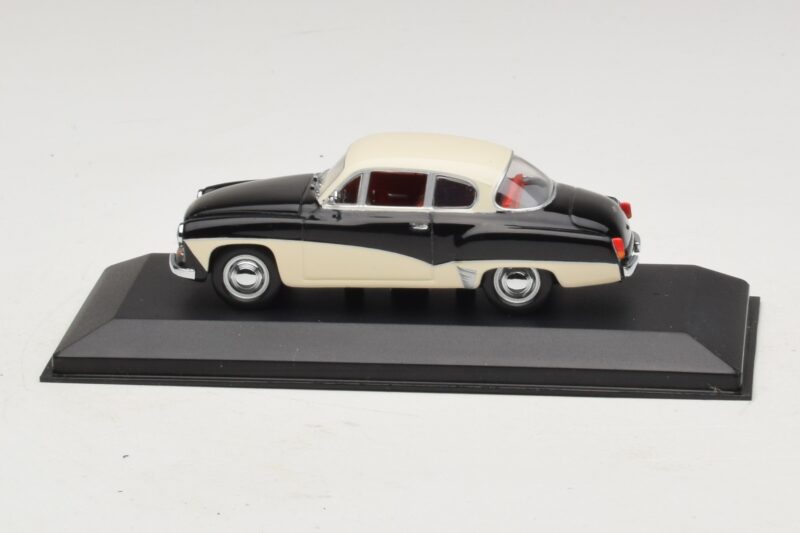
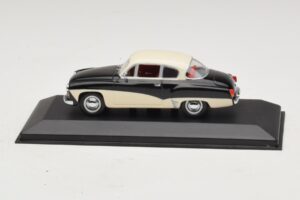
Minichamps' 1:43 diecast Wartburg A311 in dark blue and white, a sealed one-piece body of the 1958 East German saloon from Eisenach. At roughly 10 cm long, the upright 1950s lines, trim and paint separation are what a collector judges. A distinctive piece for Eastern Bloc, Cold War era or post-war European saloon collections.
About the Wartburg A311 Dark Blue White Minichamps 1:43
TL;DR: The Minichamps Wartburg A311 1:43 is a diecast saloon in dark blue and white, modelled on the 1958 car from Eisenach in East Germany. The body is a sealed casting, so upright 1950s lines, trim and paint carry the display. About 10 cm long, it suits post-war European and Eastern Bloc collections.
British collectors know the Mini and the Morris Minor; the Wartburg belongs to a different corner of European motoring, one that rewards curiosity. Minichamps gives that corner a 1:43 diecast in dark blue and white, and the sealed body keeps the attention on a shape that sits firmly in the late 1950s.
Minichamps Wartburg A311 1:43 and the Eisenach Story
A Car Named After a Castle
Wartburg takes its name from the castle that overlooks Eisenach, the Thuringian town where the cars were built. In the 1950s the factory there made saloons powered by a three-cylinder two-stroke engine, a layout that gave East German motoring a distinctive sound. For a British collector the car is an unfamiliar corner of European history, and that unfamiliarity is a strength: a Wartburg on a shelf starts conversations that another sports car never would. It is also the sort of subject where a 1:43 model is the only practical way to own the car.
Why a 1958 Saloon Rewards 1:43
The A311's body is upright and slab-sided, with generous glass and a tall roofline typical of 1950s European saloons, and these simple, honest surfaces suit diecast particularly well. A sealed body keeps them unbroken. There is little fussy bodywork to blur, so what matters is proportion: how tall the cabin sits over the wheels, how the bonnet meets the grille, and how the bumpers frame the ends. At roughly 10 cm long, the car is compact enough to sit alongside other post-war European saloons without crowding them.
Judging an Unfamiliar Subject from the Outside
Paint Separation and Trim
Because the product name pairs dark blue with white, check the listing photographs for how the two colours divide the body; any boundary between them should be crisp, straight and free of bleed. Trim, such as bumpers and window surrounds, should be distinct from the paint rather than blended into it, because 1950s cars depended on bright metal to relieve broad painted surfaces. Nothing opens on this piece, which means the outside is where the manufacturer's care can be read in full, from the depth of the gloss to the sharpness of the grille.
Stance and Glazing on a 1950s Body
With an unfamiliar subject, period photographs are the fair test. Compare the wheel size against the arch, the height of the bonnet line, and the shape of the windows. Glazing on a 1950s saloon is generous, so any misfit at the edges shows plainly. Diecast has the weight to carry a tall, upright body steadily on its wheels, and the sealed casting keeps the roof and window pillars clean. Be realistic at 1:43: thin trim and small details are printed or simplified rather than fitted separately, and that is the norm for the scale and the material.
Where an East German Saloon Sits on a Shelf
A Wartburg suits several themes at once: 1950s European saloons, Eastern Bloc motoring, or cars built in Germany that never reached the same shelves as their western neighbours. At 1:43 it stands beside a row of post-war saloons without crowding, and the two-colour finish gives it a clear identity among plainer cars. British collectors value completeness and provenance, so keep any box or paperwork, and store the model away from direct sunlight and damp. Dust it with a soft brush; the sealed casting has no gaps to trap grit. Buy it as a conversation piece that adds a rarely modelled chapter to a European cabinet.
Create a free account and claim 5% off your first order — from hundreds of collectible 1:18, 1:43 and 1:12 models by Porsche, Mercedes-Benz, BMW and more.
{"id":1706390,"name":"Wartburg A311 Dark Blue White Minichamps 1:43","price":"£<\/span>100.00<\/bdi><\/span>","image":"https:\/\/models118.co.uk\/wp-content\/uploads\/2026\/10\/wartburg-a311-dark-blue-white-minichamps-1-43-warburg001-1-1-400x400.jpg","permalink":"https:\/\/models118.co.uk\/wartburg-a311-dark-blue-white-minichamps-1-43-warburg001\/","brand":"Wartburg"}