{"ajaxurl":"https:\/\/models118.co.uk\/wp-admin\/admin-ajax.php?lang=en_GB","nonce":"639ff23817","homeUrl":"https:\/\/models118.co.uk\/","shopUrl":"https:\/\/models118.co.uk\/shop\/","cartUrl":"https:\/\/models118.co.uk\/cart-en-gb\/","checkoutUrl":"https:\/\/models118.co.uk\/checkout\/","skipCart":true,"collectionLimit":12,"i18n":{"addedToCart":"Added to basket","addToWishlist":"Add to wishlist","addedToWishlist":"Added to wishlist","removeFromWishlist":"Remove from wishlist","removedFromWishlist":"Removed from wishlist","undo":"Undo","error":"Something went wrong","loading":"Loading...","outOfStock":"Out of stock","viewCart":"View basket","proceedToCheckout":"Proceed to checkout","addedToCollection":"Added to your collection","reserved":"Added to your collection","soldOut":"Sold out","invalidEmail":"Please enter a valid email address","connectionError":"Connection error. Please try again.","tocToggle":"On this page","close":"Close","inCartTooltip":"Already in your basket \u2013 open your basket to check out","loginToSave":"Sign in to save this model","waitlistNotify":"Notify me","waitlistOnList":"On the waiting list \u2713","waitlistJoined":"You're on the waiting list. We'll email you the moment this model is available again.","waitlistRemoved":"Done \u2014 you're off the waiting list for this model.","waitlistRateLimit":"Too many attempts \u2014 please try again shortly","waitlistTurnstile":"We couldn't complete the check \u2014 please try again","waitlistError":"Sorry, something went wrong. Please try again in a moment."},"wishlist":{"loggedIn":false,"loginUrl":"https:\/\/models118.co.uk\/my-account\/","addAction":"models118_wishlist_add","removeAction":"models118_wishlist_remove"},"waitlist":{"loggedIn":false,"subscribeAction":"models118_waitlist_subscribe","toggleAction":"models118_waitlist_toggle","stateAction":"models118_waitlist_state"},"stats":{"models":2665,"brands":215,"manufacturers":129,"collectors":10000},"product":{"id":1704028,"sku":"940132571","condition":"new","availability":"in_stock","name":"Triumph TR6 Orange Maxichamps 1:43","brand":"Triumph","manufacturer":"Maxichamps","scale":"1:43","material":"Diecast","price":42,"regularPrice":42,"isOnSale":false,"savingsAmount":0,"stockQty":2,"stockStatus":"very_low","isDiscontinued":false,"image":"https:\/\/models118.co.uk\/wp-content\/uploads\/2026\/10\/triumph-tr6-orange-maxichamps-1-43-940132571-1-1-300x200.jpg","permalink":"https:\/\/models118.co.uk\/triumph-tr6-orange-maxichamps-1-43-940132571\/"}}
Cookies on Models118
We use cookies to remember your preferences, understand how the shop is used and show you models and offers that suit your interests. What you allow is up to you, and you can change it at any time.
Always active
The technical storage or access is strictly necessary for the legitimate purpose of enabling the use of a specific service explicitly requested by the subscriber or user, or for the sole purpose of carrying out the transmission of a communication over an electronic communications network.
The technical storage or access is necessary for the legitimate purpose of storing preferences that are not requested by the subscriber or user.
The technical storage or access that is used exclusively for statistical purposes.
The technical storage or access is required to create user profiles to send advertising, or to track the user on a website or across several websites for similar marketing purposes.
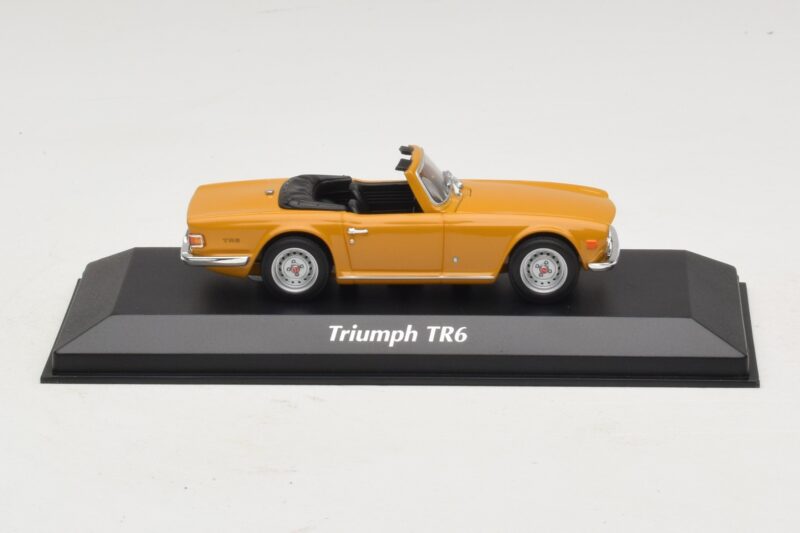
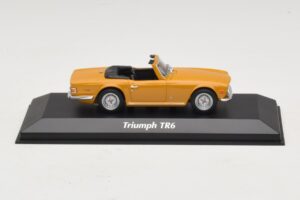
Maxichamps' 1:43 diecast Triumph TR6 in Orange recreates the 1968 straight-six roadster in under ten centimetres of metal. The body is one sealed casting with no opening parts, so the case rests on stance, paint and the squared-off tail the TR6 is known for. A strong partner for MG and Aston Martin classics on a 1960s British shelf.
TL;DR: The Maxichamps Triumph TR6 1:43 is a diecast roadster in Orange, representing the 1968 six-cylinder Triumph. Its body is a sealed one-piece casting without opening parts, so stance, paint and the squared-off tail carry the interest. Under ten centimetres long, it suits a compact shelf of British classic sports cars.
The TR6 was never subtle, and an Orange example makes that point at a glance. Maxichamps reproduces the car at 1:43, a scale that rewards bold shapes and strong colour, and the squared-off silhouette of this Triumph is exactly the sort of form that reads well when small.
Maxichamps Triumph TR6 1:43 and the Orange Finish
One Casting, Judged on Its Surface
The TR6 here is a sealed diecast body with no opening parts, so the appraisal starts and ends with the surface. Orange is an honest colour to test a model with: it hides nothing, and an uneven coat or a soft edge shows quickly under a lamp. Tilt the car and look along the flanks. The paint should lie smooth and bright without pooling in the shut lines. The metal gives the model a reassuring heft for its size, and because the casting is one piece, the door and boot cuts stay uniform in width. Open-top bodies also reveal the cockpit from above, so the seat and dashboard mouldings matter more here than on a closed coupe.
Reading the TR6 Shape
The TR6 is recognised by its flat, squared-off tail, part of a restyle of the earlier TR5 that Karmann carried out on the front and rear. Compare the model's tail panel against a photograph: the lamp clusters should sit flush and the rear edge should look crisp rather than rounded off. Check the bumpers, which should be chrome with a convincing thickness, and the wheels, which should sit centred in their arches. At 1:43, badges are tiny and are normally tampo printed, so look for clean edges. These are quick checks, and a model that passes them tends to feel right from across the room.
The Six-Cylinder Triumph Behind the Casting
What the Real Car Was
Triumph built the TR6 in Coventry as a rear-wheel-drive, six-cylinder sports car, the successor to the TR5 with the same basic engineering under fresh bodywork. It belonged to a generation of British open-top cars with a long bonnet, a straight-six engine and a cockpit with little to distract from driving. For a British collector the TR6 sits alongside the MGB as one of the two names that most readily define the postwar roadster, and the pairing makes an obvious shelf theme. The 1968 car also gives a useful reference point for anyone building a decade of open-top sports cars.
1:43 and the Collecting Case
At just under ten centimetres, the TR6 sits comfortably next to other 1:43 roadsters, and the scale allows a decade's worth of British open-tops to share one shelf. Diecast holds its geometry and paint over the years, and a sealed body means there is nothing to loosen or break with handling. The honest trade-off is detail. Windscreen frames, wipers and door handles are simplified, and the interior is moulded rather than built from separate parts. Treat it as an accessible, display-first piece, judged by proportion and finish rather than by miniature engineering, and a bright colour like Orange does a lot of the work for you.
Orange on a Shelf of British Classics
Colour is the quiet organiser of a display. Set an Orange TR6 between a Green MG and a dark coupe and the row gains rhythm without any extra effort. Keep the shelf out of direct sunlight, because bright paint and open interiors fade first, and dust the casting with a soft brush rather than a cloth that can catch on mirrors and badges. British collectors generally value the original box and any paperwork, so keep them with the model. If you want a period roadster that is easy to place, easy to judge and easy on the budget, this is a sensible piece to order for the shelf.
Create a free account and claim 5% off your first order — from hundreds of collectible 1:18, 1:43 and 1:12 models by Porsche, Mercedes-Benz, BMW and more.