{"ajaxurl":"https:\/\/models118.co.uk\/wp-admin\/admin-ajax.php?lang=en_GB","nonce":"eae0a53e66","homeUrl":"https:\/\/models118.co.uk\/","shopUrl":"https:\/\/models118.co.uk\/shop\/","cartUrl":"https:\/\/models118.co.uk\/cart-en-gb\/","checkoutUrl":"https:\/\/models118.co.uk\/checkout\/","skipCart":true,"collectionLimit":12,"i18n":{"addedToCart":"Added to basket","addToWishlist":"Add to wishlist","addedToWishlist":"Added to wishlist","removeFromWishlist":"Remove from wishlist","removedFromWishlist":"Removed from wishlist","undo":"Undo","error":"Something went wrong","loading":"Loading...","outOfStock":"Out of stock","viewCart":"View basket","proceedToCheckout":"Proceed to checkout","addedToCollection":"Added to your collection","reserved":"Added to your collection","soldOut":"Sold out","invalidEmail":"Please enter a valid email address","connectionError":"Connection error. Please try again.","tocToggle":"On this page","close":"Close","inCartTooltip":"Already in your basket \u2013 open your basket to check out","loginToSave":"Sign in to save this model","waitlistNotify":"Notify me","waitlistOnList":"On the waiting list \u2713","waitlistJoined":"You're on the waiting list. We'll email you the moment this model is available again.","waitlistRemoved":"Done \u2014 you're off the waiting list for this model.","waitlistRateLimit":"Too many attempts \u2014 please try again shortly","waitlistTurnstile":"We couldn't complete the check \u2014 please try again","waitlistError":"Sorry, something went wrong. Please try again in a moment."},"wishlist":{"loggedIn":false,"loginUrl":"https:\/\/models118.co.uk\/my-account\/","addAction":"models118_wishlist_add","removeAction":"models118_wishlist_remove"},"waitlist":{"loggedIn":false,"subscribeAction":"models118_waitlist_subscribe","toggleAction":"models118_waitlist_toggle","stateAction":"models118_waitlist_state"},"stats":{"models":2350,"brands":213,"manufacturers":128,"collectors":10000},"product":{"id":962863,"sku":"107851301","condition":"used","availability":"out_of_stock","name":"Rover Vitesse SD1 Bastos Texaco #8 T. Walkinshaw \/ W. Percy Winners Donington 500km 1985 Minichamps 1:18","brand":"Rover","manufacturer":"Minichamps","scale":"1:18","material":"Diecast","price":161,"regularPrice":161,"isOnSale":false,"savingsAmount":0,"stockQty":0,"stockStatus":"out_of_stock","isDiscontinued":true,"image":"https:\/\/models118.co.uk\/wp-content\/uploads\/2026\/06\/rover-vitesse-sd1-bastos-texaco-racing-team-8-t-walkinshaw-w-percy-winners-donington-500km-1985-minichamps-1-18-300x200.jpg","permalink":"https:\/\/models118.co.uk\/rover-vitesse-sd1-bastos-texaco-8-t-walkinshaw-w-percy-winners-donington-500km-1985-minichamps-1-18-107851301\/"}}
Cookies on Models118
We use cookies to remember your preferences, understand how the shop is used and show you models and offers that suit your interests. What you allow is up to you, and you can change it at any time.
Always active
The technical storage or access is strictly necessary for the legitimate purpose of enabling the use of a specific service explicitly requested by the subscriber or user, or for the sole purpose of carrying out the transmission of a communication over an electronic communications network.
The technical storage or access is necessary for the legitimate purpose of storing preferences that are not requested by the subscriber or user.
The technical storage or access that is used exclusively for statistical purposes.
The technical storage or access is required to create user profiles to send advertising, or to track the user on a website or across several websites for similar marketing purposes.
Rover Vitesse SD1 Bastos Texaco #8 T. Walkinshaw / W. Percy Winners Donington 500km 1985 Minichamps 1:18
Sold out
1/6
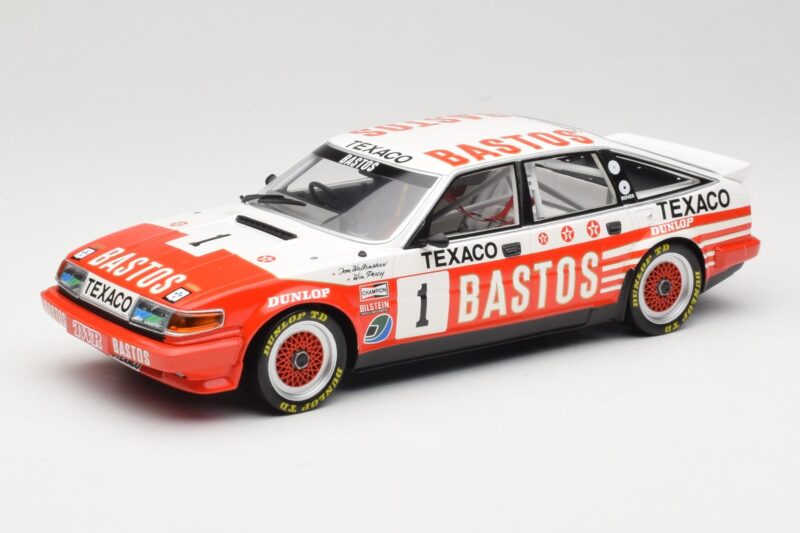
Minichamps' 1:18 diecast Rover Vitesse SD1 reproduces the Bastos Texaco #8 car that Tom Walkinshaw and Win Percy drove to victory in the 1985 Donington 500km. TWR's touring car aero kit, sponsor graphics and race number are cast in diecast metal, with opening doors included, for a Group Racing Historic display built around Rover's competitive mid-1980s touring car campaign.
About the Rover Vitesse SD1 Bastos Texaco #8 T. Walkinshaw / W. Percy Winners Donington 500km 1985 Minichamps 1:18
TL;DR: Minichamps' 1:18 diecast Rover Vitesse SD1 reproduces the Bastos Texaco #8 that Tom Walkinshaw and Win Percy drove to victory in the 1985 Donington 500km. TWR's touring car aero kit and sponsor livery are cast in diecast metal, a standard-tier anchor for a Group A touring shelf.
The Bastos Texaco livery is one of the more recognisable from TWR's mid-1980s touring car programme, and this particular car won outright at the Donington 500km. Minichamps reproduces that winning combination down to the race-number placement.
Minichamps' TWR Rover Vitesse in Bastos Texaco Livery
Race Number 8 and Sponsor Graphics
TWR ran several sponsor liveries across its Rover Vitesse touring car campaign, and the Bastos Texaco scheme carried the number 8 that Walkinshaw and Percy raced under at Donington in 1985. Minichamps places the sponsor decals, the number roundel and the supporting graphics exactly where period photographs show them, printed cleanly rather than left as a simplified block of colour. Getting the graphics right matters more on a touring car subject than almost any exterior shape detail, since two Vitesse race cars from the same season can share an identical body kit and differ only in livery, and a collector building a TWR shelf needs each one to be individually correct.
Aero Body Kit Detail in Diecast
Beneath the livery sits the same wide-arch, front-splitter body kit that distinguished TWR's Group A Vitesse from the standard road car, and Minichamps carries that kit through in diecast with correctly flared arches and a deep front spoiler that sits low enough to look purposeful rather than decorative. The wheels fill those arches properly, an area where a slightly wrong offset undermines an otherwise accurate racing model, and here the fitment reads correctly from a three-quarter view as well as head-on.
Walkinshaw, Percy and the Donington 500km Win
TWR's Touring Car Programme in the Mid-1980s
Tom Walkinshaw's team ran the Rover Vitesse in European and British touring car competition through the mid-1980s, building a reputation for taking a car that started life as a comfortable executive saloon and turning it into a genuine class contender against purpose-built rivals. Win Percy, an experienced touring car driver in his own right, shared driving duties on endurance-format rounds like the Donington 500km, where reliability mattered as much as outright pace. Their win in this Bastos Texaco car came during a period when TWR's development of the Vitesse was at its sharpest.
A Season of Strong Results for the Vitesse Programme
The Donington win sat within a broader season where TWR's Vitesse regularly ran near the front of its class, a result of the team's aero development and engine work rather than the road car's standard specification alone. For a collector, that context matters: this is not a one-off giant-killing result but a representative outcome from a well-resourced programme, part of why the livery remains a popular choice among Rover touring car subjects today.
A Group A Touring Anchor for a British Racing Shelf
This Bastos Texaco car sits well as a centrepiece among other 1980s Group A touring subjects, and its bright, sponsor-led livery contrasts usefully against the more restrained road-going Vitesse colours in a mixed Rover display. At roughly 25 centimetres in 1:18, the wide-arch body kit takes up slightly more shelf depth than the standard road car's proportions, worth allowing for when planning cabinet spacing. Paired with the Istel-liveried BTCC Vitesse from a couple of seasons later, this Donington winner shows how consistently competitive the SD1 remained across the decade. A soft brush along the spoiler edges keeps the livery's fine print legible over years of display.
Create a free account and claim 10% off your first order — from hundreds of collectible 1:18, 1:43 and 1:12 models by Porsche, Mercedes-Benz, BMW and more.