Used
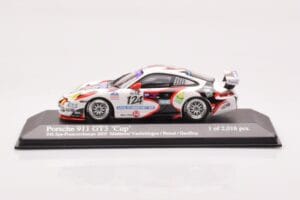
Porsche 911 997 GT3 Cup #124 Mattheus / Geoffroy / Vanbellingen / Fumal 24 Hours of Spa 2005 Minichamps 1:43
Only 3 left
Price:
£29.00
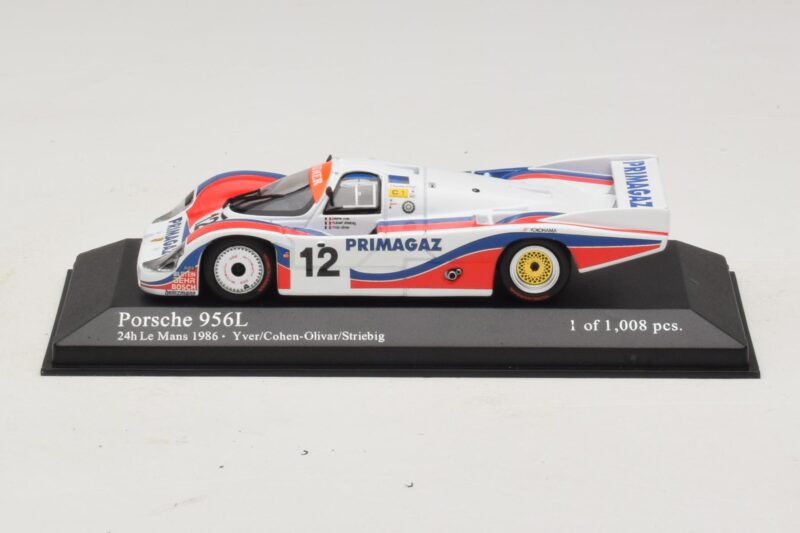
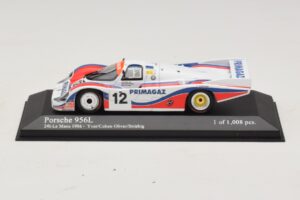
TL;DR: Minichamps' 1:43 diecast Porsche 956 Long-Tail reproduces car #12, raced by C. Yver and Cohen at the 1986 24 Hours of Le Mans during the Group C prototype era. The sealed body carries the printed livery across a continuous shell, with no opening panels to interrupt the graphics.
Group C racing produced some of the fastest closed-cockpit prototypes Le Mans has ever seen, and the 956 sat at the centre of Porsche's dominance through the mid-1980s. This casting represents car #12 from the 1986 running, one entry among a field the 956 and its successor largely defined for the better part of a decade.
The body comes as a sealed, one-piece diecast shell, so the printed sponsor decals and number 12 board run continuously across the flanks without a shut line to break the design. That matters for a Group C livery, which typically carries dense sponsor branding down the full length of the sills, and any interruption there would be immediately obvious. Minichamps keeps the moulded door and panel lines sharp regardless, preserving the silhouette's proportions even though nothing on the casting opens.
The 956's long, low wedge shape, ground-effect side tunnels and rear wing are distinctive enough that the car reads correctly from across a room, and this casting holds those proportions rather than softening them for tooling ease. The Long-Tail designation refers to the extended rear bodywork Porsche ran for high-speed circuits, a detail worth checking on any 956 model since the standard and long-tail cars differ visibly around the engine cover and rear wing mounting.
C. Yver and Cohen shared this car through the 1986 24 Hours of Le Mans, one of dozens of 956 and 962 chassis that privateer and semi-factory teams ran across the mid-1980s once Porsche made the platform available to customers beyond its own works effort. That customer programme is a large part of why 956s and 962s appear in so many liveries: the chassis was genuinely competitive in privateer hands, not just as a factory showpiece.
Porsche's 956 won Le Mans outright in 1982, 1983 and 1984, and its successor the 962 continued that run, making the platform one of the most successful Group C designs of the entire era. By 1986, the grid still carried a substantial contingent of 956s and 962s racing alongside newer machinery, exactly the period this #12 entry represents. That sustained competitiveness is why the 956 remains one of the most collected Group C subjects at any scale.
A 956 in a specific livery works best as one entry in a wider Group C display, sitting alongside other Porsche, Jaguar or Lancia prototypes from the same mid-1980s window rather than standing alone. At 1:43, a full Le Mans grid from a single year becomes realistic to assemble on one shelf, and this #12 car is a solid, specific starting point for that project. Checking the sponsor decal placement against 1986 race photography is worth doing before buying, since 956 liveries shifted between seasons even on cars that kept the same number.
Save £14.00