Used
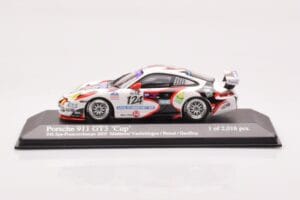
Porsche 911 997 GT3 Cup #124 Mattheus / Geoffroy / Vanbellingen / Fumal 24 Hours of Spa 2005 Minichamps 1:43
Only 3 left
Price:
£29.00
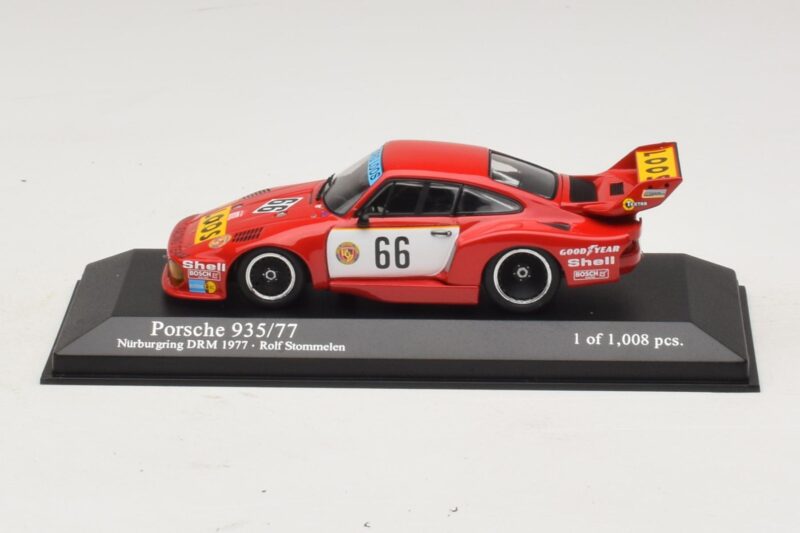
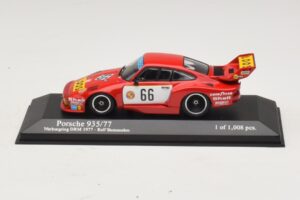
TL;DR: Minichamps' 1:43 Porsche 935/77 recreates Rolf Stommelen's #66 entry at the 1977 Deutsche Rennsport Meisterschaft round at Nürburgring, one year into the model's Group 5 career. The sealed diecast body carries the wide-arch silhouette bodywork and period livery of Porsche's dominant domestic racer.
By 1977, the Deutsche Rennsport Meisterschaft had become Germany's premier stage for Group 5 machinery, and the 935 was fast becoming its defining car. Stommelen's #66 entry at Nürburgring shows the silhouette formula a year into its life, with the same flared bodywork already proven on the international endurance circuit.
The Deutsche Rennsport Meisterschaft ran under the same Group 5 silhouette rules that governed international sportscar racing, which meant a manufacturer's factory-built weapon for Le Mans or the Nürburgring 1000km could line up in a domestic German series with only minor changes. Porsche leaned hard into that overlap, and by the late 1970s the 935 had become close to the default choice for serious DRM entrants. The wide box arches and low nose that defined the car internationally translated directly to German circuits, and the series became a proving ground where Porsche and its customer teams refined the silhouette formula further.
Rolf Stommelen, already a well-established name in Porsche's endurance-racing programme by 1977, carried car #66 at this Nürburgring DRM round, one of many appearances he made in 935s during the period. Unlike the multi-driver endurance format of an international 1000km race, DRM rounds were typically shorter sprint-style events, putting a different premium on outright pace over the turbocharged flat-six rather than sustained reliability across several hours. That distinction makes a DRM-liveried 935 a different kind of subject to its endurance-racing siblings.
The 935's box arches, flared over both axles to cover wide racing rubber, are one of the more distinctive shapes in 1970s motorsport, and Minichamps casts them here as a single fixed body rather than an opening one. That sealed construction is what keeps the flared edges holding their line consistently, without the small gaps a hinged bonnet or boot would introduce at this scale. Zinc alloy gives the wide-body shape the rigidity to hold those exaggerated proportions without any softness at the arch edges, and the low stance sits correctly on the wheels.
The #66 number and sponsor graphics are tampo-printed directly onto the paint, sitting flat across the flared surfaces without breaking at the changes in panel angle that trip up lesser transfers. Wide racing wheels fill the box arches correctly, a detail that matters more on a silhouette racer than on a road car, since the bodywork's whole point was to cover tyres far wider than anything fitted to a production 911 at the time. The rear wing and front spoiler, moulded into the casting, keep their thin profiles intact.
Set beside a Martini-liveried endurance 935 from an international round, this DRM entry tells the other half of the car's story: the domestic championship where it became a fixture rather than a novelty. Collectors building a 935 shelf around Group 5's short but eventful life will find the DRM cars offer liveries that never appeared at Le Mans or the Nürburgring 1000km, widening the variety available within a single racing model. At 1:43, several liveries sit comfortably together, and the shared sealed-body construction keeps finish quality consistent from one to the next.


Save £14.00