Used
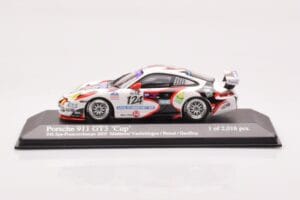
Porsche 911 997 GT3 Cup #124 Mattheus / Geoffroy / Vanbellingen / Fumal 24 Hours of Spa 2005 Minichamps 1:43
Only 3 left
Price:
£29.00
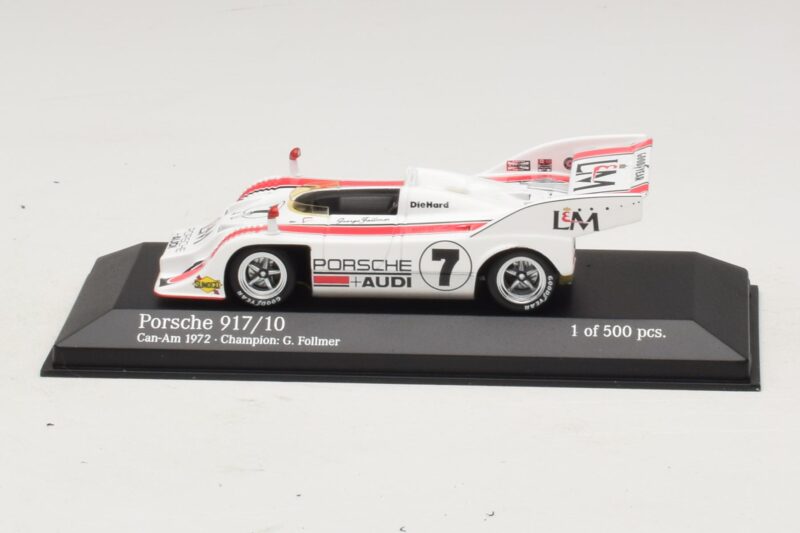
TL;DR: Minichamps' 1:43 diecast reproduces Penske Racing's #7 Porsche 917/10, driven by George Follmer to the 1972 Can-Am championship after Mark Donohue's testing injury. Sealed one-piece body, Sunoco-backed turbo livery. A genuine piece of Porsche's turbocharged Can-Am domination.
Can-Am's "anything goes" rules produced some of the most extreme sports racers ever built, and Porsche's turbocharged 917/10 topped that list through the early 1970s. Minichamps' 1:43 diecast reproduces the Sunoco-liveried #7 car that carried George Follmer to the 1972 title, a championship win that came together only after the programme's original driver was sidelined by injury.
Porsche's decision to turbocharge the 917's flat-twelve for Can-Am produced a level of power that redefined what a sports racer could deliver, figures well beyond anything the naturally aspirated opposition could match at the time. Penske Racing paired that engine with a chassis developed specifically for the series' unrestricted regulations, and the resulting 917/10 dominated the 1972 season on raw performance alone. Mark Donohue had been developing the car through pre-season testing when a crash left him injured, and George Follmer stepped into the seat with little preparation time, yet still delivered the championship, a result that speaks as much to the car's overwhelming pace as to Follmer's own ability to adapt quickly under pressure.
Sunoco's blue and yellow branding had already become closely associated with Roger Penske's racing operations across multiple series, and the sponsorship carried directly onto the 917/10's Can-Am livery. That continuity gave Penske's Can-Am effort an instantly recognisable identity separate from its open-wheel programmes, one that collectors and enthusiasts from the period still associate strongly with dominant early-1970s American sports car racing. The pairing of Porsche's engineering with Penske's operational precision produced a combination that the rest of the Can-Am field simply could not answer that season.
The Sunoco livery's blue, yellow and white colour blocks demand precise registration where each panel meets the next, since any bleed between colours is immediately obvious on a scheme this simple and bold. Minichamps keeps the number 7 crisp within its roundel, and the Sunoco lettering across the nose and flanks holds sharp edges rather than softening into the surrounding paint. Getting a livery this recognisable wrong would be immediately obvious to anyone who has seen period photography of the car, which raises the bar for accuracy considerably above a less familiar subject.
This model carries no opening doors or engine cover, cast instead as a single fixed shell, a construction choice that works well on a car whose enormous rear wing and wide bodywork are the visual story. Keeping the shell sealed protects the delicate wing end-plates and the rear intakes from the kind of wear a working hinge would introduce, and it lets the panel lines along the wide flanks run as clean, unbroken grooves. The wheels sit correctly within the flared arches, wide enough to hint at the sheer mechanical grip this car generated on track during a genuinely unrestricted era of sports car racing.
Can-Am occupies a slightly different corner of Porsche's motorsport history than Le Mans or Group C, built around raw power rather than endurance strategy, and a 917/10 brings that different flavour to a broader prototype collection. Pairing it with 917 Le Mans variants or later Group C cars traces a clear line through Porsche's changing approach to sports car racing across three distinct decades. At 1:43, the 917/10's wide rear wing gives it real shelf presence despite the compact scale, standing out even next to larger-looking prototypes from other eras. For anyone assembling Porsche's motorsport story chronologically, this Can-Am champion marks a genuinely pivotal chapter rather than a footnote.
Save £14.00