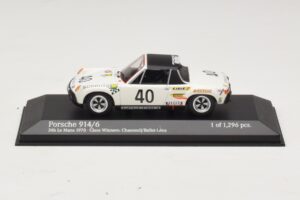
Used
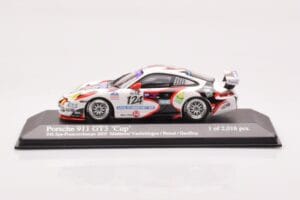
Porsche 911 997 GT3 Cup #124 Mattheus / Geoffroy / Vanbellingen / Fumal 24 Hours of Spa 2005 Minichamps 1:43
Only 3 left
Price:
£29.00
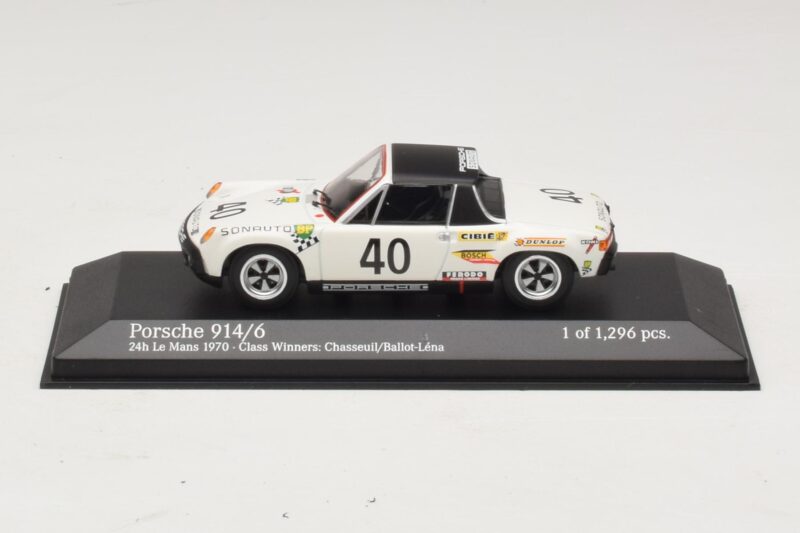
TL;DR: Minichamps' 1:43 diecast Porsche 914/6 recreates the number 40 car Guy Chasseuil and Claude Ballot-Lena drove to a class win at the 1970 24 Hours of Le Mans. The sealed zinc-alloy body wears correct race livery, built as a display casting rather than an opening-panel model.
Winning your class at Le Mans means surviving 24 hours of traffic, darkness and rival GT entries without a single costly mistake, and that is exactly what Chasseuil and Ballot-Lena managed in 1970. This 1:43 Minichamps diecast puts their number 40 914/6 on the shelf, a genuine class-winning car rather than a competitive also-ran dressed up in period colours.
By 1970, Porsche's 914/6 had established itself as a capable GT-class entry at Le Mans, smaller and lighter than the outright prototypes fighting for overall victory but well suited to the class regulations it competed under. Class wins at Le Mans depend on reliability across 24 hours as much as raw pace, since prototype battles further up the order rarely affect how the GT classes shake out. Chasseuil and Ballot-Lena's number 40 car ran to that strength, completing the full distance without the mechanical dramas that eliminated faster but less dependable rivals. A class victory at the Sarthe, even in a smaller car, remains a genuine result.
Guy Chasseuil and Claude Ballot-Lena both built long careers in French endurance racing, appearing at Le Mans across multiple decades in a range of GT and prototype machinery. In 1970 their partnership in the 914/6 reflected a common approach among privateer French entries: a well-prepared, dependable production-based car driven by experienced hands who understood pacing a 24-hour race rather than sprinting it. That experience mattered more than outright speed in the GT class, where consistency across day and night stints separated the finishers from the retirements.
Minichamps casts this 914/6 as a single sealed zinc-alloy shell, so the roof panel, engine cover and doors are represented without any hinged, moving parts. That construction lets the casting hold tight, even shut lines along every panel edge, without the slight gap widening hinge tolerances would otherwise introduce at this scale. The model carries real weight for its size, and the engine cover's louvred vents and the car's low waistline are rendered crisply, detail that would be harder to hold consistently across a body built with opening panels.
Race number 40 is applied in tampo print, keeping the numerals flat and sharp-edged against the bodywork rather than raised or prone to yellowing the way an ageing decal can be. The livery follows the 1970 scheme with accurate placement of sponsor and class markings, and Minichamps keeps the wheel and tyre proportions correct for the period rather than substituting a later, wider fitment. Glazing sits flush around the compact cabin, and the wing mirrors and door handles read as crisp, separately defined details rather than soft casting artefacts.
At around 9cm long, this model sits comfortably alongside other 1:43 Le Mans entries from the early 1970s, letting a collector build a broad picture of that era's GT and prototype classes without needing a large cabinet. It pairs particularly well with other 914/6 liveries from the same period, showing how the same platform performed across different teams and events. Because the body is sealed, the model's value rests on stance, livery accuracy and casting crispness, and it compares favourably with other diecast from the same production run. A genuine class win at Le Mans is a stronger anchor than a car that merely started the race.

Save £14.00