Used
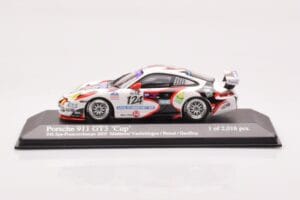
Porsche 911 997 GT3 Cup #124 Mattheus / Geoffroy / Vanbellingen / Fumal 24 Hours of Spa 2005 Minichamps 1:43
Only 3 left
Price:
£29.00
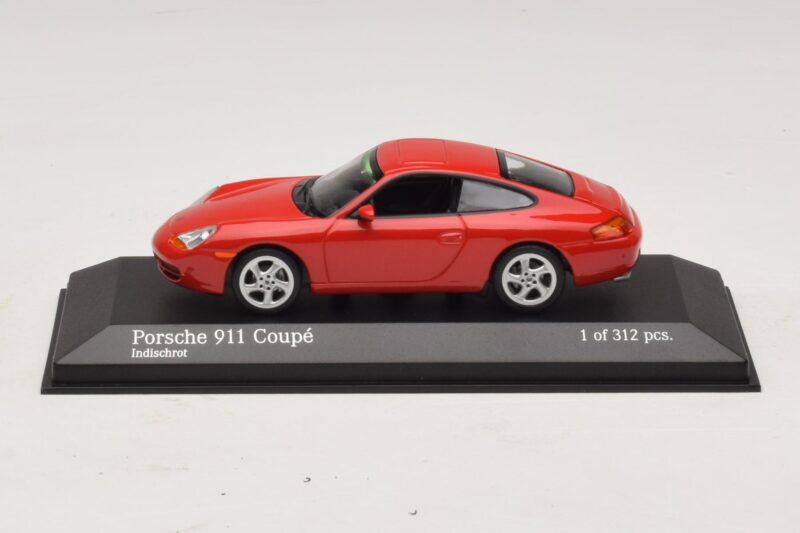
TL;DR: Minichamps' 1:43 diecast Porsche 911 996 in red reproduces the 1998 coupe as a sealed zinc alloy casting, its panel lines fixed rather than hinged. The first water-cooled 911, a generation that split opinion at launch, now a genuine entry point for a classic Porsche shelf.
No 911 divides opinion quite like the 996. It swapped air cooling for water cooling after three decades and borrowed headlights from the Boxster, changes purists resisted at the time. Minichamps' 1:43 red coupe captures that transitional car honestly, a sealed casting that puts the design in its actual context rather than flattering it.
At this scale, Minichamps builds the 996 as a single sealed shell, doors, bonnet and boot fixed into the casting rather than hinged open. That's the right approach for a body this size: a one-piece construction holds continuous panel lines that a working hinge mechanism would struggle to keep consistent at 1:43, and it lets the coupe's smooth, rounded surfacing, the defining shift from the boxier 993 that preceded it, read as one clean form. The zinc alloy build carries real weight for its size, denser in the hand than a resin piece of similar dimensions, and that mass gives the model a settled, substantial feel on the shelf rather than a hollow lightness. Glazing sits flush and the wheel design carries defined spokes even at this reduced scale.
The red finish sits deep and even across the bodywork, the gloss a hard zinc alloy shell allows a painted surface to hold, and it suits the 996's rounded contours particularly well, catching light differently along the fenders than it would on a sharper-edged earlier 911. Door handles, mirror housings and the badge on the boot lid are picked out with tampo-printed precision rather than left as flat colour, small details that matter more once opening panels aren't there to draw attention elsewhere. The headlight units, the feature that generated most of the controversy on the real car, are cast with the correct teardrop shape and clear lens detail, letting a collector judge that design choice for themselves rather than taking anyone else's word for it.
Porsche launched the 996 in 1997 as the first 911 to use water cooling, ending three decades of air-cooled flat-six engines that had defined the model since 1963. The change was necessary: emissions regulations and the pursuit of more power made air cooling's limits increasingly hard to work around, and Porsche needed a platform that could carry the 911 forward for another generation. It was also, for many long-time owners, the moment the 911 stopped being the same car underneath its familiar silhouette. That tension between necessary engineering progress and emotional continuity is exactly why the 996 remains a talking point among collectors decades later, more discussed than almost any other generation despite, or perhaps because of, how divisive it was at launch.
The 996's teardrop headlights, shared with the contemporary Boxster to save development cost, became the era's most-criticised design decision, earning the nickname fried-egg headlights among unhappy enthusiasts. Porsche eventually corrected course with the facelifted 996 and moved further away from the shared look with the following 997 generation, an implicit admission that the criticism had landed. Viewed now, with three further generations of 911 between the 996 and the current car, the headlight controversy reads as a snapshot of a specific moment rather than a lasting flaw, and the smoother overall shape the 996 introduced quietly carried through to every 911 that followed it. A collector holding this red coupe owns the generation that took the criticism so later versions wouldn't have to.
A shelf built entirely from air-cooled 911s tells only part of the story, and the 996 is the piece that shows where the model went next. Placed beside a 964 or an earlier classic, the shift in headlight shape and overall roundness becomes obvious in a way specification sheets never quite convey; placed beside a later 997 or 991, the 996 reveals which of its choices Porsche kept and which it quietly walked back. At 1:43, several generations fit comfortably on one shelf without the space demands of 1:18, making a full generational run genuinely achievable. For a collector interested in the 911's design evolution rather than a single favourite era, this red 996 is the hinge point the whole collection turns on, a generation worth understanding rather than dismissing out of hand.
Save £14.00