Used
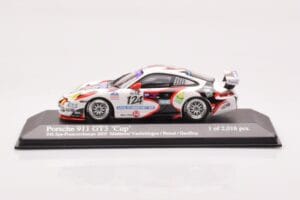
Porsche 911 997 GT3 Cup #124 Mattheus / Geoffroy / Vanbellingen / Fumal 24 Hours of Spa 2005 Minichamps 1:43
Only 3 left
Price:
£29.00
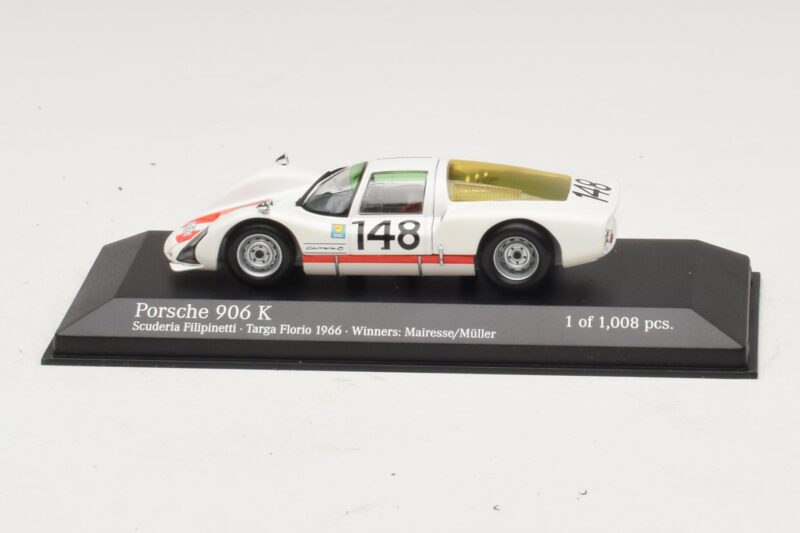
TL;DR: Minichamps' 1:43 diecast Porsche 906 reproduces Scuderia Filipinetti's outright-winning car from the demanding 1966 Targa Florio, driven by Willy Mairesse and Herbert Muller through Sicily's mountain roads. The sealed zinc-alloy body carries race number 148 and period livery, built for confident display rather than opening panels.
The Targa Florio rewarded cars that could survive Sicily's brutal mountain circuit lap after lap, and Porsche's 906 was built exactly for that punishment. This 1:43 Minichamps release puts Scuderia Filipinetti's 1966 winner on the shelf, a reminder that Porsche's endurance pedigree started well before the 935 and 936 that followed a decade later.
Willy Mairesse and Herbert Muller shared the winning 906 for Scuderia Filipinetti, the Swiss team that ran Porsche's competition cars alongside its own Ferraris through the mid-1960s. The Targa Florio ran on closed public roads through the Madonie mountains, a circuit that punished cars over roughly 45 miles per lap with blind crests, unmarked drops and constantly changing surface grip. Outright wins there demanded a car light enough to change direction quickly and strong enough to survive hours of abuse without a single mechanical lapse. The 906, with its tubular space frame and mid-mounted six-cylinder engine, was built precisely for that kind of demand, and this result proved the concept worked outright.
Porsche built the 906 as a homologated racer rather than a pure prototype, which let it compete in period GT categories while still carrying serious factory development. Scuderia Filipinetti ran cars for several manufacturers, but its Porsche entries carried real factory support in parts and setup advice, blurring the line between works and privateer effort. That arrangement suited both parties: Porsche gained results without fielding an official team car, and Filipinetti gained competitive machinery for a strong driver line-up. The 1966 win stands as one of the clearest examples of that partnership paying off, an outright victory rather than a class result buried in the results sheet.
Minichamps casts this 906 as a sealed zinc-alloy body, a construction choice that suits the subject well at 1:43. Without doors, engine cover or boot lid to hinge open, the casting holds tight, consistent shut lines along every seam, none of the gap widening a moving panel would introduce. The mass in the hand is unmistakably metal, and that density lets the model sit with real presence on a shelf despite its compact footprint. Wheel arches are cut cleanly around correctly proportioned wheels, and the low, curved nose that defined the 906's aerodynamic shape is rendered without the seam lines a multi-part opening body would need.
The livery follows Scuderia Filipinetti's scheme closely, with race number 148 printed crisply on the doors and the team's identifying colours held in sharp registration against the body paint. Tampo printing keeps these markings flat rather than raised or prone to silvering with age, a detail that matters where sponsor and number graphics carry much of the visual identity. Glazing sits flush around the low windscreen, and the wheels carry period-correct proportions rather than a generic aftermarket look. At 1:43, none of that detail overwhelms the model; it simply confirms the subject on close inspection.
At roughly 9cm long, this 906 sits comfortably among other 1:43 Porsche prototypes and GT cars from the same era, a scale that lets a collector cover several decades of factory and privateer racing without needing a large cabinet. It works particularly well alongside later 935 and 936 models, tracing Porsche's endurance development from open-road classics like the Targa Florio through the Group 5 and Group 6 eras that followed. The sealed body means the value here sits entirely in stance, livery accuracy and casting crispness rather than opening features, and on those terms this model holds up well against other 1:43 diecast from the period. For anyone building a Porsche competition-history display, an outright Targa Florio winner is a natural early entry.
Save £14.00