Used

Porsche 911 997 GT3 Cup #124 Mattheus / Geoffroy / Vanbellingen / Fumal 24 Hours of Spa 2005 Minichamps 1:43
Only 3 left
Price:
£29.00
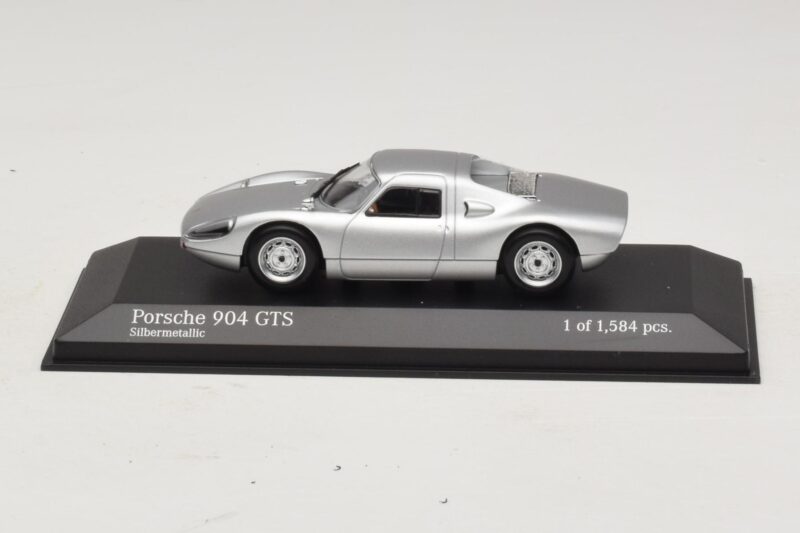
TL;DR: Minichamps' 1:43 diecast Porsche 904 Carrera GTS in Silver reproduces the 1964 homologation special, built to qualify for GT racing with a bonded fibreglass body over a steel platform chassis, a construction unique among road-going Porsches of its era. The casting is a sealed, one-piece shell, rendering that low coupe body as fixed painted surface.
GT racing regulations of the early 1960s required manufacturers to build a minimum production run before a car could compete, and the 904 was Porsche's answer: a purpose-built coupe designed by Ferdinand Butzi Porsche, styled with a low, tapering nose for genuine aerodynamic benefit rather than mere appearance, and constructed to meet the homologation number while still being fast enough to win outright.
The real 904 was unusual for bonding its fibreglass body directly to a steel platform chassis using structural adhesive, a construction method Porsche adopted partly for rigidity and partly because it suited the low production numbers homologation demanded. Rendering that in diecast means the model, unlike the original, is a single metal casting rather than a bonded composite, but the sealed body suits the subject well regardless: the 904's value on a shelf is its shape, not its material, and a fixed zinc alloy shell holds that shape's low nose and tapering tail with more dimensional stability over years of display than a lighter material would.
Silver was a common competition and press-photograph finish for the 904, and on this casting it shows off the body's surfacing rather than hiding it under a bolder colour. The nose tapers dramatically from the windscreen forward, the rear deck sits almost flat behind the engine cover, and the wheel arches sit tight around the tyres with minimal visual clutter, a shape that rewards a paint finish which lets light travel cleanly along its length. Shut lines at the doors and the front and rear lids hold consistent width across the body, one of the clearer signs of a well-tooled casting at this scale.
Homologation rules for GT racing in the early 1960s required a defined minimum number of a model to be built before it qualified to compete in that class, closing off the loophole of one-off prototypes racing against production-based rivals. The 904 was engineered specifically to hit that number while remaining genuinely competitive, using a mid-mounted four-cylinder engine derived from Porsche's existing range rather than a bespoke racing unit, which kept the car's cost and complexity within reach of the production run it needed. That balance between homologation requirement and outright competitiveness is what makes the 904 a significant car rather than simply a rare one.
The details worth checking first on a 904 casting are the nose's taper angle, the depth of the front air intake, and the rear deck's near-flat profile behind the engine cover, three shape cues that a lazy tooling job tends to round off or exaggerate. The greenhouse, the glazed area around the cabin, is also unusually low and shallow compared with contemporary GT cars, and getting that proportion right is what separates a genuinely accurate 904 from a generic 1960s coupe wearing the right badge. None of this comparison depends on anything opening, since the 904's identity is entirely a matter of its exterior surfacing.
A silver 904 GTS earns a place on a Porsche racing shelf that goes beyond decoration: it represents a specific regulatory moment, the point where homologation rules shaped a road-legal car's entire design brief, and the result happened to be one of Porsche's most distinctive shapes. It sits well alongside 356 and early 911 road cars as the racing counterpoint to that lineage, or alongside later 911-based competition cars as an earlier chapter in the same story. The sealed casting requires no adjustment before display, and at the 1:43 diecast tier it offers a genuinely significant subject without the cost of a larger-scale or resin alternative, making it one of the stronger value propositions here for buyers who care about the history behind the shape as much as the shape itself.




Save £14.00