{"ajaxurl":"https:\/\/models118.co.uk\/wp-admin\/admin-ajax.php?lang=en_GB","nonce":"9b87cef9ee","homeUrl":"https:\/\/models118.co.uk\/","shopUrl":"https:\/\/models118.co.uk\/shop\/","cartUrl":"https:\/\/models118.co.uk\/cart-en-gb\/","checkoutUrl":"https:\/\/models118.co.uk\/checkout\/","skipCart":true,"collectionLimit":12,"i18n":{"addedToCart":"Added to basket","addToWishlist":"Add to wishlist","addedToWishlist":"Added to wishlist","removeFromWishlist":"Remove from wishlist","removedFromWishlist":"Removed from wishlist","undo":"Undo","error":"Something went wrong","loading":"Loading...","outOfStock":"Out of stock","viewCart":"View basket","proceedToCheckout":"Proceed to checkout","addedToCollection":"Added to your collection","reserved":"Added to your collection","soldOut":"Sold out","invalidEmail":"Please enter a valid email address","connectionError":"Connection error. Please try again.","tocToggle":"On this page","close":"Close","inCartTooltip":"Already in your basket \u2013 open your basket to check out","loginToSave":"Sign in to save this model","waitlistNotify":"Notify me","waitlistOnList":"On the waiting list \u2713","waitlistJoined":"You're on the waiting list. We'll email you the moment this model is available again.","waitlistRemoved":"Done \u2014 you're off the waiting list for this model.","waitlistRateLimit":"Too many attempts \u2014 please try again shortly","waitlistTurnstile":"We couldn't complete the check \u2014 please try again","waitlistError":"Sorry, something went wrong. Please try again in a moment."},"wishlist":{"loggedIn":false,"loginUrl":"https:\/\/models118.co.uk\/my-account\/","addAction":"models118_wishlist_add","removeAction":"models118_wishlist_remove"},"waitlist":{"loggedIn":false,"subscribeAction":"models118_waitlist_subscribe","toggleAction":"models118_waitlist_toggle","stateAction":"models118_waitlist_state"},"stats":{"models":2328,"brands":213,"manufacturers":128,"collectors":10000},"product":{"id":717828,"sku":"8145","condition":"used","availability":"out_of_stock","name":"Peugeot 203 Gris Clair Solido 1:18","brand":"Peugeot","manufacturer":"Solido","scale":"1:18","material":"Diecast","price":40,"regularPrice":40,"isOnSale":false,"savingsAmount":0,"stockQty":0,"stockStatus":"out_of_stock","isDiscontinued":true,"image":"https:\/\/models118.co.uk\/wp-content\/uploads\/2026\/06\/peugeot-203-gris-clair-solido-1-18-300x200.jpg","permalink":"https:\/\/models118.co.uk\/peugeot-203-gris-clair-solido-1-18-8145\/"}}
Cookies on Models118
We use cookies to remember your preferences, understand how the shop is used and show you models and offers that suit your interests. What you allow is up to you, and you can change it at any time.
Always active
The technical storage or access is strictly necessary for the legitimate purpose of enabling the use of a specific service explicitly requested by the subscriber or user, or for the sole purpose of carrying out the transmission of a communication over an electronic communications network.
The technical storage or access is necessary for the legitimate purpose of storing preferences that are not requested by the subscriber or user.
The technical storage or access that is used exclusively for statistical purposes.
The technical storage or access is required to create user profiles to send advertising, or to track the user on a website or across several websites for similar marketing purposes.
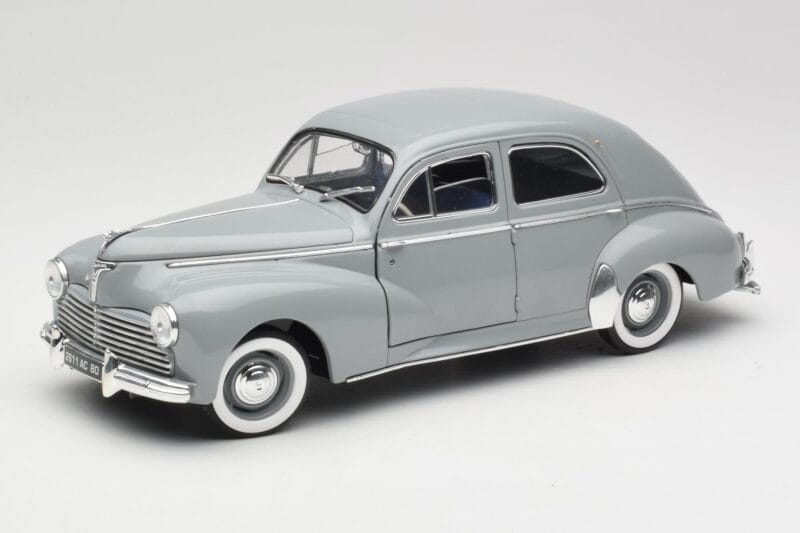
Solido's 1:18 diecast Peugeot 203 wears Gris Clair over the simple, upright body that made this France's defining postwar family saloon. A modest, honest replica for collectors building a European vintage classics display rather than chasing headline sports cars.
TL;DR: Solido's 1:18 diecast Peugeot 203 reproduces France's first true mass-production postwar saloon in Gris Clair. A straightforward zinc-alloy replica of the upright, unibody family car that put Peugeot back on French roads after the war.
Not every collectible needs to be exotic. The 203 was the ordinary car of ordinary French families through the 1950s, and that everyday honesty is precisely its appeal on a shelf.
Solido's Diecast Rendering of a French Family Saloon
The 203's upright roofline and rounded wings give this diecast simple, legible surfaces rather than the compound curves that push a manufacturer's tooling. Solido's zinc-alloy body carries the reassuring weight collectors expect from diecast construction, with doors that open on functional hinges rather than the sealed body a resin equivalent would use. Gris Clair paint sits flat and even, appropriate to a car whose original appeal was practicality over showroom drama. The proportions, tall greenhouse, modest overhangs, narrow track, read unmistakably as early 1950s European engineering rather than the longer, lower American saloons of the same period. This is not a piece built to impress from across a room; it rewards a closer look at a shape most collectors outside France rarely encounter.
The Peugeot 203 as Postwar France's Everyday Car
Launched as France was rebuilding, the 203 was Peugeot's first genuinely modern unibody design, replacing prewar architecture with something lighter and more efficient to build at scale. It sold in large numbers precisely because it asked little of its owners: simple mechanics, modest running costs, dependable service life. For a British collector, that makes it a useful contrast piece next to home-market saloons of the same decade, a reminder that France's postwar recovery had its own quiet automotive symbol, distinct from anything Austin or Morris was building at the time.
Create a free account and claim 10% off your first order — from hundreds of collectible 1:18, 1:43 and 1:12 models by Porsche, Mercedes-Benz, BMW and more.