{"ajaxurl":"https:\/\/models118.co.uk\/wp-admin\/admin-ajax.php?lang=en_GB","nonce":"67d70c6a5f","homeUrl":"https:\/\/models118.co.uk\/","shopUrl":"https:\/\/models118.co.uk\/shop\/","cartUrl":"https:\/\/models118.co.uk\/cart-en-gb\/","checkoutUrl":"https:\/\/models118.co.uk\/checkout\/","skipCart":true,"collectionLimit":12,"i18n":{"addedToCart":"Added to basket","addToWishlist":"Add to wishlist","addedToWishlist":"Added to wishlist","removeFromWishlist":"Remove from wishlist","removedFromWishlist":"Removed from wishlist","undo":"Undo","error":"Something went wrong","loading":"Loading...","outOfStock":"Out of stock","viewCart":"View basket","proceedToCheckout":"Proceed to checkout","addedToCollection":"Added to your collection","reserved":"Reserved!","soldOut":"Sold out","invalidEmail":"Please enter a valid email address","connectionError":"Connection error. Please try again.","loginToSave":"Sign in to save this model","waitlistNotify":"Notify me","waitlistOnList":"On the waiting list \u2713","waitlistJoined":"You're on the waiting list. We'll email you the moment this model is available again.","waitlistRemoved":"Done \u2014 you're off the waiting list for this model.","waitlistRateLimit":"Too many attempts \u2014 please try again shortly","waitlistTurnstile":"We couldn't complete the check \u2014 please try again","waitlistError":"Sorry, something went wrong. Please try again in a moment."},"wishlist":{"loggedIn":false,"loginUrl":"https:\/\/models118.co.uk\/my-account\/","addAction":"models118_wishlist_add","removeAction":"models118_wishlist_remove"},"waitlist":{"loggedIn":false,"subscribeAction":"models118_waitlist_subscribe","toggleAction":"models118_waitlist_toggle","stateAction":"models118_waitlist_state"},"stats":{"models":2106,"brands":206,"manufacturers":127,"collectors":10000},"product":{"id":1679653,"sku":"151015402","condition":"new","availability":"in_stock","name":"NSU Ro80 Yellow Minichamps 1:18","brand":"NSU","manufacturer":"Minichamps","scale":"1:18","material":"Diecast","price":123,"regularPrice":123,"isOnSale":false,"savingsAmount":0,"stockQty":2,"stockStatus":"very_low","isDiscontinued":false,"image":"https:\/\/models118.co.uk\/wp-content\/uploads\/2026\/09\/nsu-ro80-yellow-minichamps-1-18-151015402-1-1-300x200.jpg","permalink":"https:\/\/models118.co.uk\/nsu-ro80-yellow-minichamps-1-18-151015402\/"}}
Cookies on Models118
We use cookies to remember your preferences, understand how the shop is used and show you models and offers that suit your interests. What you allow is up to you, and you can change it at any time.
Always active
The technical storage or access is strictly necessary for the legitimate purpose of enabling the use of a specific service explicitly requested by the subscriber or user, or for the sole purpose of carrying out the transmission of a communication over an electronic communications network.
The technical storage or access is necessary for the legitimate purpose of storing preferences that are not requested by the subscriber or user.
The technical storage or access that is used exclusively for statistical purposes.
The technical storage or access is required to create user profiles to send advertising, or to track the user on a website or across several websites for similar marketing purposes.
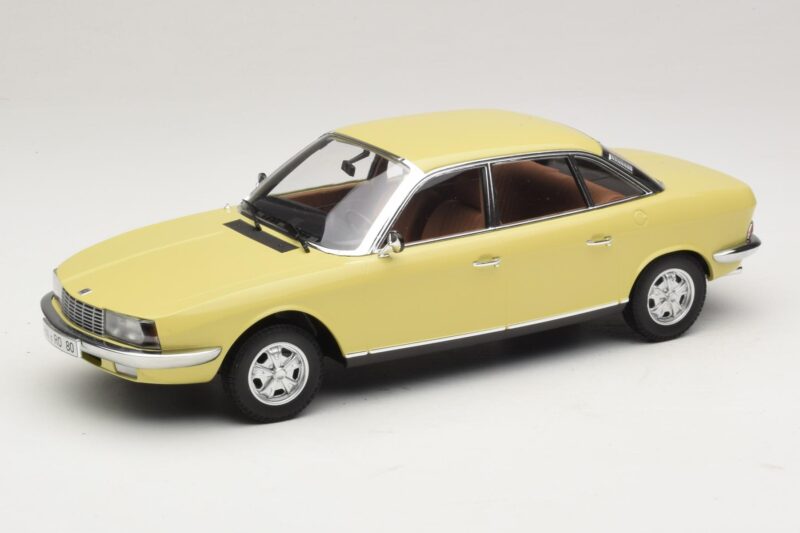
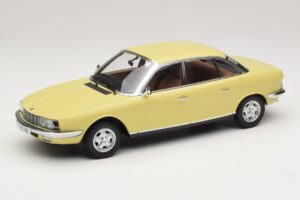
Minichamps' 1:18 diecast NSU Ro80 reproduces the twin-rotor Wankel sedan in yellow, a car whose aerodynamic bodywork was decades ahead of its 1970s contemporaries. The sealed zinc alloy body carries crisp shut lines and period-correct trim, with paint depth that holds up under direct light. The Ro80's distinctive tapering roofline is captured with genuine paint depth rather than a flattened, single-tone finish. A distinctive piece for collectors building a German engineering or 1970s sedan theme.
TL;DR: Minichamps' 1:18 diecast NSU Ro80 reproduces the yellow twin-rotor Wankel sedan from the early 1970s, a car whose slippery, low-drag bodywork anticipated aerodynamic trends by a decade. The sealed zinc alloy body holds crisp panel lines and period trim, a fixed casting that lets the paint and glazing carry the model's presentation.
Few 1970s sedans looked as unusual on the road as the Ro80, its long, tapering tail and minimal ornamentation chasing airflow rather than convention. NSU built its reputation on the twin-rotor Wankel engine inside, a technical gamble that gave the car startling smoothness and, ultimately, the reliability problems that would end the company's independence.
Minichamps' Sealed-Body Casting of an Aerodynamic Sedan
A Fixed Shell Built for a Slippery Shape
The Ro80's bodywork was designed around minimal drag rather than fashion, so a fixed zinc alloy casting suits it well, holding the tapering tail and low beltline as one continuous surface without a hinge line to interrupt the profile. Weight settles in the hand the way a metal casting always does, dense enough to anchor the model firmly against a shelf, and the panel gaps along the doors and boot read as single, consistent grooves rather than the wider tolerances a lower-tier casting would leave. That level of surface discipline matters more on a vehicle this plain, since there is no dramatic styling to distract from a soft or blurred casting line.
Yellow Paint, Chrome Trim, and Period Detail
The yellow finish carries genuine depth under direct light, with a metallic undertone rather than a flat, single-note colour, and the chrome window surrounds and bumper trim separate cleanly from the body paint rather than bleeding into it. Badge details on the nose and boot hold their lettering under close inspection, a small but telling sign of a mid-tier casting rather than a simplified toy-grade one. Against a mass-market alternative sold without any livery specificity at all, this attention to a single, correctly researched colour and trim scheme is what earns the model its place in a themed collection.
The Ro80's Rotary Engine and NSU's Costly Gamble
A Genuinely Advanced Design for Its Time
NSU launched the Ro80 with a twin-rotor Wankel engine driving the front wheels, a combination that gave the car smoothness and refinement well beyond typical family sedans of its era, paired with a low, wind-cheating body shape that European road testers praised at launch. The car's styling, credited to Claus Luthe, influenced sedan design well beyond NSU's own limited production run. Journalists at the time frequently compared its ride and cabin refinement to cars costing considerably more, a rare compliment for a mid-market German sedan.
Warranty Costs That Ended NSU's Independence
The rotary engine's rotor tip seals wore out faster than expected in everyday use, and NSU's decision to replace failed engines under warranty rather than lose customer trust drained the company's finances at a rate the car's sales could never offset. That financial strain led directly to NSU's merger into the Volkswagen group, folding the brand into what became Audi NSU Auto Union, and NSU production ended entirely within the decade. The episode remains a cautionary tale often cited in discussions of how a single component failure can outweigh genuine engineering achievement.
Where the Ro80 Fits on a German Engineering Shelf
This Ro80 suits a collection built around ambitious engineering rather than sales success, sitting naturally alongside other rotary-engined subjects or period German sedans that took real technical risks. At 1:18, the Ro80's long wheelbase and low roofline need a wider shelf slot than a compact hatchback of the same scale, so measure cabinet depth accordingly. Minichamps positions this comfortably at a mid-tier for classic German diecast, ahead of mass-market toy grids and appropriate for a car whose story is more interesting than its production numbers. Keep the model out of direct sunlight to protect the yellow paint's saturation over years of display, and rotate it periodically if shelved alongside brighter, more common classics.
Create a free account and claim 10% off your first order — from hundreds of collectible 1:18, 1:43 and 1:12 models by Porsche, Mercedes-Benz, BMW and more.