Back in stock
Save £4.00
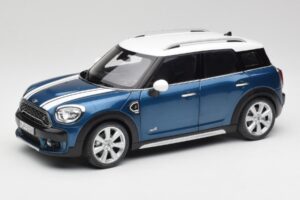
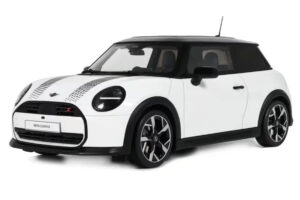
TL;DR: Otto's 1:18 resin Mini Cooper S F66 reproduces the newest Mini generation in Blazing Blue Metallic, built at Oxford, as a sealed one-piece body with fixed panels. It carries the Cooper S badge's Monte Carlo Rally pedigree into 2025, aimed at collectors who track the Mini nameplate's continuing hot hatch identity.
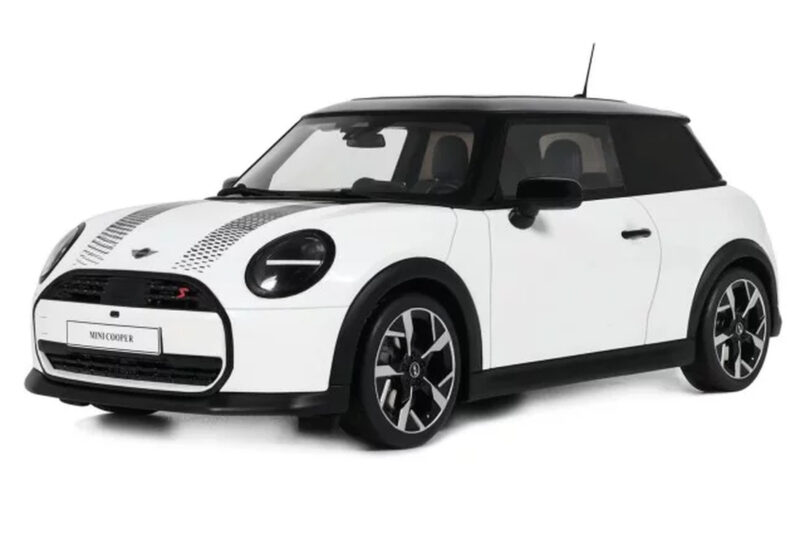
Resin tooling needs no steel die, which is why small manufacturers can have a car on a shelf months before diecast versions catch up. Otto's 1:18 Mini Cooper S F66 arrives while the new generation is still fresh from Oxford, its Blazing Blue Metallic body cast as one sealed shell rather than waiting on a pressed-metal production line.
The current Mini generation, internally coded F66 for the three-door hatchback, arrived as a substantial rework rather than a facelift, bringing a new interior architecture and a round central display that borrows more from Mini's electric models than from any previous Cooper. Despite the Bavarian ownership under BMW, the hatchback continues to be assembled at Oxford's Plant Cowley, the same site that has built Minis since the marque's relaunch under BMW at the turn of the millennium. That continuity matters to British buyers in a way it rarely does for other BMW Group products; the Mini name and Oxford production remain tightly linked in the public mind, even as the platform underneath has changed generation after generation. The Cooper S badge on this new car signals the turbocharged petrol version within the range, the direct successor to a lineage of sportier Minis that stretches back further than most hot hatch nameplates on sale today.
The Cooper S name goes back to the original Mini, when John Cooper's tuning input turned a humble economy car into a genuine rally weapon. Works Minis won the Monte Carlo Rally outright in 1964, 1965 and 1967, and famously finished first on the road in 1966 only to be disqualified over a headlamp technicality, a controversy still argued in British motoring circles decades later. That history is why the Cooper S badge has carried real weight on every Mini generation since, long after the original car's giant-killing days ended. Otto's Blazing Blue Metallic finish sits on a body shape that owes its basic silhouette, if not its underlying engineering, to that same idea: a compact hatchback with genuine sporting intent rather than badge-only decoration. The new F66 Cooper S inherits that expectation directly, and a scale model wearing the badge is, in a small way, part of the same continuous story.
Diecast tooling starts with a steel die, an expensive commitment that only pays off across a long production run, which is why mass-market diecast versions of a brand-new car typically arrive a year or more after launch. Resin works differently. A master pattern and a set of moulds get a small manufacturer to market far sooner, at the cost of the larger production runs diecast tooling eventually supports. That trade-off is exactly why Otto can put a 2025 Mini Cooper S on a shelf while the F66 generation is still the newest thing in Mini showrooms, rather than waiting for a die-cast rival to catch up years later. For collectors who like being first to a new nameplate, that head start is the whole appeal of buying resin over diecast on a car this new, whatever the eventual mainstream competition ends up looking like.
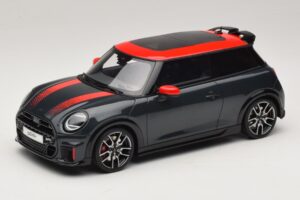
This casting has no opening doors, bonnet or tailgate. It is built as one fixed resin shell, which suits the new Mini's rounded, bulbous surfacing better than a body broken up by hinge lines would. The F66's design leans on tight, continuous curves across the roof and shoulder, a shape that reads best when nothing interrupts it. Blazing Blue Metallic carries genuine depth under direct light, the kind that shows the paint has real thickness rather than sitting as a thin coat over bare resin, and a sealed body lets that gloss run unbroken from the bonnet line to the tailgate. At roughly 21 centimetres nose to tail, the model is compact enough to sit comfortably among other 1:18 hatchbacks without the T-top-era heft that similarly detailed muscle car castings carry, a lighter, tighter package that matches the car it reproduces.
Blue metallics photograph unevenly under mixed lighting, showing flat and grey under fluorescent tubes and genuinely vivid under a single directed lamp, so where this model sits in a cabinet affects how good the colour looks more than most finishes on the shelf. A side-on spotlight brings out the metallic fleck across the roof and bonnet without washing out the darker shade in the door panels, the same effect that makes Blazing Blue a strong choice for a factory colour photographed at a car show. Because the body is sealed, there is no interior to light separately, so a single well-placed source does the whole job, simpler than arranging light for a model with an open engine bay competing for attention. At 1:18, the F66's compact footprint sits comfortably alongside earlier Mini generations from other manufacturers, letting a shelf trace the badge across three different ownership eras without needing three different scales to do it.
This Cooper S works best for a buyer already tracking the Mini nameplate across generations, or for someone who wants a genuinely current car on the shelf rather than another decades-old classic. It will not appeal to anyone hoping to pop the bonnet and inspect the turbocharged engine underneath; Otto built this one for the outside only, and that is worth knowing before ordering. What it offers instead is an accurate, well-finished record of the newest Mini generation in a colour that suits the shape, arriving on shelves well before most mainstream diecast competition. For a UK collector, a British-built hatchback wearing a badge with real rally history is a reasonable case for space on a Hot Hatches shelf.