Used
Back in stock

McLaren 12C GT3 #82 Russian Team A. Vasiliev / D. Vasiliauskas / M. Asmer / B. Spengler Spa 24 Hours 2014 Minichamps 1:43
Only 2 left
Price:
£40.00
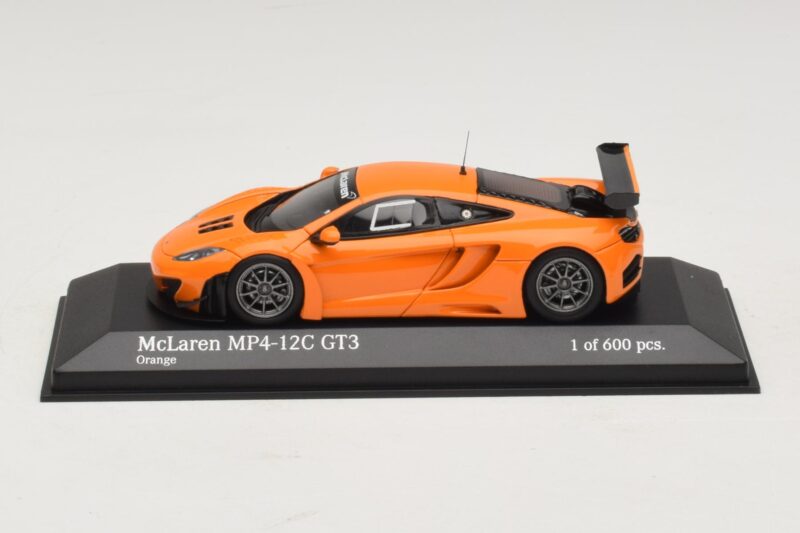
TL;DR: Minichamps' 1:43 diecast McLaren MP4-12C wears Street Orange, echoing the papaya colour McLaren has carried since its earliest Formula 1 days. The sealed body holds a clean coupe stance without interruption, giving collectors a vivid contrast piece built around the marque's identity rather than a specific race entry.
Orange has meant McLaren since Bruce McLaren's own cars ran papaya in the late 1960s, long before it became the team's modern Formula 1 identity again. Putting that colour on the MP4-12C, the road car that restarted McLaren's production line in 2011, ties the marque's racing history directly to its return as a serious supercar builder.
The casting is a sealed diecast shell, so the Street Orange finish runs across bonnet, roof and rear deck without a shut line breaking the colour's continuity. On a bright single-colour car that consistency matters more than it would on a livery built from separate sponsor panels, because any interruption in a strong orange would be immediately visible. The paint sits with genuine depth over the zinc alloy body, catching light along the car's swept roofline and side intakes in a way that a matte or poorly finished surface never could. Trim around the headlights and lower intakes separates cleanly from the body colour rather than bleeding into it.
Zinc alloy gives the model genuine heft in the hand, a density that signals proper diecast construction rather than a lightweight promotional piece. That mass helps Minichamps hold the MP4-12C's low, wide stance accurately, the car sitting close to the ground with wheel arches filled correctly by the road wheels rather than looking perched above them. The dihedral doors, a defining MP4-12C feature on the full-size car, are represented as part of the sealed shell here, with the shut lines moulded in tight and consistent rather than left wide the way a working hinge would demand.
The MP4-12C, launched in 2011, was McLaren's first series-production road car since the legendary F1 of the 1990s, built around a carbon monocoque tub and a McLaren-developed twin-turbo V8. It marked the start of what became a full model range rather than a one-off exercise, and its design language, low nose, sculpted air intakes, dihedral doors, carried through to every McLaren road car that followed. Choosing a bold colour like this for an early example says something about how McLaren wanted the car seen, not as a quiet alternative to Ferrari and Porsche, but as a distinct identity in its own right.
McLaren's association with orange goes back to Bruce McLaren's own racing cars in the late 1960s, when the papaya shade became the team's calling card well before McLaren's modern Formula 1 return to the same colour decades later. Applying that heritage tone to a road car rather than a race car is a deliberate statement, linking a modern supercar to a colour history most enthusiasts recognise instantly. For a collector building a shelf around brand identity rather than motorsport results, that connection carries real weight, and it is exactly why this Street Orange finish reads as more than a simple paint option.
Set beside McLaren's GT3 racers or its Formula 1 history at the same scale, this orange MP4-12C works as the road-car anchor of a McLaren-themed display, the piece that explains where the marque's design and colour language actually comes from. Its sealed body keeps that display role simple, with no hinge tolerance to loosen with handling over the years, just a clean shape that holds its stance indefinitely. At 1:43, several McLaren eras fit onto one shelf without demanding the space a run of 1:18 pieces would need, which makes this scale the practical choice for tracking the brand across road and race applications rather than committing to a single hero model.





Save £14.00