Used
Back in stock
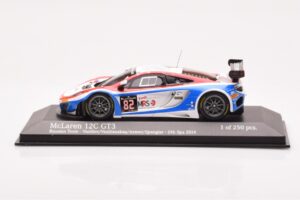
McLaren 12C GT3 #82 Russian Team A. Vasiliev / D. Vasiliauskas / M. Asmer / B. Spengler Spa 24 Hours 2014 Minichamps 1:43
Only 2 left
Price:
£40.00
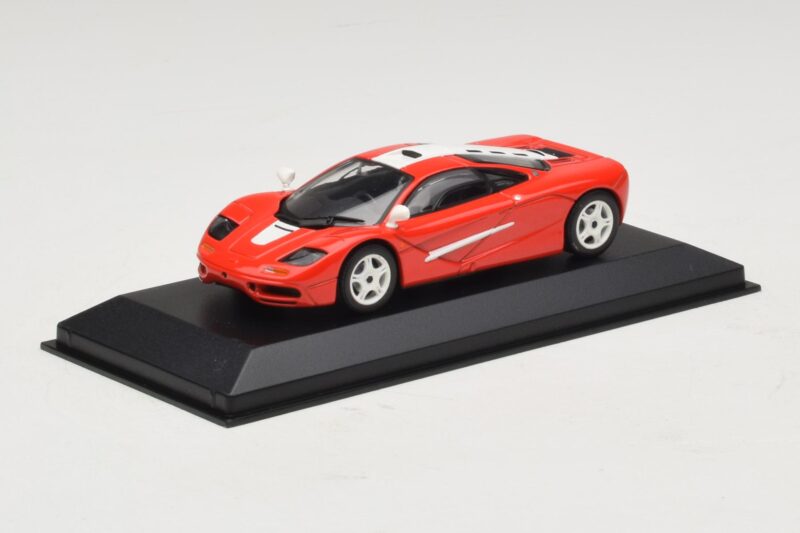
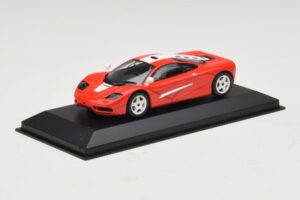
TL;DR: Minichamps' 1:43 diecast McLaren F1 reproduces the 1996 road car in red with white stripes, a striking two-tone treatment that pairs naturally with its black and yellow sibling. The sealed one-piece body holds Gordon Murray's low, wide stance, a compact way to add the marque's landmark hypercar to any display.
Two-tone stripe liveries have a way of making a familiar shape look freshly considered, and this red and white treatment gives Minichamps' McLaren F1 a different personality to its black and yellow sibling despite sharing an identical casting underneath. Before comparing the two, it is worth looking at what makes the shape itself worth reproducing twice.
Running a stripe cleanly over a shape as curved as the F1's roofline and rear haunches is no small feat for a 1:43 tampo print, and this red and white scheme holds its registration through the tightest transitions, over the roof, down the rear buttress and along the sill, without drifting off-line or showing a ragged edge. The sealed one-piece casting gives the print an uninterrupted surface to sit on, avoiding the small misalignment a bonnet or door shut line could introduce on a hinged body. White reads bright and clean against the red base rather than looking greyed out, a small but noticeable sign of careful colour separation in production.
The red base coat carries an even, deep gloss that lets the F1's subtle surfacing catch light naturally, particularly around the wheel arches and the car's distinctive central roof scoop, a detail unique to the F1 among road-going supercars of its era. Panel lines are engraved with the same consistent spacing seen on the black and yellow version, confirming both liveries share an identical, well-resolved base casting rather than one being a simplified variant of the other. The dihedral door line reads as a single clean seam rather than a functioning hinge, keeping the flank uninterrupted beneath the stripe.
Gordon Murray's decision to place the driver in the centre of the F1's cabin, flanked by two passenger seats set slightly back, remains one of the most distinctive packaging choices ever put into production, and it shaped the car's narrow nose and symmetrical proportions from the outset. The carbon fibre monocoque underneath was similarly uncompromising for a road car of the early 1990s, drawing directly on motorsport construction rather than adapting an existing platform. Both liveried versions of this model share that same fundamental shape, a reminder that great packaging can outlast whichever paint scheme happens to sit on top of it.
A bespoke BMW-built V12 with no forced induction gave the F1 its distinctive high-revving character, prioritising throttle response and driver feel over the turbocharged approach many rivals eventually took. That combination of light weight and a free-breathing engine let the F1 hold the outright production car speed record for years after its launch, a benchmark still referenced whenever the conversation turns to naturally aspirated performance. None of that history depends on an opening bonnet to communicate; the proportions, low nose, long tail, minimal overhangs, do the talking on a shelf regardless of which stripe colour sits on top.
Displayed together, the red and white F1 and its black and yellow sibling make a genuinely effective pairing, two distinct stripe treatments over an identical, well-resolved casting, letting a collector show variety without needing two different tooling runs to justify the comparison. At 1:43, both sit comfortably among GT3 racers and other 1990s hypercars without dwarfing them, a useful scale for anyone building a themed run rather than committing shelf space to a single hero piece. The sealed body keeps handling simple for both castings, with nothing to realign or loosen over years of display. For UK collectors whose interest runs toward road-going engineering landmarks as much as liveried racers, having both stripe colours side by side offers a small but satisfying way to appreciate the same design from two different angles.
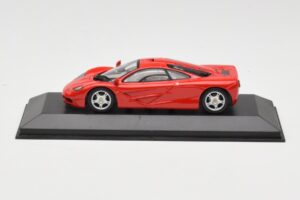




Save £14.00